Marina Yee M.Y.: Small Changes, Lasting Clothes
Existing coats, handwork and the care involved in changing a garment.
ÉPOPLI ·
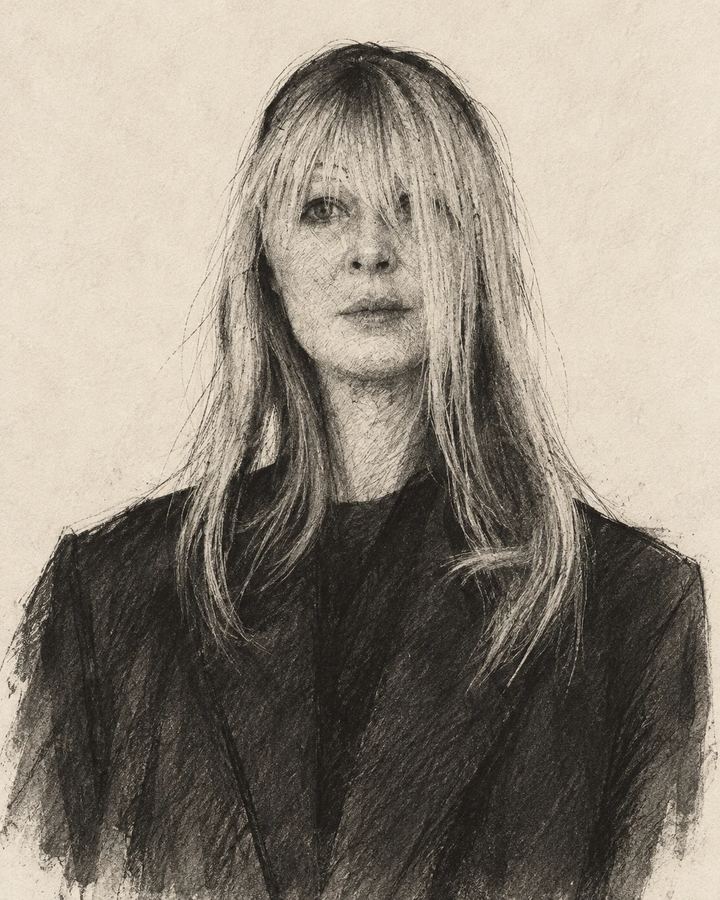
Looking again at an existing coat
The small collection presented in Tokyo in 2018 began with recognisable sailor coats, trench coats and parkas. Marina Yee M.Y. history asks whether novelty requires an entirely new archetype. Studying vintage coats led her towards altered folds and handwork. A changed collar or sleeve position reorganises space around the body while leaving the garment recognisable. Her folding techniques redistribute existing fabric rather than simply adding decoration.
Early work and Marie
Born in 1958, she graduated from Antwerp’s Royal Academy in 1981 and worked for Bassetti and Gruno & Chardin. Marina Yee M.Y. history also includes Marie, launched with a Japanese business partner in 1986, and the Antwerp Six’s international emergence. In 1990 she distanced herself from the industry and ran a Brussels café that doubled as a creative space. Work for Lena Lena and Dirk Bikkembergs womenswear, theatre costumes and painting followed. Reduced runway visibility did not mean the end of making.
People who supported a return
Laila Tokio’s Hideo and Yukiko Hashiura sought her out and supported the 2018 presentation. Marina Yee M.Y. history includes that recognition alongside her own initiative. In 2021 she established M.Y. Collection with Rafael Adriaensens, whose studio and sales work connected making with customers. Sonja Noël of STIJL had supported her early career. These relationships mattered to a practice in which small production still required organisation and distribution. Altering vintage coats and bringing them to an audience were different kinds of work.
Caban stitches and white cotton
The M.Y. Caban directs attention to hand stitching across a familiar naval coat. Marina Yee M.Y. history treats such marks as structural clues. She connected the front detail with Fernand Khnopff’s portrait of his sister in white. Thick white cotton also shifted roles between shirt and lightweight outerwear. These folding techniques made plain material behave unexpectedly. The trench-related M.Y. Imper similarly retained a known form while introducing subtle changes. Recognition made those differences meaningful.
Unique alterations and small series
The process of upcycling gives discarded or redundant materials another use. Marina Yee M.Y. history distinguished handmade Upcycle Couture pieces from the PRO Collection’s reproducible designs, sometimes made in limited runs from leftover cloth. Existing sleeves, collars and buttons constrain vintage coats. Her folding techniques work with those conditions. An autumn/winter 2024–25 sleeveless jacket assembled separate pieces; a spring/summer 2025 denim jacket displayed a repair made with old jeans. Not every product therefore followed an identical recycling process.
Art and teaching
The 2018 Tokyo work E. SHE brought together small things gathered during her stay. Marina Yee M.Y. history extends upcycling beyond garment production into a broader practice of rearranging existing matter. She also taught in Tournai, Ghent and The Hague, encouraging observation, sensory awareness and making. Concentrating on a principal intervention rather than loading every idea onto one silhouette connected her teaching with her own work. Simplicity required practice rather than the absence of thought.
Final work and posthumous attention
She received the Belgian Fashion Awards Jury Prize in 2024 and continued working before her death on 1 November 2025. Marina Yee M.Y. history separates that lifetime practice from subsequent exhibitions. Gallery Sofie Van de Velde presented her work posthumously in 2026, including the visual art that accompanied clothing. The concept of upcycling alone cannot explain the precision of her construction. Repairs, asymmetric collars and small folds reveal decisions about what to preserve and what to change. Her legacy includes sustained attention to clothes already in existence.
Timeline
- 1958 — Born
- 1981 — Graduated from Antwerp academy
- 1986 — Marie label launched
- 1990 — Distanced herself from the industry while continuing creative work
- 2018 — M.Y. Project presentation in Tokyo
- 2021 — M.Y. Collection established
- 2024 — Belgian Fashion Awards Jury Prize
- 2025 — Died on 1 November
- 2026 — Posthumous gallery exhibition
Sources
- MoMu — Marina Yee
- MoMu — In memoriam, 1958–2025
- Vogue — 2018 direct interview
- Them Magazine — 2018 direct interview
- Tomorrowland — Direct interview, published 2023
- 1 Granary — Direct interview, 2025
- Gallery Sofie Van de Velde — Posthumous exhibition, 2026
- Gallery Sofie Van de Velde — Artist record