Jacques Doucet: Materials and a Collector’s Eye
Metallic dress, layered outerwear and Réjane’s white tea gown.
ÉPOPLI ·
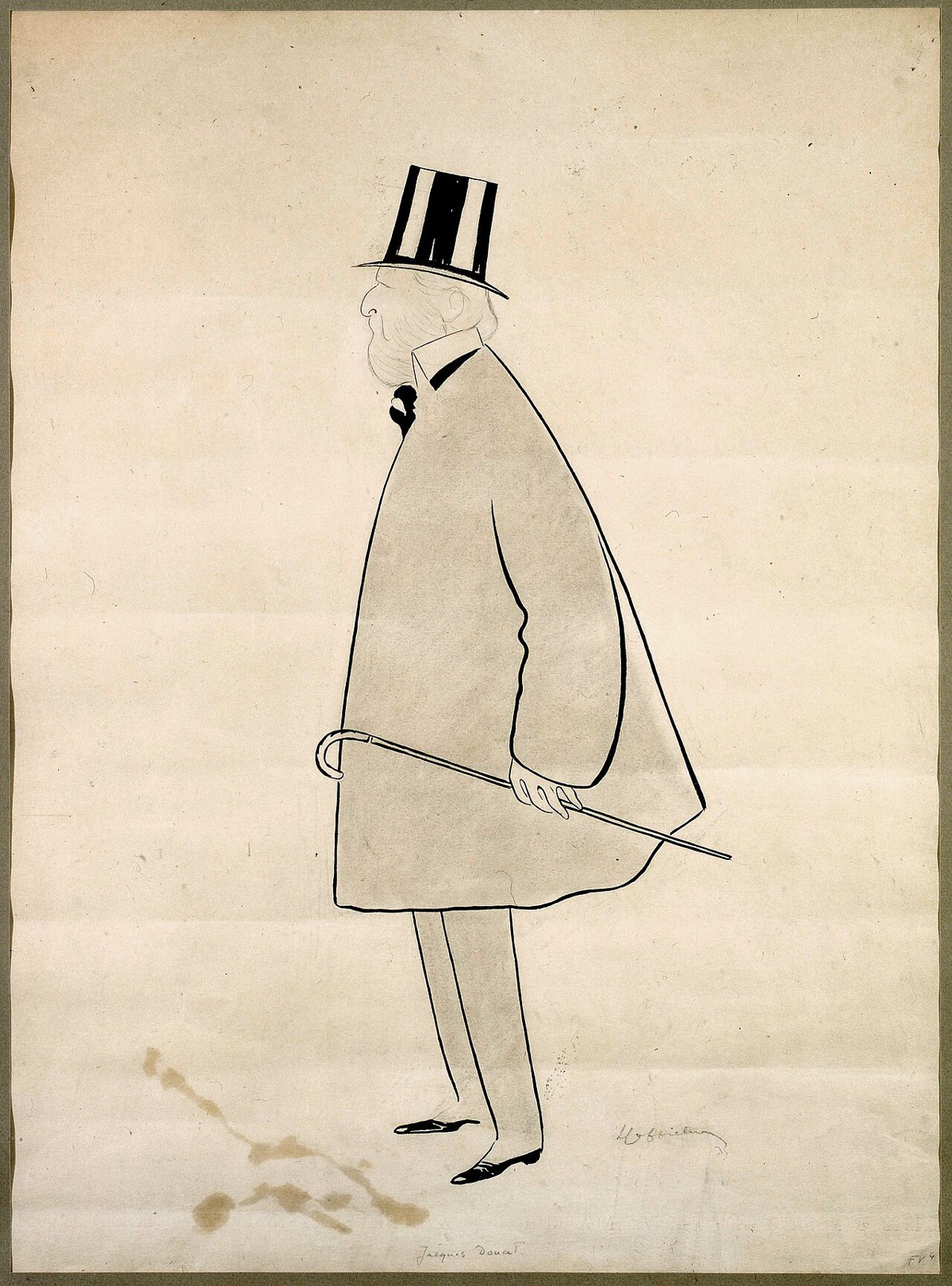
A surface that gathers light
Jacques Doucet history can begin with an evening gown dated 1898–1900. The Metropolitan Museum describes lamé and ten different metallic materials in its decoration. Lamé introduces metallic brilliance into cloth, but the effect here is more complex than a uniformly shiny fabric. Different reflective elements respond differently to movement. The museum also records damage: not every irregularity visible today represents an original design decision. An evening gown rewards close inspection while making an impression across a social room. The useful question is how materials are organized on the body, and whether their decoration obscures or clarifies its outline.
Transforming an inherited business
Born in Paris in 1853, he grew up within a family business dealing in men’s shirts and women’s lace and lingerie. Jacques Doucet history does not follow a simple story of founding a company from nothing. His parents Édouard and Mathilde already operated in this trade. INHA dates his entry into the business to about 1875 and his inheritance after his father’s death to 1898. The firm’s origin and his personal career are therefore different dates. Fine finishing near the skin offers a context for the later clothes, but not proof of a psychological origin for every preference. The sources establish the expansion of an existing business into couture; they do not supply a detailed formal education to be invented in retrospect.
Layers around the shoulders
An evening cape of 1900–1905 offers another entry into Jacques Doucet history. Associated with Caroline Schermerhorn Astor Wilson, the Met object brings lace, pink chiffon and sparkling ornament into layers. A cape spreads from the shoulders rather than dividing the arms into separate sleeves, making the relationship between weight and fall especially important. Open lace exposes another layer and creates actual depth. A broad outline can coexist with apparently delicate components. The material field lists wool, silk and rhinestones, so it should not all be described as one silk textile. Worn above an evening gown, the cape both covers another design and independently shapes the appearance of arrival and departure.
Réjane in white
A tea gown of about 1898 associated with the actress Réjane offers a quieter side of Jacques Doucet history. Palais Galliera attributes the garment to him but records its missing label; attribution must not become certainty. White cotton voile, machine-made lace insertions and white rose embroidery form the garment. Voile is a light, thin fabric, and a tea gown served comparatively informal entertaining at home. Different densities create pattern without strong colour contrasts. Informality is still a mode of presentation. Galliera describes his personal attention to Réjane’s fittings, a relationship in which comfort and social expression were not necessarily opposites.
Clients and the workshop
Jacques Doucet history includes Paul Poiret, Madeleine Vionnet and the model-maker José de La Peña de Guzman, as well as Charles Pardinel in management. A couture name coordinated different kinds of work rather than replacing them. Clients also acted on the results. Galliera describes Sarah Bernhardt altering costumes to shape her own appearance. The anonymous costume illustrating that discussion should not consequently be relabelled as a Doucet work. A documented client relationship is not proof of the maker of every surviving object. Records around Bernhardt and Réjane instead show clothing acquiring meaning through fittings, performances and photographs, each with different demands on silhouette and finish.
Collecting is another activity
Art collecting and patronage belong to Jacques Doucet history, but a picture in his possession is not automatically the source of a dress. INHA documents a movement from eighteenth-century holdings toward modern and contemporary art around and after the 1912 sale. Comparing the selection of objects with the combination of clothing materials can be productive; a direct influence requires further evidence. Two INHA pages give different years, 1923 and 1924, for the acquisition of Picasso’s major painting, so no single date is asserted here. A documented change in collecting does not prove that clothing changed at precisely the same pace. The commercial clientele and the audience for a private collection were different.
A library outlives a career
He sold the couture business in 1925 and died in 1929. Jacques Doucet history must separate his working lifetime from subsequent uses of the name. The art-historical library and literary holdings preserve it through another activity: enabling future research with books, manuscripts, photographs and records. Clothes benefit from similarly precise reading. An object number, material list, wearer and date range turn a vague idea of Belle Époque elegance back into a particular thing. Metallic surfaces in an evening gown, the depth of a cape and the contrasting densities of a white tea gown surround the body differently. His contribution is better understood through this material and social precision than reduced to the invention of one silhouette.
Timeline
- 1853 — Born in Paris
- c.1875 — Joined the family business
- 1898 — Inherited the business after his father’s death
- 1925 — Sold the couture business
- 1929 — Died
Sources
- INHA — Jacques Doucet biography
- The Met — Evening dress 1898–1900
- The Met — Evening cape 1900–1905
- Galliera — Sarah Bernhardt and costume attribution
- INHA — Catalogue of Doucet collections
- Galliera — Anatomie d’une collection, Réjane tea gown (PDF)