Halston: The Construction Behind Ease
The Construction Behind Ease.
ÉPOPLI ·
A washable fabric enters a polished wardrobe
A tan Ultrasuede shirt dress from 1972, preserved at the Museum at FIT, offers a practical starting point for Halston house history. Its familiar collar and front opening recall a man’s shirt, but the length and proportions turn it into a complete outfit. The synthetic material could be washed, connecting the design’s appearance to the labor of caring for it.
The garment demonstrates that luxury can be communicated through a controlled outline rather than conspicuous ornament. The opening begins lower than a conventional shirt collar fastening, altering the frame around the face and chest. The waist can be organized without making the whole body rigid. These small decisions are easy to overlook in photographs of the designer’s famous social circle, yet they explain why the clothes became useful to customers beyond that circle.
A milliner learns to frame the face
Roy Halston Frowick, born in 1932, developed his early career in millinery. Work in Chicago preceded his move to New York and employment with Lily Daché, followed by Bergdorf Goodman. Halston house history reaches a highly public moment with the pillbox hat worn by Jacqueline Kennedy at the 1961 presidential inauguration.
A hat changes the relationship between face, hair and the rest of an outfit. Its apparent simplicity can require exact decisions about scale and placement. The inauguration made one design widely visible through photographs and television, but the professional work involved fitting clients and producing pieces within a department-store salon. Those relationships later helped support the transition into clothing. Millinery was therefore a substantial first career, not merely a decorative prelude to the evening gowns for which he is now remembered.

The label expands from head to body
The move into ready-to-wear and an independent business in the late 1960s changed the scale of Halston house history. A complete outfit had to negotiate movement, different body proportions and the practical relationships between separate garments. Cashmere tops, jackets and trousers supplied a relatively spare daytime vocabulary.
The shirt dress is one result of that approach. It borrows a recognizable form and edits it rather than assembling many unrelated details. Later uses of Ultrasuede, including coats and a quilted pantsuit represented in the FIT exhibition, show that the same material could support several kinds of surface and volume. The designer’s contribution should not be confused with inventing the textile itself. It lay in choosing how the material could function within a particular wardrobe and making that use publicly recognizable.
One seam can organize a body
A sarong dress changes the question from the appearance of a shirt to the movement of wrapped cloth. Halston house history follows the red silk-crêpe example dated around 1976 and a gold hammered-satin version from the same year in FIT’s collection. The museum describes sophisticated construction using a spiral seam and carefully controlled draping.
The seam is not merely a line joining two edges. It determines how the cloth travels around the torso and where fullness gathers or releases. The two materials respond differently to light: one offers a comparatively subdued surface, while the other adds a shifting gleam. The design can remain spare even when the effect is sensuous and visually rich. Comparing versions helps explain why apparent ease may depend on highly specific cutting rather than on using very little technique.
Performance, jewelry and a social image
The designer’s friendships with performers and models helped circulate the clothes, but Halston house history also includes collaborators whose objects changed the finished look. Elsa Peretti’s work ranged from jewelry to the bottle for the house fragrance. A metal-mesh halter in the FIT exhibition shows how an accessory designer’s contribution could become a garment-like surface.
The 1973 Versailles benefit presentation placed American ready-to-wear before an international audience. Models, music and the rhythm of the presentation mattered to its impact. Nightclub photographs later supplied another setting in which flowing garments could be seen moving. Neither event should replace the construction history. The social image explains how the clothes were received, while the surviving objects reveal the work that allowed the wearer to turn, dance or sit without losing the intended outline.
Commercial reach and creative control
Halston house history also records the sale of the business to Norton Simon and the later Halston III arrangement with J.C. Penney. These changes expanded distribution but complicated the relationship between a prestigious designer name and different retail markets. A product’s price, store and audience contribute to how the same name is understood.
During subsequent corporate changes, the founder lost control of designing under his own name. The distinction between personal authorship and ownership of a trademark became painfully concrete. It is too simple to explain this entire history through a single collection or a story of personal excess. Contracts, management and the structure of the business were material factors. The episode remains relevant when a designer’s identity becomes an asset that can be sold and directed by others.
Two surfaces under light
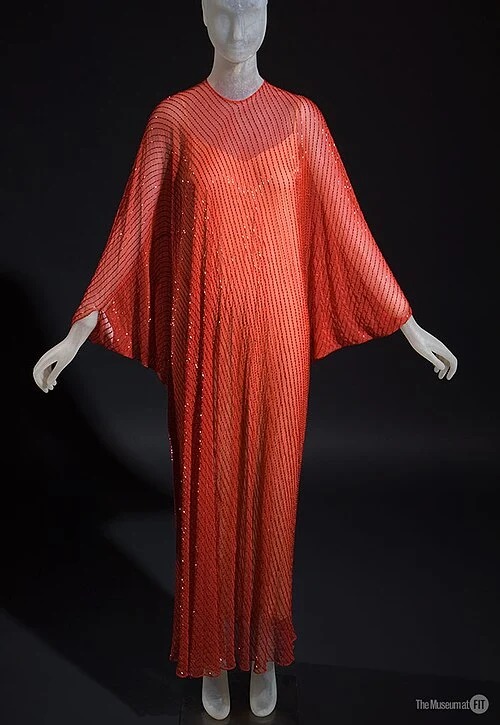
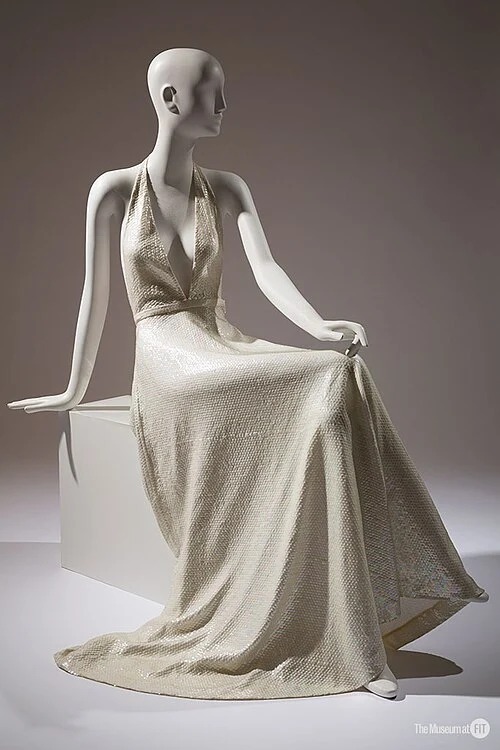
The photographed dress of 1974 and red dress of about 1977 use light differently. The former emphasizes a pale continuous surface and long fall of fabric; the latter establishes a vertical rhythm through repeated beaded decoration. The useful question is how that surface treatment changes the fall of the textile, rather than simply how much decoration has been added. Museum photographs also make sleeves and hems available for comparison when those details might disappear into a social photograph’s background.
Looking past the nightclub photograph
Halston died in 1990. Halston house history separates his own designs from the later products and revivals of the label. The founder’s legacy is particularly clear when an everyday garment is compared with a fluid evening piece: one establishes a recognizable outline, while the other lets the fabric describe the body through movement.
A sarong dress, a simple cashmere layer and a carefully placed hat solve different problems, but each concentrates attention rather than scattering it. The most useful question is where the apparent simplicity comes from. A fastening may have been removed, a seam redirected or a material chosen to do work that an internal support would otherwise perform. Examining those decisions returns the designer to the workroom and gives the clothes a history more substantial than their association with famous parties.
Timeline
- 1932 — Born Roy Halston Frowick
- 1959 — Joined Bergdorf Goodman millinery
- 1961 — Jacqueline Kennedy wore his inaugural pillbox hat
- Late 1960s — Independent clothing business developed
- 1972 — Ultrasuede shirtdress
- 1973 — Versailles benefit presentation
- 1976 — Silk sarong dresses documented by FIT
- 1990 — Died
Sources
- Museum at FIT — Yves Saint Laurent + Halston, objects and construction
- Museum at FIT — Halston career timeline (PDF)
- Museum at FIT — Halston and Madame Grès
- Image and object record — Halston, red beaded nylon dress, about 1977. The Museum at FIT, 82.3.1.
- Image and object record — Halston, sequined polyester dress, 1974. The Museum at FIT, 80.128.12.

Related reading
Fashion History · Charles James · Claire McCardell · Designers