Charles James: The Space Inside a Ball Gown
The Space Inside a Ball Gown.
ÉPOPLI ·
A hemline seen from above
The four lobes of the 1953 Clover Leaf gown offer a direct entrance into Charles James house history. Instead of treating the skirt as a simple circle around the wearer, the design extends and recedes in a controlled sequence. The outline changes as the viewer moves around it. Its shape is not explained by the outer fabric alone.
The gown uses several coordinated layers, including a slip and shaped supporting components. Each has a different task in maintaining the silhouette. A beautiful surface is the visible result of an arrangement that also has to balance weight and permit the wearer to stand and move. The space between cloth and body is therefore part of the design, not an accidental gap beneath a large skirt.
Millinery before dressmaking
Born in Surrey, England, in 1906, James grew up with British and American family connections. He began as a milliner in Chicago in 1926 under the name Boucheron, then worked in New York, London and Paris. Charles James house history follows an unconventional professional path without formal dressmaking training.
Making a hat presents a compact problem of volume, balance and attachment. His later clothing pursued related questions at a much larger scale. That relationship does not mean that a gown can be designed exactly like a hat, but it makes the early work relevant to his interest in shaping space. Clients and artistic acquaintances provided opportunities as the business developed. The movement between cities also placed him in contact with different expectations of custom dress, fashion presentation and patronage.

The workroom in New York
After settling permanently in New York in 1939, he worked briefly with Elizabeth Arden before establishing his own workroom and salon. Charles James house history includes clients such as Dominique de Menil and Austine Hearst, whose support mattered both during his career and in preserving it afterward. Custom work allowed repeated fitting and revision for a particular person.
This method could conflict with the deadlines and consistency expected in a larger ready-to-wear enterprise. A shape refined over many trials is not automatically easy to reproduce in a range of sizes. His business difficulties should be discussed through those practical circumstances and documented events rather than through speculative diagnoses of temperament. The clothes reveal a sustained investigation, but the continued existence of a commercial workroom required resources beyond the development of an exceptional sample.
Four lobes and a controlled center
The Clover Leaf design is the most familiar example in Charles James house history, but its effect becomes clearer when the center and edge are considered separately. The fitted upper portion establishes a relatively narrow reference point. The skirt then projects outward into its alternating lobes, making the waist seem more concentrated by comparison.
The Met describes the use of layered components to create this form. An internal structure does not merely make the dress larger; it determines where the volume appears and how it is supported. A photograph from the front cannot communicate the entire geometry. Side, back and overhead views reveal different relationships. The gown is consequently a strong example of why a garment archive needs more than a single glamorous image: construction records and multiple viewpoints explain the decisions that produce the silhouette.
Butterfly and Diamond are different answers
The 1955 Butterfly gown and the 1957 Diamond dress provide contrasting paths through Charles James house history. Butterfly concentrates a profusion of layered tulle around the lower body, creating a substantial volume behind a closely shaped upper section. Its visual lightness does not mean that the physical garment is weightless; the museum records a considerable quantity of material.
Diamond offers a comparatively spare, close-fitting outline. Looking at the two together prevents the designer’s work from being defined only by enormous skirts. One design emphasizes the expansion of cloth away from the body, while the other relies on the precise organization of the surface near it. Both involve geometric cutting, but they distribute attention differently. The comparison makes visible a repeated problem pursued through different solutions rather than a single silhouette copied throughout a career.
Seams as evidence of a method
Charles James house history also includes coats, suits and more restrained daywear. Their collars, sleeves and seams reveal questions that can be difficult to see beneath a richly layered ball gown. A seam can redirect the grain of a fabric, change the contour or bring together pieces with different degrees of fullness.
The relationship between geometric cutting and material behavior is essential. A pattern drawn on paper describes an arrangement, but the cloth adds weight, flexibility and thickness. Supporting one area may allow another to appear freer. An internal structure can be rigid in one garment and unnecessary in another when the cut and textile hold the desired form. The designer’s surviving patterns and trial garments help distinguish these methods, giving substance to the often vague description of clothing as sculptural.
The long line of the 1934 wedding dress
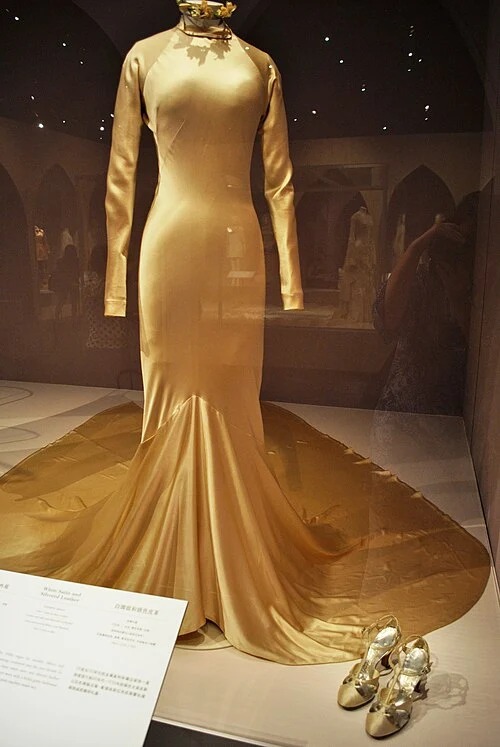
The 1934 wedding dress for Baba Beaton has a different outline from the later expansive ball gowns. A high neck and long sleeves lead into a close line that opens farther down the body. The point at which the skirt’s volume begins changes the impression of the whole figure. Expansion around the waist and expansion below the knee create different spaces, even within the category of a long dress. This earlier example shows that the later large volumes were not the designer’s only constructional solution.
Preserving unfinished questions
James left his showroom and workroom in 1958 and continued working in reduced circumstances, spending his later years at the Chelsea Hotel. He died in 1978. Charles James house history includes his deliberate efforts to preserve garments, patterns, sketches and related material through the Brooklyn Museum. Those holdings later became part of the Metropolitan Museum’s Costume Institute.
The archive records more than completed luxury objects. It preserves evidence of adjustment, repetition and the return to earlier ideas. That makes the legacy useful even for readers who will never wear a custom ball gown. The central questions remain accessible: where is the garment supported, how does it move, and what does the outline conceal? By answering them through actual objects and construction records, the work can be understood beyond the reputation of an eccentric genius.
Timeline
- 1906 — Born in Surrey, England
- 1926 — Began millinery work in Chicago
- 1939 — Settled permanently in New York
- 1953 — Clover Leaf gown
- 1955 — Butterfly gown
- 1957 — Diamond dress
- 1958 — Left the established showroom and workroom
- 1978 — Died
Sources
- The Met — Charles James, biographical and technical essay
- The Met — Clover Leaf, construction account
- The Met — Clover Leaf, 1953
- The Met — Butterfly, 1955
- The Met — Diamond, 1957
- The Met — Charles James: Beyond Fashion
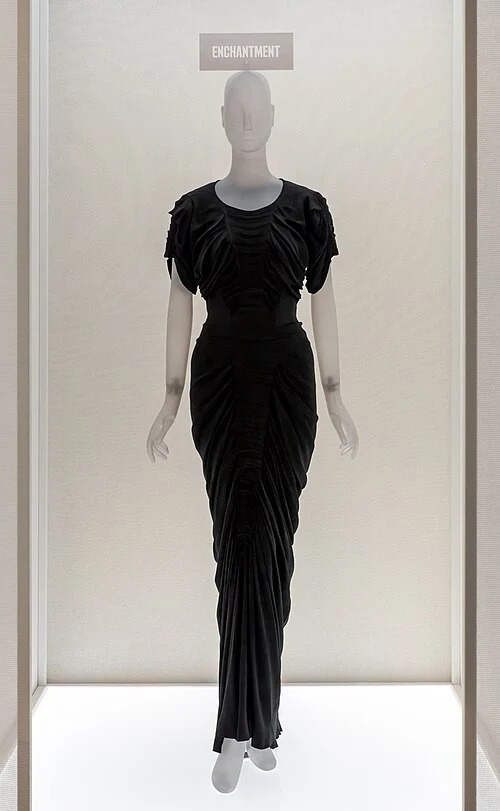
- Image and object record — Charles James, La Sirene dress, 1941. Displayed at The Metropolitan Museum of Art.
- Image and object record — Charles James, wedding dress designed for Baba Beaton, 1934.
