Pucci: Colour and Clothes in Motion
Pucci’s story is more than a story of bright resort patterns.
ÉPOPLI ·
- Brand
- Pucci
- Origins
- Florence, Capri and clothes for movement
- Focus
- Luxury fashion
Pucci: Colour and Clothes in Motion
Pucci history is more than a story of bright resort patterns. The official chronology dates Emilio Pucci’s brand to 1947 and his first Capri boutique to 1950. Ski clothing and a moving body were part of its beginning. Instead of projecting today’s familiar colours backwards, consider what sport, travel and rest ask of clothes. A travelling garment spends time packed away as well as on a body. Those practical conditions met a strong graphic language. Recognising print is therefore only half the task: material behaviour matters too. Numerous colours can occupy a simple outline, whose restraint allows the surface to become more visually active.
America and textile development
Early connections with America mark a transition in Pucci history. The Metropolitan Museum describes the 1948 Lord & Taylor collection and collaboration with textile industrialist Guido Ravasi. A drawing does not become wearable cloth without decisions about sheen, drape and use. Jersey describes a knitted structure, not a particular fibre. Treating every design as one material obscures differences between early cotton garments and silk evening clothing. Fabric behaviour also changes the apparent design: lines narrow within folds, while spacing may shift where a surface stretches. Studying production therefore helps explain the graphic effect rather than distracting from it. Movement belongs inside the visual language.
The hand-painted cotton dress
A two-piece dress dated 1954–56 at the Powerhouse complicates familiar assumptions about Pucci history. Its orange cotton bustier and circle skirt carry hand-painted abstract decoration. A fitted upper and broad skirt share a surface language while responding differently to the body. One holds an outline; the other changes its visible field during movement. Hand painting should also be distinguished from a mechanically repeated print. The museum records Jennie Mackenzie’s purchase in 1956, preserving a wearer’s connection as well as a design date. Such evidence gives the object a route through actual lives, more specific than a general account of holiday glamour.
An evening in 1966
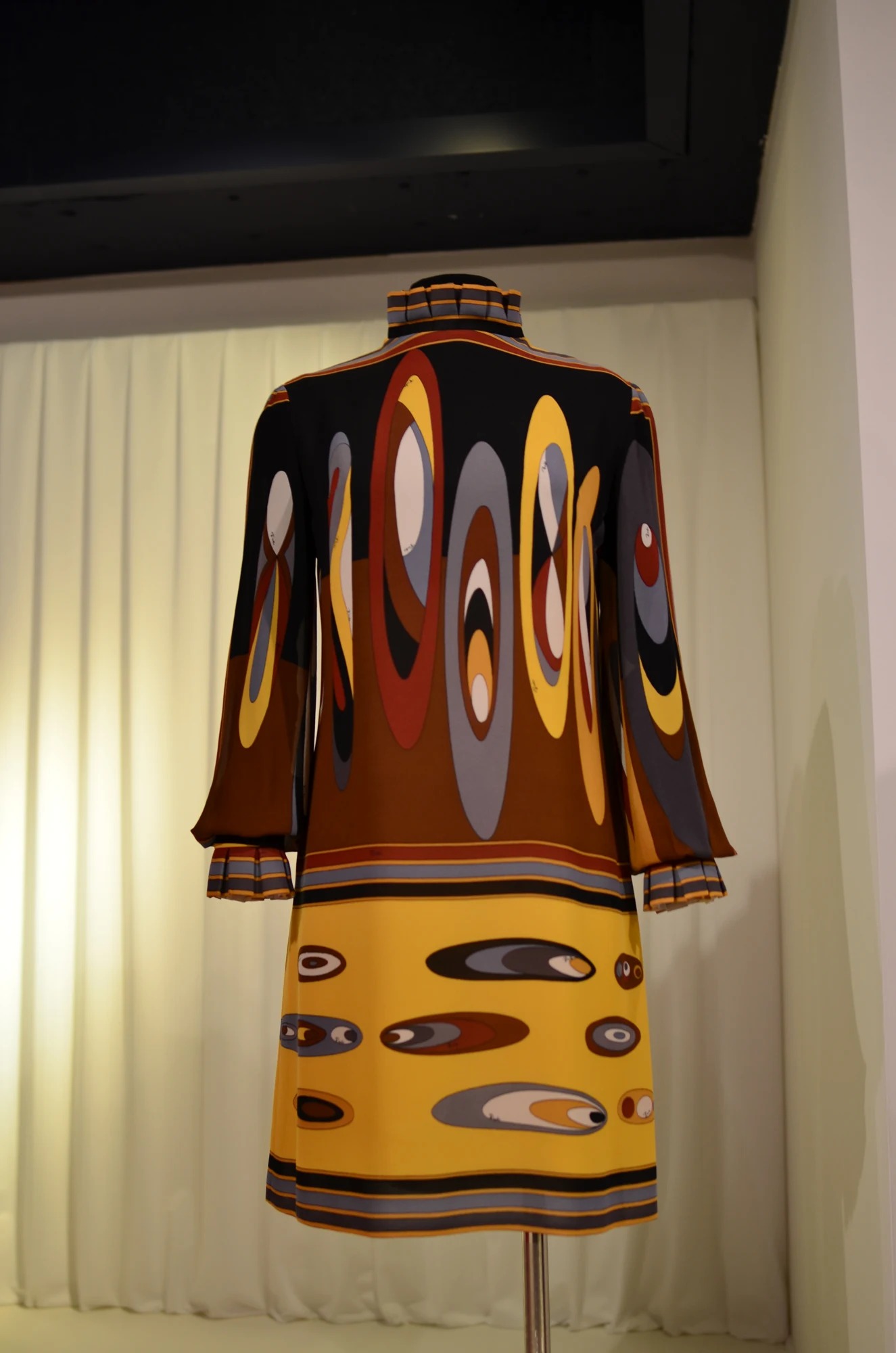
The Met’s 1966 silk evening dress places Pucci history in another setting. Its catalogue identifies a meeting of glamour and a sportswear sensibility. Here sportswear can describe an approach to activity and dressing, rather than clothing restricted to exercise. The word silk alone does not identify every aspect of weave or weight. Look separately at the colour fields, length and relationship between cloth and body. An impression of abundant decoration is not proof of complex cutting. When much happens across a surface, the outer silhouette can remain comparatively quiet. That balance helps explain how large-scale graphics can carry an evening garment without requiring equally elaborate shaping.
Braniff and the working body
The 1965 Gemini IV uniform for Braniff shifts Pucci history from the passenger’s holiday to the flight attendant’s work. The Chicago History Museum describes interchangeable layers: pink skirt and suit, purple top and culottes, and a lime-green coat. Distinct colours help distinguish components, while layering responds to changing conditions. Yet a celebration of the advertising image alone would be incomplete. The museum also discusses marketing that sexualised female flight attendants. Practical workwear and a commercial image existed together. This example shows a fashion label shaping the appearance of a service, with responsibilities and meanings different from those of a private customer’s wardrobe.


Founder and later house
Separating founder designs from later work is essential to Pucci history. The LVMH account checked for this article records Camille Miceli’s appointment as artistic director in September 2021. Continuity of name and motif does not make all subsequent clothes one person’s work. An archive preserves more than reusable drawings: it records how clothing operated in particular circumstances. Painted cotton, a silk evening dress and airline workwear address different bodies and social settings. Comparing them clarifies what inheritance involves—selection and changed context, not automatic repetition. Accurate object dates and attributions make a new interpretation easier to identify rather than confining it within the founder’s lifetime.
Looking beyond the pattern
A useful way to read Pucci history today is to notice the pattern first, then ask what movements the garment allows. A fitted cotton bodice, an expansive skirt, an evening surface and a layered uniform provide different answers. Similar colours do not guarantee similar experiences. Openings, fastenings, sleeves and folds affect how clothing is worn. Object records alongside photographs keep material claims precise. Distinguishing terms for structure from terms for fibre prevents jersey and silk being treated as interchangeable categories. The bright surface is not a picture detached from life: it belongs to bodies, places and movement. Reading both leisure in Capri and labour aboard an aircraft makes that range visible.
Timeline
- 1947 — Brand established
- 1950 — First Capri boutique
- 1954–56 — Hand-painted cotton dress
- 1965 — Braniff Gemini IV uniform
- 1966 — Silk evening dress
- 2021 — Camille Miceli appointed
Questions and answers
Where was the first boutique?
It opened in Capri in 1950.
Was every garment jersey?
No. Surviving examples include hand-painted cotton and a silk evening dress.
What distinguishes the Braniff uniform?
The 1965 Gemini IV design combined interchangeable layers.