Etro: When Fabric Becomes a Brand
Etro’s story starts with fabric before a finished wardrobe.
ÉPOPLI ·
- Brand
- Etro
- Origins
- Founded as a Milan textile company
- Focus
- Luxury fashion
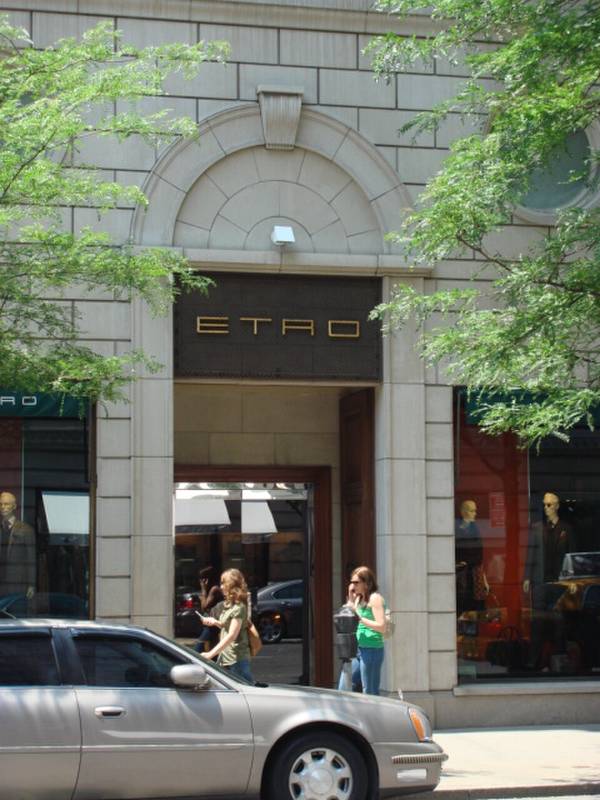
Etro: When Fabric Becomes a Brand
Etro history starts with fabric before a finished wardrobe. Gimmo Etro established a textile company in Milan in 1968. Its initial design question concerned the world a surface could contain, rather than only the shape of a garment. That beginning remains useful when looking at clothes and accessories. Scale and spacing can radically change the effect of the same motif: small repetitions merge into texture from a distance, while large ones remain individual figures. Following a flat design onto a body or a bag reveals another transformation. Patterns interrupted by seams and colours disappearing into folds become part of the finished composition.
Reworking an inherited motif
The house introduced paisley in 1981, making it a recognisable element of Etro history without inventing the motif itself. The curved, droplet-like figure belongs to a textile history older than the company. Etro’s contribution lies in repeatedly arranging it within its own systems of colour and spacing. Look inside each figure and at the empty ground around it. Curved tips suggest direction; differently sized units can produce depth. Enlarging a drawing is not the same as redesigning its intervals. Distinguishing a motif’s cultural history from the history of a particular commercial use avoids treating an established visual tradition as one brand’s invention.
Arnica and the patterned plane
A patterned Arnica bag provides a tangible way into Etro history. The official description identifies the pattern in jacquard fabric, where a design is woven into the structure rather than simply printed on top. A large figure on the front narrows at the side or stops beneath the opening. Its interruption helps us read the object’s dimensions. From a distance the colours form a field; close up, fine lines become visible. The surface consequently offers information at two viewing distances. Plain handles and borders frame that density, giving the eye a pause. Decoration becomes part of how the bag communicates its shape.
From cloth to accessory
Transferring textile design into accessories presents a further question in Etro history. Clothing moves and folds, while a bag carries objects and must retain a usable outline. A similar pattern does not mean identical physical demands. Thickness, backing and edge treatment affect how the repeated figure sits. Follow the junction between the front, sides and base of an Arnica example: what looks decorative on a broad panel can emphasise construction at a corner. This observation is not a durability verdict drawn from a photograph. It identifies the decisions involved in converting a flat visual arrangement into a three-dimensional object used by the body.
Vela and concentrated symbols
Marco De Vincenzo’s Vela bag shows why Etro history cannot be explained through pattern alone. Its pointed calfskin outline suggests a sail, with a V fastening concentrating attention. Across a plain leather surface, reflected light describes the curves; metal supplies a smaller focal point. The official description identifies a double-sided medallion carrying the brand and Pegaso emblems. The symbol therefore gathers in one place rather than repeating across an entire textile. Recognition can survive a reduction in the amount of decoration. Here the outline and the action of opening the bag take on tasks previously carried by a patterned field.
The archive and later choices
Reading the archive beside a later accessory separates continuity from change within Etro history. The company describes a Milan library and archive bringing textile records together with art books and historical clothing. Preserving material does not prescribe literal copying. A later designer can alter proportions, choose a plain surface or move an emblem to a different position. The founding textile enterprise and Vela should not be attributed to one author. A shared name accumulates decisions by different makers over time. Comparing dense jacquard with broad leather planes makes those distinctions visible. Inheritance involves deciding what to repeat and what to reconsider, rather than following one compulsory motif.
Where a pattern stops
To examine Etro history through objects today, find the unit of repetition and then notice where it stops. On a patterned bag, borders and side panels matter; on a plain one, fastening and medallion become key destinations. One surface keeps the eye moving, while another leads it around an outline towards a small detail. Both organise density and open space, with different results. Photographs may exaggerate colour or erase fine weave, so combine an overall view with material close-ups. Pattern need not always mean excess, nor plain colour restraint. Scale, placement and reflected light explain more precisely how a textile-based design language works across different objects.
Timeline
- 1968 — Gimmo Etro founded a Milan textile company
- 1981 — The house introduced paisley
Questions and answers
How did Etro begin?
As a textile company founded by Gimmo Etro in Milan in 1968.
Did Etro invent paisley?
No. The house adopted an existing motif in 1981 and developed its own arrangements.
Who designed Vela?
The official product description credits Marco De Vincenzo.