Oscar de la Renta history: flowers, form and occasion
Established in New York in 1965, Oscar de la Renta connects daywear, occasion dressing and multiple ways of constructing botanical decoration.
ÉPOPLI ·
- Brand
- Oscar de la Renta
- Origins
- New York, United States
- Focus
- Womenswear and accessories
From a person to a company
Oscar de la Renta history includes the process by which a personal name became a company. Born in the Dominican Republic, the founder worked in Spain and Paris before reaching New York in 1963. Kent State University Museum distinguishes his 1965 business relationship with Jane Derby from the subsequent label bearing his own name. This is more precise than a story of solitary creation: finance, production and sales had to support design. Work undertaken for other houses also needs to be distinguished from products of his own company. Following the label and date matters when a business later continues without its founder. Personal taste becomes a shared organizational language.
Collections across day and evening
A collection in Oscar de la Renta history means more than a single dress for an exceptional evening. The museum’s preserved Spring 1982 collection and earlier work connect clothing across different situations. A theme can be varied without simply shrinking elaborate eveningwear into daywear. Movement, sitting, putting on outer layers and physical proximity impose distinct demands. An evening dress and daytime clothing consequently present different structural problems. Comparing repeated colours or materials across lengths and shapes is more revealing than praising a collection as a whole. Surviving garments and presentation records also recover the companions around an individual piece: what appeared beside it was part of its original proposal.
Flowers as pattern and structure
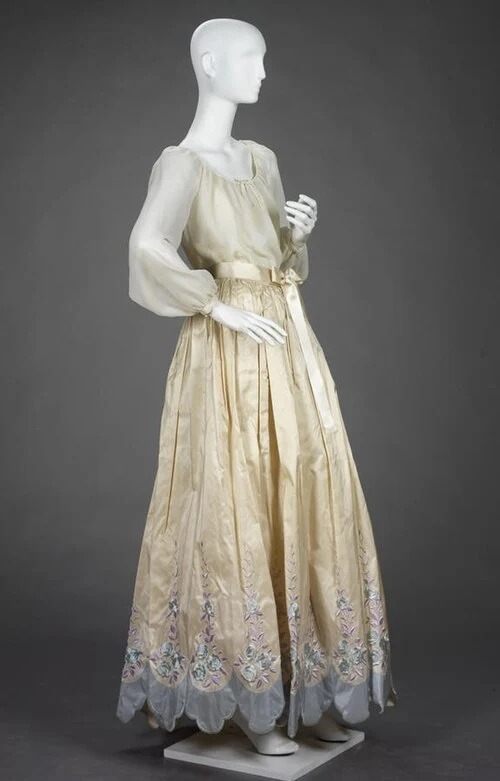
The use of botanical decoration provides a specific route into Oscar de la Renta history. The George W. Bush Library retrospective brought together floral embroidery, appliqué and botanical printing. Appliqué attaches separate pieces to a ground, producing a different surface from printed colour. Calling all of this romantic would obscure the making. A print can read as a field from a distance; threads reveal direction and density at closer range; projecting pieces create small shadows in movement. The use of botanical decoration therefore translates one subject into different dimensions. Placement matters as well: ornament at a shoulder, waist or hem changes the order in which the eye reads the body. It participates in composition rather than merely finishing it.
An evening dress in the record
A silk evening dress dated around 1982 at the Metropolitan Museum offers an object-level view of Oscar de la Renta history. Record 1997.225.2 separates design house, designer, approximate date and material. An approximate year should not be converted into a certain season, while the word silk does not establish the complete weave or internal support. Such limits clarify observation rather than preventing it. Confirmed information comes first; unknown construction remains unknown. A famous label does not make every detail automatically recoverable. The record also distinguishes this object from subsequent work under the same trademark. Respecting the boundary of evidence is part of reading an archive.
A successor’s garden and techniques
The founder’s death in 2014 makes attribution essential to later Oscar de la Renta history. The official Spring 2026 account names Laura Kim and Fernando Garcia as co-creative directors. Here, botanical decoration moves through crochet, lace and leather in that collection. Crochet forms structures by looping yarn with a hook, changing the relation between motif and ground. The account’s connection to Kim’s family garden should not be rewritten as the founder’s personal memory. Fluid silk chiffon and a softly structured cocoon coat also offer different supports for related imagery. One can be considered through movement, the other through space around the body. Continuity of subject does not mean identity of maker.


When a flower becomes a bag
The Spring 2026 poppy bag places a flower at the centre of an accessory in Oscar de la Renta history. The official account describes laser-cut poppy forms alongside wicker versions in banana and cerulean colours. Wicker introduces an interlaced structure rather than a flat printed ground. The poppy bag cannot be treated as a miniature dress, since storage, opening and balance in the hand introduce different conditions. A floral outline does not by itself establish internal construction or durability. Moving decoration from a broad garment surface to the area beside the hand also redirects attention. Insect- and fruit-shaped jewelry in the same presentation offers further translation of natural forms into objects.
Reading occasion dressing
Oscar de la Renta history loses much of its material specificity when reduced to a list of famous wearers. Public photographs contributed to recognition, but thread relief and fabric movement remain separate subjects. The poppy bag, an earlier silk garment and a successor’s floral collection address different making problems under one name. Stitching, interlacing and printing can reference nature while producing different thicknesses and reflections. A garden is a starting point for comparison, not a complete explanation. Daywear and public dressing likewise address changing situations rather than one permanent female ideal. Keeping lifetime work distinct from later design allows those changes to become visible within the continuing house.
Timeline
- 1965 — Business involvement with Jane Derby; origin of the house.
- 1966 — Label changes to his own name.
- 1982 — Spring collection, later donated to the museum.
- 2014 — Founder dies.
- 2026 — Spring collection by Kim and Garcia.
Questions and answers
When did the house begin?
Museum records identify 1965 as its origin and distinguish the 1966 change to the founder’s name alone.
Are all floral effects embroidered?
No. Printing, appliqué, crochet and interlaced structures offer distinct approaches.
Did the founder design Spring 2026?
No. The official account attributes that collection to Laura Kim and Fernando Garcia.