Oscar de la Renta: Clothing for a Public Occasion
Clothing for a Public Occasion.
ÉPOPLI ·
A dress belongs to an occasion
Laura Bush’s second inaugural wardrobe, later displayed at the George W. Bush Presidential Library, offers one entrance into Oscar de la Renta house history. The clothes were made for a person, but they were also seen through a public ceremony and its photographs. Their effect depended on distance, lighting, movement and the expectations surrounding the occasion.
This does not make every formal garment a political statement with a single fixed meaning. It does show why the wearer’s circumstances matter. An outfit seen while standing at a podium is read differently from one moving across a ballroom. The designer’s attention to clients and their social lives was therefore part of the work itself, not simply a way to promote it. Clothing had to function within a setting while making its wearer visible.
From Santo Domingo to European workrooms
Born in the Dominican Republic in 1932, de la Renta went to Madrid in 1951 to study art. His experience with Balenciaga in Spain and later work under Antonio Castillo at Lanvin in Paris preceded his New York career. Oscar de la Renta house history follows this movement through actual training and employment rather than assigning every later color or ornament to his birthplace.
In 1963 he joined Elizabeth Arden to design its couture collection. The transition joined European workroom experience to an American clientele and business environment. A design had to answer the customer’s needs while also fitting the organization that sold it. The atelier was a place where proportion, fitting and finish were learned through practice. Those skills remained useful even as his later business concentrated on ready-to-wear rather than on individually commissioned European couture.

Jane Derby and a business with several contributors
The 1965 partnership with Jane Derby is central to Oscar de la Renta house history. Financial backing from Ben Shaw supported the arrangement, and Derby’s death that year was followed by the label’s transition toward the younger designer’s name. The chronology is more complicated than the simple statement that a fully independent house appeared at once in 1965.
The company’s growth also depended on management. The Kent State University Museum’s account identifies the Shaw family and later executives alongside the designer, making the commercial structure visible. A collection needed orders, reliable production and delivery as well as appealing clothes. This division of work should not be treated as a distraction from creativity. It explains how a design practice could continue across decades and offer a wide range of garments each season.
A collection works through variations
Kent State’s holdings include a substantial group from the spring 1982 collection, allowing Oscar de la Renta house history to be read through related pieces rather than isolated celebrity looks. The museum describes a collection of many variations, with recurring ideas developed across different silhouettes. A customer could encounter a shared direction without being offered only one type of outfit.
A silk evening dress dated around 1982 in the Met provides another point of reference. Its material and date are recorded, but they do not tell the whole story of fit or wear. Looking at the neckline, waist and distribution of fullness helps explain how the garment organizes the body. Comparing it with other pieces from the same period can reveal whether an apparent signature belongs to one special commission or to a broader collection practice.

Flowers are made in several different ways
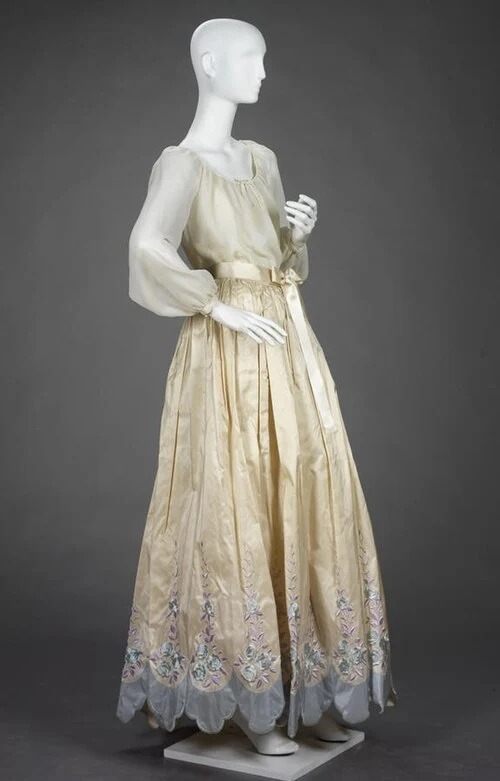
Oscar de la Renta house history includes floral motifs in prints, embroidery and applied decoration. These techniques do different jobs. A printed flower is part of a flat visual field; an embroidered one introduces thread and relief; an appliquéd shape can lift away from the surface. The same botanical subject can therefore produce very different effects in motion and under light.
The Presidential Library exhibition also connected his work to Spanish dress and decorative traditions. Such references are best discussed through identifiable forms and techniques rather than a generalized idea of national temperament. A lace edge, a concentrated area of embellishment and a wide skirt each guide attention in a different way. The specialists who produced those surfaces were part of the design’s realization. The finished image should not make their work disappear behind the name on the label.
The same designer, another house
A spring–summer 1997 caftan in the Met is catalogued as Balmain designed by Oscar de la Renta. Oscar de la Renta house history preserves both parts of that credit. His work for the French house belongs to its history as well as his own career, and it must not be attributed to Pierre Balmain personally.
The caftan’s loose outline offers a useful comparison with a closely fitted evening dress. Here the relationship to the body can be mediated by a broad field of cloth rather than a strongly defined waist. Nancy Kempner’s ownership and travel wardrobe provide a documented setting for the piece. The museum record identifies synthetic material and silk, reminding the viewer to examine the actual object instead of assuming that a luxurious appearance necessarily means one particular fiber. The atelier adapts its skills to the garment’s intended behavior.
The uneven hem of a 1966 black dress
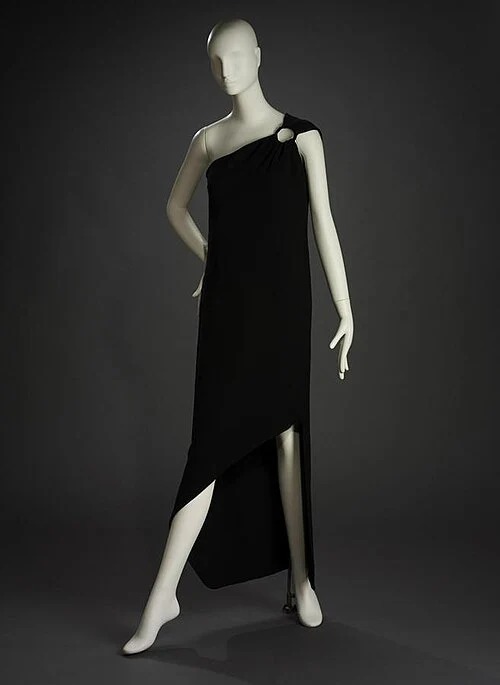
The RISD Museum’s 1966 cocktail dress was designed for Elizabeth Arden. Its exposed shoulder and high-low hem create direction within a black surface. It is a different solution to occasion dressing from the broadly floral garments associated with the designer. With less conspicuous ornament, the line from shoulder to hem and the position of the exposed leg become more important. The object should therefore be read with its employer and date, rather than folded into a timeless account of later floral decoration.
A lifetime’s work and a continuing label
The designer died in 2014. Oscar de la Renta house history separates the collections he directed from those made under the continuing label afterward. Exhibitions at Kent State, the Presidential Library and other museums preserve different aspects of his lifetime practice, from coordinated collections to specific clients and public appearances.
The archive’s value is not limited to identifying famous wearers. The early New York work, the 1982 collection, the Balmain caftan and the inaugural clothes show different relationships between a garment and its setting. Recurring floral motifs connect some pieces, but their technique, scale and placement need to be examined separately. That close reading explains how a designer could maintain a recognizable vocabulary while responding to different bodies, occasions and houses. It also restores the role of managers, workrooms and clients in a career often summarized through glamorous photographs.
Timeline
- 1932 — Born in the Dominican Republic
- 1951 — Began art studies in Madrid
- 1961 — Joined Antonio Castillo at Lanvin
- 1963 — Designed for Elizabeth Arden in New York
- 1965 — Partnership with Jane Derby
- 1982 — Spring collection later extensively donated to Kent State
- 1997 — Balmain caftan documented by the Met
- 2014 — Died
Sources
- George W. Bush Presidential Library — Five Decades of Style
- Kent State University Museum — Oscar de la Renta: American Elegance
- The Met — Evening dress, circa 1982
- The Met — Balmain caftan by Oscar de la Renta, 1997
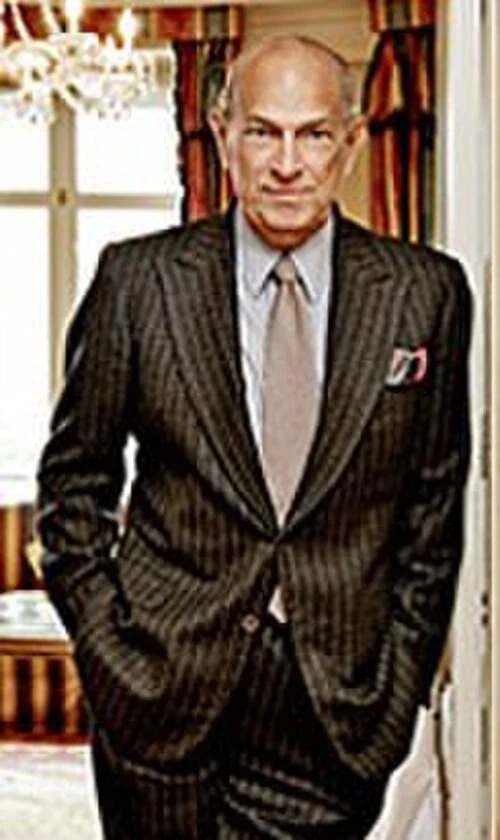
- Image and object record — Oscar de la Renta, photographed at the Ritz Hotel in Madrid.
- Image and object record — Oscar de la Renta for Elizabeth Arden, black silk crêpe cocktail dress, 1966. RISD Museum.
- Image and object record — Oscar de la Renta, embroidered silk blouse and skirt, 1977. RISD Museum, 2007.95.1.

Related reading
Fashion History · Cristóbal Balenciaga · Pierre Balmain · Designers