Maison Margiela history: Making Clothing Visible
Maison Margiela’s story asks what finished clothing normally conceals.
ÉPOPLI ·
Maison Margiela Product histories →
- Brand
- Maison Margiela
- Origins
- Founded in Paris, France
- Focus
- Luxury fashion
Maison Margiela history: Making Clothing Visible
Maison Margiela history asks what finished clothing normally conceals. Established in Paris in 1988, the house gave seams, linings and familiar objects new visibility. Exposing construction did not make technique unnecessary: deciding what to reveal demanded precision. A divided-toe boot, garments informed by a dress form and a top assembled from gloves offer three concrete starting points. Each changes a different relationship between clothing, bodies and materials. Here reuse can be understood as redesigning a purpose rather than simply preserving an old object. The useful question is not only why something looks unusual, but what operation produced that difference.
A Paris partnership and an unnamed label
The partnership of Martin Margiela and Jenny Meirens belongs at the centre of Maison Margiela history. MoMu records their Paris foundation in 1988. A designer’s name identifies the house, but making products, presentations and an organisation involves other contributions. The blank white label and four stitches offer another paradox. Removing a prominent name does not remove recognition: a repeated trace becomes a sign. Calling it merely clothing without a logo misses the visible thread on the outside. An attachment normally hidden within a garment becomes part of what the viewer reads. Identity can reside in a construction detail rather than printed lettering.
A divided toe and red footprints
The Tabi gives Maison Margiela history a recognisable foot shape. The official account acknowledges Japanese split-toe socks as an antecedent; the division itself was not invented by the house. Transformation into a heeled boot and its presentation supplied a new context. Red-painted soles left footprints across a white runway. A mark could therefore communicate the shape without showing the shoe. Frontal views emphasise the divided toe, while side views reveal the relation between heel and ankle. Looking from both directions makes the Tabi more than a single eccentric detail. An inherited form acquires another meaning through movement and display.
When the dress form becomes clothing
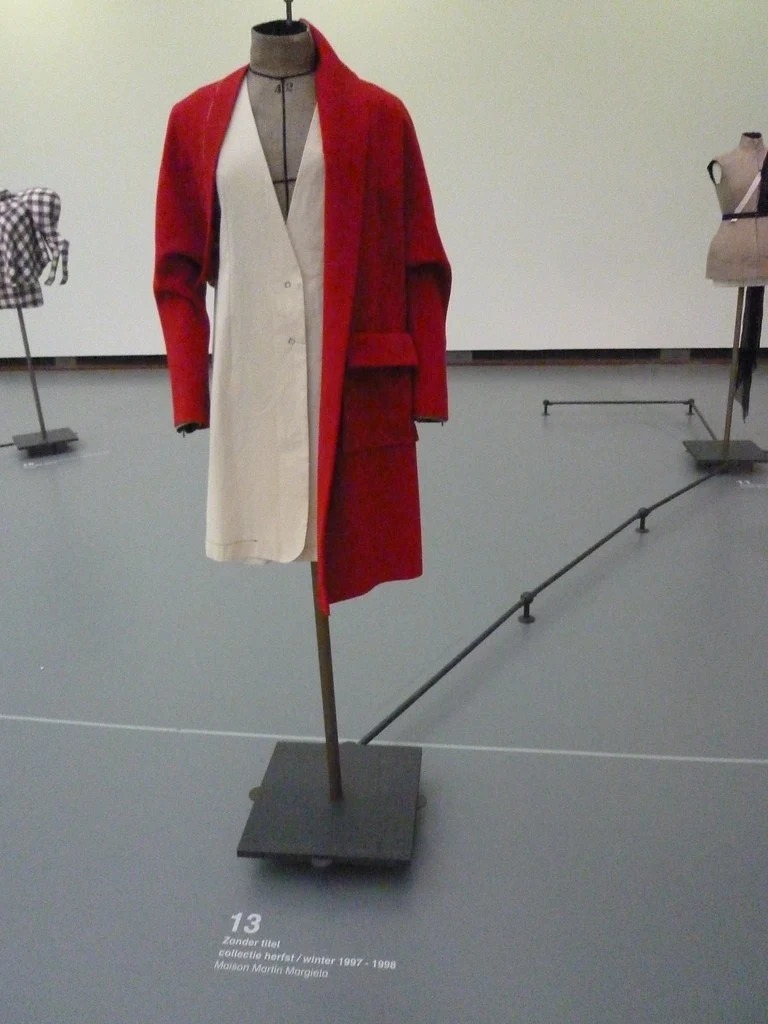
Whose body is the template for a garment? Dress-form references make that question tangible within Maison Margiela history. MoMu describes 1990s work that brought normally concealed components and the form of a tailoring mannequin onto the surface. The making process remained visible in its result. This was more than an inside-out effect: a standard workshop body and an individual wearer are not identical. Emphasised contours allow viewers to recognise both the actual person and the body proposed by clothing. The making process becomes an explanatory trace and an independent silhouette, unsettling the convention that completion requires construction to disappear.
Turning gloves into a top
A leather-glove top from spring–summer 2001 makes a change of purpose visible in Maison Margiela history. MoMu’s object record shows small forms intended for hands becoming a surface for the torso. Recognisable outlines retain the earlier object’s memory. This use of reuse need not be retroactively presented as proof of a complete environmental programme. Material identification and an assessment of total production impact are separate questions. Within the garment, scale, repeated edges and the joining of units can be examined directly. If the gloves became entirely unrecognisable, the tension between their original role and their new arrangement would diminish.
A house beyond its founder
The present organisation is not identical to its founder’s individual practice. Maison Margiela history includes entry into OTB in 2002 and the Haute Couture appellation in 2012, both recorded by the group. Its current official page names Glenn Martens as creative director. These facts describe the house without changing the authorship of earlier objects. Artisanal work, ready-to-wear and accessories also have different production conditions. A technique documented for one special piece should not be assigned automatically to every product. Continuity becomes more specific when a familiar sign is compared across different materials, proportions and presentations rather than treated as evidence of unchanged intention.
Reading the inside of the archive
Maison Margiela history can be read by placing footprints, dress-form surfaces and glove outlines alongside one another. First recognise a familiar thing, then notice its changed location. The approach does not require abstract vocabulary before looking: compare objects intended for feet or hands, and components previously hidden inside clothing. A single frontal photograph cannot show every relation. Enlarging the glove top reveals its constituent forms; side and interior views clarify a constructed silhouette. A shoe touches the body but also leaves a trace elsewhere. Changing the direction and distance of observation brings the viewer closer to the house’s practical questions about dress.
Timeline
- 1988 — Paris house founded
- 2001 — Spring–summer glove top
- 2002 — House joins OTB
- 2012 — Haute Couture appellation
Questions and answers
Who founded the house?
Martin Margiela and Jenny Meirens founded it together in Paris in 1988.
Did the house invent the split toe?
No. Its own account acknowledges Japanese split-toe socks as an antecedent.
When was the glove top made?
MoMu records the leather-glove top as spring–summer 2001.