Dries Van Noten history: Reading Contrasting Surfaces
Dries Van Noten’s story is a story of unlike surfaces entering a relationship.
ÉPOPLI ·
- Brand
- Dries Van Noten
- Origins
- Established in Antwerp, Belgium
- Focus
- Luxury fashion
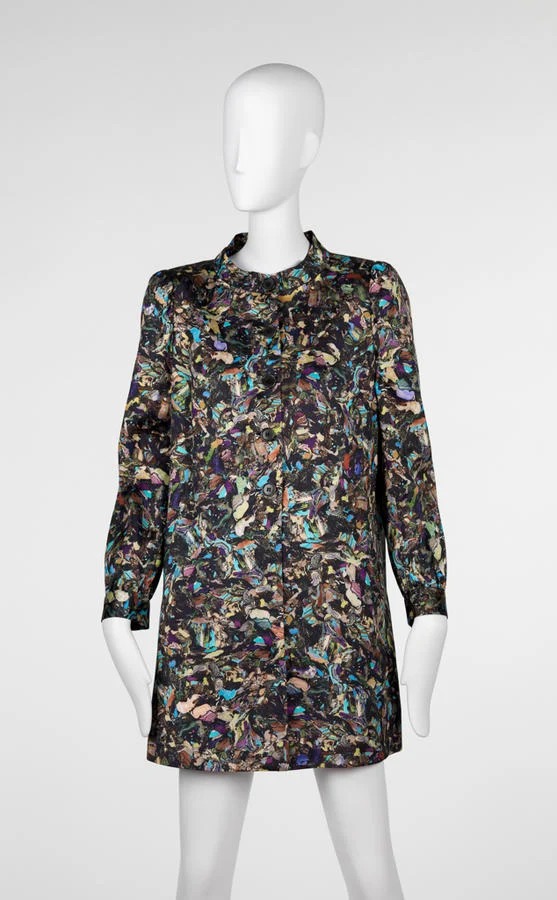
Dries Van Noten history: Reading Contrasting Surfaces
Dries Van Noten history is a story of unlike surfaces entering a relationship. Refined and ordinary materials, deep and pale colours can coexist without one erasing the other. Identifying the elements that meet is more useful than simply calling the clothes patterned. The technique of embroidery adds thread or ornament to a foundation and can turn its surface into relief. A wrap skirt from autumn–winter 1996, white blouses from spring–summer 2005 and the spring–summer 2015 presentation offer distinct examples. None is adequately explained by one isolated motif. Their significance emerges from the tensions between clothing, decoration and setting.
From an Antwerp shop to international collections
The official chronology records a first menswear collection in 1986 and the Modepaleis store opening in Antwerp in 1989. Dries Van Noten history therefore includes the practical encounter between making and selling, not only runway recognition. A city shop, international buyers and a later Paris presentation create different points of contact. Menswear and womenswear also allow familiar garments to cross conventions. A shirt, jacket or soft textile changes its associations when placed elsewhere. Such a combination is not necessarily random mixing: it can preserve contrasting expectations while establishing a new relation. An isolated object and a complete outfit reveal different aspects of that decision.
Materials within a wrap skirt
The autumn–winter 1996 wrap skirt brings Dries Van Noten history into close focus. MoMu records bead, sequin and thread decoration on an otherwise comprehensible garment form. Its embroidery changes reflected light as well as colour. A photograph may merge many small elements into one area, while a detail reveals their assembly. The museum also identifies continuing collaboration with producers in India. Design choices and the expertise that realises them are connected but distinct contributions. A single name on clothing should not erase that relationship. Reading the surface means attending to both its visible units and the skills needed to join them.
White blouses above a dining table
A dining table became a runway for spring–summer 2005. Within Dries Van Noten history, the event connects hospitality and presentation. MoMu records white blouses and full skirts appearing after dinner. Familiar surroundings changed their role, while broad white surfaces created a point of contrast for subsequent colour and ornament. The blouse itself was not an unfamiliar garment category. What changed was its setting, sequence and relation to other clothes. Product photography might direct attention to collar and sleeve, whereas a show creates rhythm between outfits. An ordinary item can produce a memorable scene without depending entirely on elaborate decoration.
A moss-like floor and light clothing
The moss-like floor for spring–summer 2015 was a carpet by Alexandra Kehayoglou. This collaboration gives Dries Van Noten history another spatial dimension. Vogue’s contemporary review connects the setting with light clothing. A floor can receive colour and movement rather than function as a neutral background. More broadly, floral motifs are selected and arranged images, not unmediated nature. Garden and textile differ in scale, time and touch. When floral motifs meet stripes or an unpatterned surface, their character can become clearer. Looking for where clothing and setting depart from literal reality reveals how a presentation constructs an environment of its own.
After the founder’s final show
Puig’s majority investment in 2018 and the founder’s final collection in June 2024 are separate kinds of transition in Dries Van Noten history. Ownership and creative responsibility are not identical. The official timeline records Julian Klausner’s appointment in December 2024 and his first women’s runway in March 2025. The continuing brand should not be treated as an unchanging body of work by its founder. A recurring colour or ornament may enter a new combination of proportion and material. Judging a successor only by resemblance overlooks those decisions. Both continuity and difference are necessary to describe a house operating through time.
Looking beyond a single motif
Dries Van Noten history rewards looking at the same outfit from different distances. From afar, lengths and areas of colour become clear; nearby, threads and texture separate. Reflected light matters in the wrap skirt, contrast around the white blouse, and the relation of body to setting on the carpet. These are different questions, not interchangeable examples of elaborate clothing. Placing a broad pattern beside a smaller one or a rough surface beside a smooth one changes the pace of looking. There is no universal rule of taste involved. The archive expands ways of seeing garments together rather than providing only a catalogue of recognisable motifs.
Timeline
- 1986 — First menswear collection
- 1989 — Modepaleis store opens
- 2018 — Puig becomes majority shareholder
- 2024 — Founder’s final collection; Klausner appointed
Questions and answers
What was the first collection?
The official timeline records a first menswear collection in 1986.
Was the 2015 floor real moss?
It was a moss-like carpet created by Alexandra Kehayoglou.
When was the founder’s final collection?
The official timeline dates it to June 2024.