Dolce & Gabbana history: Regional Memory on Clothing
Dolce & Gabbana’s story traces regional references into clothing, photography and presentation.
ÉPOPLI ·
- Brand
- Dolce & Gabbana
- Origins
- An Italian house founded by two designers
- Focus
- Luxury fashion

Dolce & Gabbana history: Regional Memory on Clothing
Dolce & Gabbana history traces regional references into clothing, photography and presentation. The house, founded in 1985, bears the names of Domenico Dolce and Stefano Gabbana. Sicily is an important reference, but no brand represents an entire regional culture. Black clothing and brightly painted cart imagery already suggest different interpretations. The autumn–winter 1987 collection, Susan Sarandon’s 1996 evening ensemble and spring–summer 2013 motifs offer distinct examples. They concern bodily outline, public attention and visible cultural reference. Separating the source of an idea, its manufacture and its photographic presentation makes those decisions clearer than treating them as one atmosphere.
Two designers within one house
Reading both founders’ names is fundamental to Dolce & Gabbana history. A shared authorship should not be reduced to one person, and the Met records the house’s foundation as 1985. Biographical origins may offer context, but cannot explain every design intention. Actual collections provide firmer starting points. When everyday clothing or festive objects enter luxury fashion, materials, uses and audiences change. The original and the new product are separated by selection and transformation. Describing tradition as passing through unchanged would obscure design itself. Asking what remains and what changes shows interpretation at work within a commercial presentation.
Black clothing and a photographic scene
The autumn–winter 1987 La Sicilia collection connects black clothing with photography in Dolce & Gabbana history. The official account names Ferdinando Scianna’s campaign with Marpessa alongside the collection’s references to southern Italian dress. Photographer and model therefore contributed to its remembered scene. Sicily functioned both as a place and as a selected visual setting. Dark surfaces can emphasise the boundary between skin and fabric, but weight, transparency and distance from the body also matter. Pose and lighting modify those effects. A campaign’s atmosphere should therefore not be assigned automatically to every garment without examining the clothes themselves.
A 1996 gown and public attention
Susan Sarandon’s 1996 evening ensemble at the Metropolitan Museum introduces a public occasion into Dolce & Gabbana history. The record identifies silk and synthetic fibre and explains the attention generated by the awards ceremony. Celebrity association and design are different kinds of evidence attached to one object. During the event, movement and lighting changed its appearance; a museum presentation offers other opportunities for examining construction. Neither record supplies everything. Looking at both prevents the story of recognition from replacing the garment itself. The house’s growth can be understood through the meeting of material design, wearer and widely circulated event.
Moving painted carts onto garments
Painted-cart references and other folk imagery expanded the surface vocabulary of Dolce & Gabbana history in spring–summer 2013. The official account identifies several sources rather than a single generic tradition. Once transferred to cloth, a picture leaves its original scale and function: it folds and disappears as a body moves. The house’s exhibition also names makers including Salvatore Sapienza, the Bevilacqua brothers and Gianfranco Fiore. Such craftspeople should not dissolve into an anonymous idea of handwork. Painting and ceramics require distinct skills. The resulting ornament can be examined through both its visible imagery and the actual roles that sustain those practices.

Handwork within a contemporary shirt
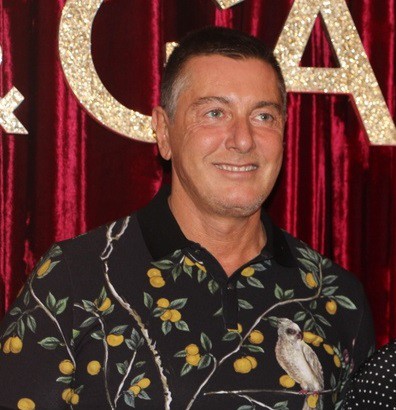
A spring–summer 2026 account brings Dolce & Gabbana history into a contemporary striped pyjama shirt with hand-applied sparkling elements. A familiar garment convention meets a different surface. Moving an indoor clothing form into a public presentation changes its context, not merely its brightness. Identifying craftspeople does not justify extending one documented process to every product. The particular attachment and foundation matter. Regular stripes and floral sparkle direct attention differently, while distance changes whether pattern or individual components dominate. The ornament therefore connects a recognisable everyday form with a specific material operation, rather than functioning only as an abstract sign of luxury.
Distinguishing a region from its interpretation
Dolce & Gabbana history cannot be contained by one fixed regional picture. Black clothing, an evening ensemble, printed surfaces and a transformed shirt reveal different selections. The useful question is how a reference becomes an object and who participates in that movement. Photographers, models, makers and wearers contribute at different stages. Reading material records, seasons and named collaborators together follows garments from workshop to event, photograph or collection. Each location emphasises something else. Regional memory is rearranged in that journey rather than preserved unchanged. Observing the rearrangement avoids reducing the house’s cultural references to either unqualified praise or an undefined exotic mood.
Timeline
- 1985 — House founded
- 1987 — La Sicilia autumn–winter season
- 1996 — Sarandon evening ensemble
- 2013 — Spring–summer folk references
- 2026 — Pyjama-shirt handwork documented
Questions and answers
When was the house founded?
The Metropolitan Museum records its foundation as 1985.
Who donated the 1996 ensemble?
The Met identifies Susan Sarandon as the donor.
Does the brand represent every regional tradition?
No. It selects and interprets references rather than equalling an entire culture.