Comme des Garçons history: rethinking the body
Comme des Garçons is the Japanese fashion label founded by Rei Kawakubo. Open knits, displaced volume and flat coats use different methods to question the expectation that clothing must follow the body.
ÉPOPLI ·
- Brand
- Comme des Garçons
- Origins
- Established in Tokyo, Japan
- Focus
- Experimental design
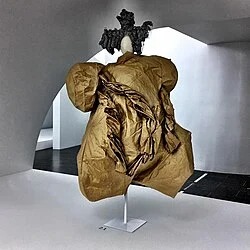
An unexpected volume inside a familiar check
A spring/summer 1997 gingham dress places an unfamiliar volume inside a familiar pattern. This offers a precise starting point for Comme des Garçons history. The padded garment preserved by the Metropolitan Museum of Art makes a particular body outline available for examination. Rather than immediately treating every enlargement as an attempt to improve proportions, observe where the cloth projects. Regular checks become a visual measure of the changing surface. Pattern and structure work together: a grid bending across a protrusion makes its position legible. The object asks us to inspect how clothing describes a body before deciding whether that description is flattering.
A beginning should not become a predetermined destination
Rei Kawakubo began her label in 1969. Reading Comme des Garçons history backward from a familiar present-day image can make every early choice seem inevitable. Museum accounts instead describe an approach in which abstract words or images could reach the pattern makers. Her lack of formal fashion training does not imply an absence of technical work. It gives pattern making a different problem: turning an unresolved proposition into an object. Joining, opening and distributing weight require concrete decisions. Studying those decisions is more useful than inventing a personality or intention from an unusual photograph. Experiment becomes assessable when it leaves a structure behind.
The 1982 knit: empty areas also make a surface
The open knitted work of 1982 introduces another question into Comme des Garçons history. Against an expectation of dense, even knitting, gaps become immediately noticeable. Yet an opening also reveals another garment, skin or light behind it. Filled and empty areas can therefore be read together. The effect of asymmetry extends beyond unequal measurements: different densities redirect attention across the surface. This observation need not convert every hole into a claim about destruction or politics. Spacing and edges provide enough material for a careful reading. Once smoothness is no longer the only measure of completion, openness becomes an organised design element.
1997: added volume negotiates with the wearer
Body Meets Dress–Dress Meets Body does not make influence run in only one direction. Padding interrupts the assumption that the body outline must determine the garment’s final contour. This episode in Comme des Garçons history differs from simply enlarging an entire garment. A local projection redistributes space differently from general looseness. The costume collaboration for Merce Cunningham’s Scenario in the same year adds movement to that investigation. A turning performer lets the audience follow volume through time. Such asymmetry is a moving structure as well as a visual effect. Nevertheless, runway garments and stage costumes retain distinct uses and should not become one undifferentiated product list.
A flat coat answers from the opposite direction
The autumn/winter 2012–13 collection 2 Dimensions approaches the problem differently. NGV describes a coat retaining a planar impression through stiff material and a defined perimeter. Placing it beside the padded dress makes a change in Comme des Garçons history visible. Conventional pattern making turns flat material into volume fitted around a wearer; here, the continuing appearance of flatness becomes central. Following the edge directs attention toward the garment’s independent shape. The body still matters: it holds the plane upright, moves it and supplies scale. Continuity lies in repeatedly altering a relationship, rather than producing the same silhouette again.
A museum selection is not the whole brand
The Metropolitan Museum’s 2017 exhibition was followed by NGV’s pairing of Kawakubo and Vivienne Westwood from December 2025 to April 2026. Museum-based accounts of Comme des Garçons history should acknowledge selection. An exhibition arranges objects for interpretation; it is not an inventory of everything sold under a name. One experimental dress cannot explain the construction of every product. Conversely, a familiar commercial item cannot exhaust the questions explored in the archive. Exhibition dates, collection seasons and production dates also describe different moments. Checking those distinctions allows meaningful comparisons without turning a curator’s chosen examples into a fixed definition of an entire business.
A sequence for looking at difficult clothing
A useful approach to Comme des Garçons history begins before assigning meaning. Locate where cloth touches or leaves the wearer, then compare open and closed surfaces and front and side views. The knit directs attention to density, the padded dress to placement of volume, and the flat coat to its edge. Calling all three unusual describes a response but not their differences. Where available, compare a collection photograph with an image on a wearer. Add documented materials, seasons and collaborators to set limits around interpretation. These objects invite familiar judgments about beauty, finish and function to be tested against specific physical evidence.
Timeline
- 1969 — Rei Kawakubo’s label begins.
- 1982 — Open, irregular knitted surfaces enter the collection.
- 1997 S/S — Body Meets Dress–Dress Meets Body collection.
- 1997 — Costume collaboration for Merce Cunningham’s Scenario.
- 2012–13 A/W — 2 Dimensions explores flat clothing.
- 2017 — The Metropolitan Museum of Art presents Kawakubo’s work.
- 2025–26 — NGV presents Westwood | Kawakubo.
Questions and answers
Which works make a useful first comparison?
Compare the open knit of 1982, padded dresses for spring/summer 1997 and flat coats for autumn/winter 2012–13. They organise surface, volume and edges differently.
Is the padded dress simply oversized?
Enlarging an entire garment differs from adding padding at particular locations. This collection changes the encounter between bodily and garment contours.
Are exhibition dates and collection years interchangeable?
No. Earlier clothing can appear in a later exhibition, and a presentation date can differ from the season named for the collection.