Maison Margiela Tabi history: a divided footprint
Maison Margiela Tabi history explores the divided toe, round heel and painted museum boots, distinguishing the 1988 debut from the spring–summer 1989 collection.
A footprint before a logo
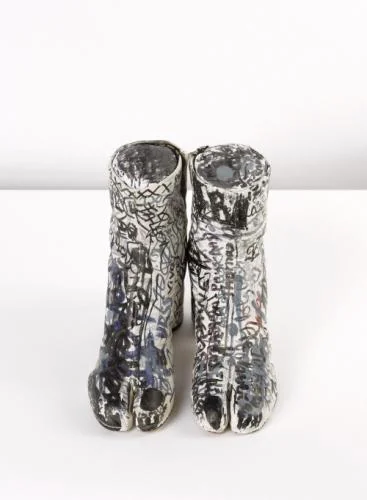
Maison Margiela Tabi history can begin with a trace rather than a frontal view. The house recalls red-painted soles leaving divided footprints across a white runway at the first presentation. Walking made the unfamiliar construction legible. Footwear became part of the show’s environment as well as something supporting the clothes. This does not mean that every boot worn there had the same surface as the museum example pictured here. The performance, the design and a surviving object are related pieces of evidence, rather than interchangeable illustrations.
Presentation date and collection season
The dates 1988 and 1989 describe different things. Maison Margiela places the first presentation in 1988; Palais Galliera assigns the documented Tabi to spring–summer 1989. Recording both avoids turning a show date and a season into a false contradiction. The house also acknowledges Japanese divided socks as a precedent. Margiela did not invent the idea of separating the big toe from the remaining toes. His intervention concerned its translation into a heeled fashion boot and the circumstances in which that boot was presented.
The toe and the heel belong together
The split toe is the quickest identifying feature, but the rear of the boot also matters. A cylindrical heel offers a broad round volume rather than the visual line of a stiletto. The house relates that volume to the human heel. Looking at the two ends together explains more than isolating the toe as an eccentric detail: the front articulates a division, while the back ends in a rounded support. This is an observation about visible construction, not a medical claim or a promise of comfort for every wearer.
A surviving pair with a marked surface
Palais Galliera describes white-painted suede boots overlaid with black, grey and blue writing. Its record lists leather, cotton, acrylic paint and felt-tip pen, as well as metal fastenings at the inner ankle. These graffiti boots make the difference between a design and a particular object especially clear. Their marks are evidence of a worked surface, contrasting with the uniform finish of a conventional new-product photograph. The record does not justify inventing an author for every inscription or identifying an undocumented wearer. Close description is more informative than attaching an unsupported anecdote.
Repetition without an identical object
MoMu places Margiela footwear beside clothing from different moments of the designer’s work. Its exhibitions and collection research allow recurring forms to be considered beyond the novelty of a single season. A recognisable split toe can persist while materials, finish and proportions change. A cylindrical heel is equally useful when comparing the early boot with later forms. The archive should therefore distinguish a current purchasable model from a historical specimen. Their shared family resemblance does not make their specifications identical. Following those differences turns an unusual-looking shoe into a record of sustained design decisions.
Timeline
- 1988
- Tabi boots appeared at the first collection presentation.
- 1989
- Palais Galliera dates its boots to the spring–summer 1989 collection.
- 1991
- The documented boots entered the Palais Galliera collection in October.
- 2008
- MoMu presented its Martin Margiela twentieth-anniversary exhibition.