Ferragamo Rainbow sandal history: colour in layers
Ferragamo Rainbow sandal history explores the 1938 design for Judy Garland, its coloured cork platform and the distinction between museum originals and reissues.
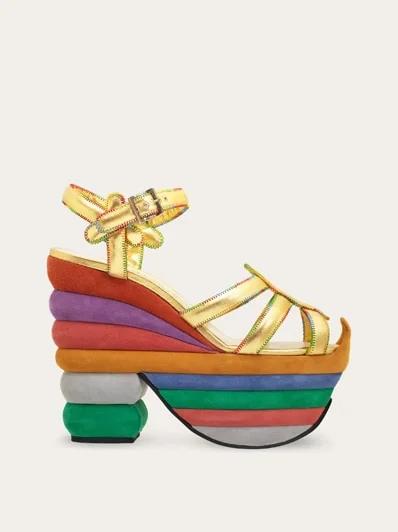
Colour placed beneath the foot
Ferragamo Rainbow sandal history begins below the straps. Bands of colour build up a substantial sole, with the elevated rear continuing towards a platform at the front. The rainbow is therefore not simply a picture printed on the shoe: it is organised around its volume. Ferragamo dates the design to 1938 and associates it with Judy Garland. That connection matters, but the object offers more than a celebrity anecdote. Materials, height and colour must be considered together. The historical design is also distinct from the current reproduction illustrated on this page.
What the date establishes
Museum and company records identify 1938 as the design year. Museo Ferragamo records a construction involving cork and coloured suede; The Wolfsonian also lists gilded leather and leather. These material descriptions provide a firmer foundation than an unverified story about a film set. A shoe designed for an actress cannot automatically be described as a costume worn in a particular film. Likewise, a familiar name should not substitute for evidence about how an object was used. The date, the intended recipient and the surviving materials are separate facts.
Core and covering
A cork wedge invites a distinction between the material creating volume and the covering visible from outside. Coloured suede does not mean the entire thickness consists of that material. Core and covering perform different jobs. The Metropolitan Museum’s account of another Ferragamo sandal from 1938 discusses the broad supporting base of a platform. That object should not be renamed Rainbow, but it provides a useful comparison for the period’s experiments with elevated footwear. Structural comparison is more precise than assuming that every thick-soled Ferragamo shoe belongs to one model.
A heavy base and an open upper
In side view, successive horizontal colours emphasise the depth of the sole. The straps supply a different kind of line, enclosing only part of the foot above that substantial base. Open space and volume therefore work against one another. The contrast is also one of surfaces: gilded leather and a soft, matte covering handle light differently. This is a visual reading of the object, rather than a claim about an undocumented intention in the designer’s mind. Colour is useful here because it makes construction easier to see.
An archive design returns to production
Ferragamo launched Creations in 2006 to revisit designs from its archive. The current Rainbow belongs to that context. An archive reissue is not a photograph of the original 1938 object, and its current specifications should not be transferred backwards to a museum specimen. The distinction matters even when the visual resemblance is strong. The image used here shows a present-day Creations model. Read as an archive reissue, it documents the continued production and interpretation of an earlier form. Read incorrectly as the original, it would obscure precisely the history that makes the shoe interesting.
Timeline
- 1938
- Salvatore Ferragamo designed the Rainbow sandal for Judy Garland.
- 2006
- Ferragamo Creations launched to revisit archive designs.
- 2026
- The 1938 Rainbow appeared in The Wolfsonian’s Foot Notes exhibition.