Ferragamo: The Shape Beneath the Foot
Ferragamo’s story begins where a shoe becomes both a small sculpture and something capable of supporting a moving body.
ÉPOPLI ·
- Brand
- Ferragamo
- Origins
- Rooted in Florentine shoemaking
- Focus
- Luxury fashion
Ferragamo: The Shape Beneath the Foot
Ferragamo history begins where a shoe becomes both a small sculpture and something capable of supporting a moving body. After making footwear for film clients in America, Salvatore Ferragamo returned to Florence in 1927. Celebrity names are less revealing than the structure beneath the sole, the fastening across the foot and the weight of the material. The upper is the portion surrounding the top and sides of the foot. A sandal can expose much of that foot while still depending on carefully positioned support. Colour and unusual heels therefore belong to a practical design question, rather than sitting outside it.
From America to a Florentine workshop
The encounter between American experience and Florentine workshops is an important business chapter in Ferragamo history. The foundation describes training artisans and dividing production into stages. A workshop need not mean one person completing every operation. Measuring, cutting and assembly connect different kinds of knowledge. Shoe construction involves an ordered process as well as skilled hands; a recognisable design must be deliverable to more than one customer. Reading the founder’s signature should not make the production organisation disappear. Both ornate and restrained shoes depend on support hidden inside and on edges that meet the skin. Experiment requires a workshop capable of translating it into an object.
Rainbow and the visible platform
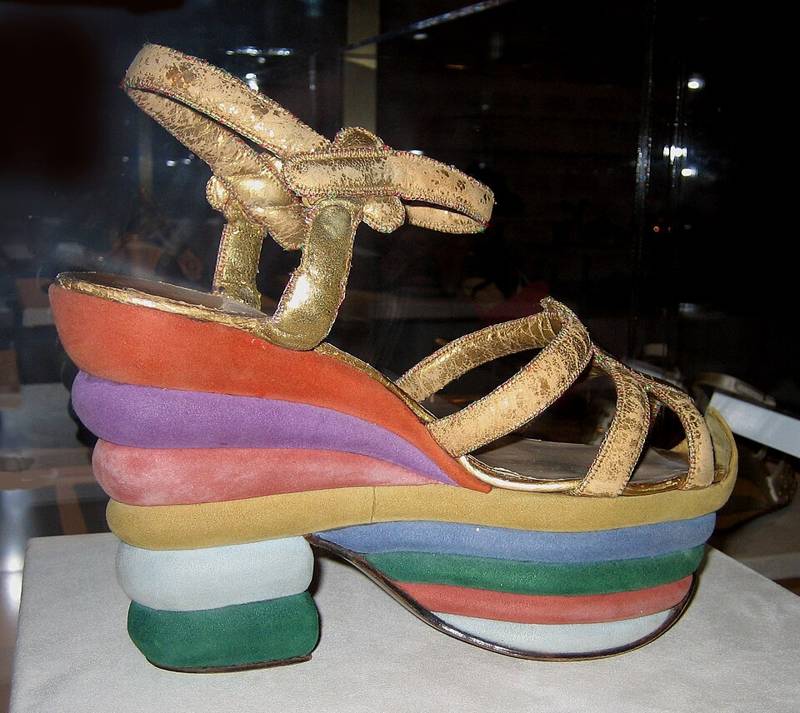
The Rainbow sandal, made for Judy Garland in 1938, makes Ferragamo history visible through colour and volume. Coloured suede covers a cork wedge. Unlike a narrow heel, the wedge creates a substantial mass beneath the foot, and horizontal bands emphasise its height. From the side, this resembles a miniature platform, while the upper straps leave much of the foot visible. The density of the two areas differs deliberately. Rather than simply listing the colours, follow the meeting of the horizontal bands and the sloping foot. A device for raising the body also becomes a graphic surface. The silhouette is inseparable from the material supporting it.
Invisible support
The 1947 Invisible sandal takes the opposite approach, holding the foot with transparent nylon fishing line above an F-shaped wooden heel. In Ferragamo history, it demonstrates that visual drama need not mean adding more visible material. The lines do not truly disappear: reflected light can reveal them, briefly exposing the connection between foot and sole. The heel remains solid while the upper appears comparatively weightless. If Rainbow makes the base conspicuous, this design allows its fastening to recede. Comparing the two reveals how material selection controls what we notice. Transparency is an active compositional choice, not simply the absence of decoration.
Vara and Fiamma’s everyday shoe
Fiamma Ferragamo designed the Vara shoe in 1978; it should not be attributed to her father. Ferragamo history includes the next generation’s response to everyday dressing. The official account describes a shoe intended for comfortable wear throughout the day. Its bow detail gives the eye a small destination rather than turning the whole shoe into sculpture. The placement is readable from above and from the front. A bow detail need not be treated as a fixed symbol of femininity: here it introduces softness into an orderly shape. Beside the experimental sandals, Vara shows the house addressing a longer, more ordinary span of daily activity.
Succession and the archive
After Salvatore died in 1960, Wanda took charge of the business alongside family and workshop colleagues. Attribution consequently matters throughout Ferragamo history: a shared label does not indicate a single author. The Creations project, introduced in 2006, offers another relationship with the archive through limited reissues of historical designs. An original design date and a newly manufactured object’s date should remain separate. Similar outlines do not remove the need to inspect contemporary materials and sizing. Shoe construction records can distinguish repeatable decisions from conditions specific to an earlier period. Reissuing a form does not collapse all its production history into one moment.
Reading a shoe from the side
A useful way to read Ferragamo history today is to compare Rainbow from the side, Invisible across the instep and Vara from the front. Observe the wedge and colour bands, then the transparent lines and curved heel, and finally the scale of ornament concentrated near the toe. This does not force different products into one taste; it separates the visual problems each addresses. A single frontal photograph cannot explain every shoe. Side views reveal support, while views from above reveal the lines enclosing the foot. Moving between decorative object and bodily tool makes the house’s accumulated knowledge more tangible than a celebrity association or logo alone.
Timeline
- 1927 — Returned to Florence
- 1938 — Rainbow sandal
- 1947 — Invisible sandal
- 1978 — Fiamma’s Vara shoe
- 2006 — Creations reissue project
Questions and answers
Who designed Vara?
Fiamma Ferragamo designed Vara in 1978.
What is Rainbow?
A 1938 sandal for Judy Garland, with coloured suede covering a cork wedge.
What is Creations?
A project introduced in 2006 to reissue historical models in limited editions.