Chanel tweed suit history
Explore Chanel tweed suit history through the couture comeback, fabric and trim, using a documented museum ensemble to distinguish a design family from one outfit.

A history larger than one garment
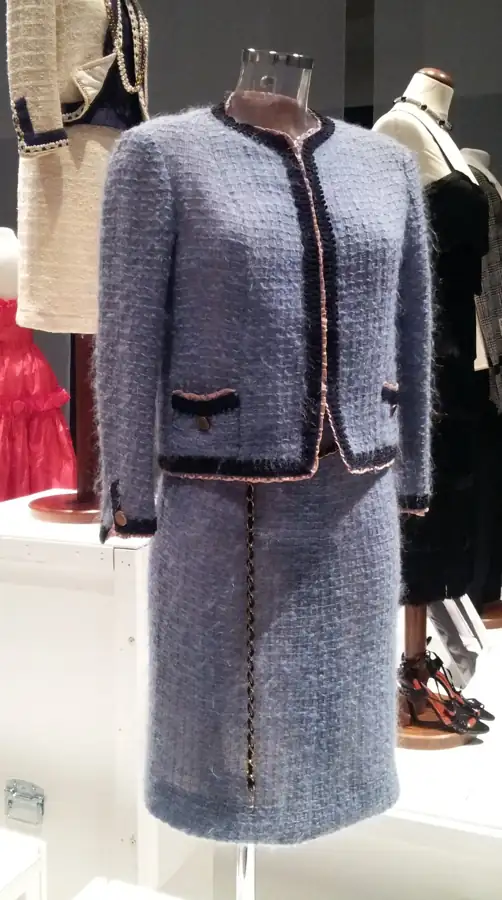
Chanel tweed suit history is not the biography of one unchanging outfit. It concerns a relationship among jacket, skirt, woven surface and contrasting edges, developed through different examples. A tweed jacket shown alone cannot tell the whole story of an ensemble. Before tracing influence, it helps to establish the period of the object and to ask how its two principal garments were intended to work together.
The word tweed provides a starting point for Chanel tweed suit history, not a complete explanation. Yarn, surface texture, weight and lining all affect how an individual garment behaves. Treating every tweed jacket as interchangeable loses precisely those decisions. Comparison becomes useful when the stable outline of a design is considered alongside differences in fabric, proportion and the treatment of each opening.
A couture return
A major turning point in Chanel tweed suit history follows Chanel’s return to couture in 1954. The house chronology highlights a trimmed suit in 1956. That milestone should not be converted into a claim that every aspect of the suit appeared at one instant. A return to professional activity and the development of a recognisable design language are related historical processes, but they are not identical events.
Cloth against the body
The question of movement runs through Chanel tweed suit history. The V&A describes a supple, cardigan-like approach to the jacket. That description encourages attention to the body inside the garment rather than only to the outline presented in a photograph. It does not establish that every example fits or feels the same. Material, internal finishing and the dimensions of a particular object still require individual examination.
A separate V&A examination of Lauren Bacall’s pink 1959 suit identifies generous skirt hems allowing alteration and a concealed functional pocket. Even a couture ensemble made to her measurements incorporated possibilities for later adjustment and everyday use.
The work of an edge
The contrasting trim in Chanel tweed suit history gives the eye a route around the garment. Front opening, neckline and pockets become legible boundaries. This contrasting trim can therefore be analysed as an organising device rather than merely an amount of decoration. Its width and placement alter the balance of a jacket. This reading helps explain why a relatively restrained arrangement can remain visually specific without covering every available surface.
Comparing a museum object
A museum object anchors Chanel tweed suit history: the Met’s suit dated around 1962, recorded in wool, silk and metal. A museum object provides a dated point of comparison, not a universal recipe for all Chanel clothing. Its documented materials belong to that ensemble. Keeping this distinction prevents a description of one surviving example from becoming an unsupported statement about decades of production.
The ensemble and the later jacket
A later jacket may preserve features of an earlier ensemble without carrying precisely the same relationship to its accompanying skirt. Compare lengths, openings, pockets and lining before describing continuity. The significance of the form lies in how these parts can be coordinated while remaining readable as a whole. Looking closely at differences makes the history richer than a single formula about elegance: it reveals choices within a familiar visual framework.
Timeline
- 1954
- Chanel resumed her couture activity.
- 1956
- The house chronology highlights the trimmed tweed suit.
- 1962경
- The Met’s documented suit was made around this date.