Burberry trench coat history: cloth, service and city life
Burberry trench coat history connects gabardine, the Tielocken and wartime design with civilian dress, distinguishing historical coats from the Heritage range.
Several functions in one garment
Burberry trench coat history can be read through the simple action of tightening a belt. The waist changes, and so does the distribution of volume above and below it. Shoulder tabs, cuffs and overlapping fronts do different jobs. Their familiar combination should not make them invisible. A coat that now appears to be one coherent fashion image also contains a history of separate practical decisions about covering and moving the body.
The development of gabardine in 1879 is an important material date in Burberry trench coat history. It is not the founding date of the business, which began in 1856, nor the introduction date of every coat subsequently made from the cloth. Separating company, textile and garment histories prevents a long development from collapsing into one invention story. Cloth can remain significant while the shapes cut from it change considerably.
Fabric came first
The Tielocken, patented in 1912, provides an earlier garment to compare within Burberry trench coat history. It precedes the wartime trench rather than being interchangeable with every later model. A shared belted principle establishes a relationship, not an identical specification. Similarly, the continuing importance of gabardine does not establish that construction or fit remained unchanged. Historical comparisons become useful when they identify both continuity and the limits of that continuity.
The Tielocken and wartime changes
The First World War places Burberry trench coat history within military clothing. Burberry’s account associates the epaulettes with rank and belt-mounted D-rings with equipment. Knowing those purposes changes how a detail is interpreted. It also does not prove that one company exclusively invented the entire category. A history of a particular manufacturer’s coat should remain distinguishable from the broader history of service outerwear made by multiple suppliers.
A second life for service details
When military clothing enters civilian wardrobes, form and function need not travel together. In Burberry trench coat history, an epaulette can still emphasise a shoulder after its original service role has ceased to matter to the wearer. A belt divides the body visually even when it carries no equipment. This formal reading explains how details can persist without requiring the same conditions of use, or an unbroken symbolic meaning, in every subsequent setting.
Identity on the inside
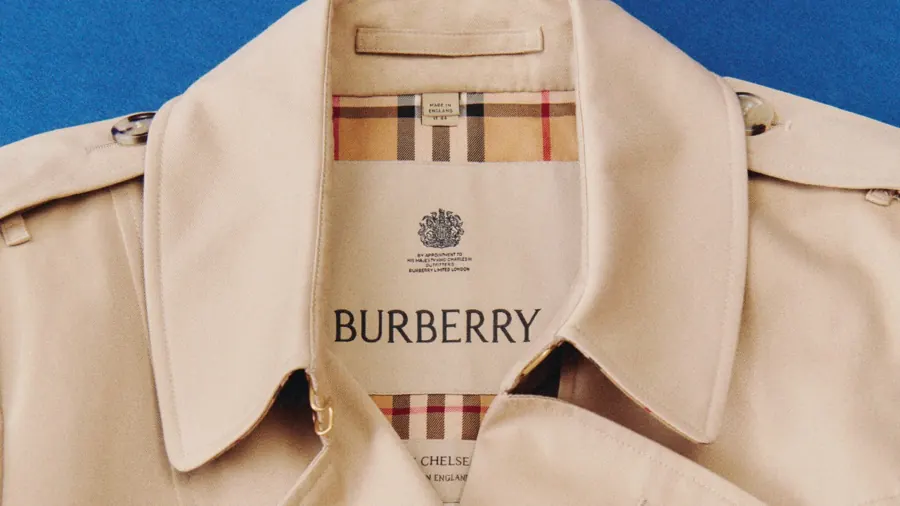
The check lining introduced in the 1920s adds another layer to Burberry trench coat history. Unlike a motif covering the outside, a lining is revealed selectively as the coat opens or moves. Placement therefore changes the way a pattern communicates identity. The Tielocken comparison and the lining comparison ask different questions: one concerns the development of a garment type, the other the visibility of a sign within it.
Heritage is not a single replica
The current Heritage family should not be treated as a single historical replica in Burberry trench coat history. Different fits are documented, and their dimensions cannot simply be projected onto earlier surviving coats. The value of the archive lies in following relationships between cloth, construction and use. Its subject is a design that accumulated recognisable features over time, rather than a modern stock item supposedly present in complete and unaltered form from the beginning.
Timeline
- 1879
- Thomas Burberry developed gabardine.
- 1912
- The Tielocken design was patented.
- 1914–1918
- The military trench coat developed during the First World War.