Burberry check scarf history: from lining to accessory
Burberry check scarf history follows a lining motif into a 1970s accessory, exploring cashmere, Scottish weaving and the difference between pattern and product.
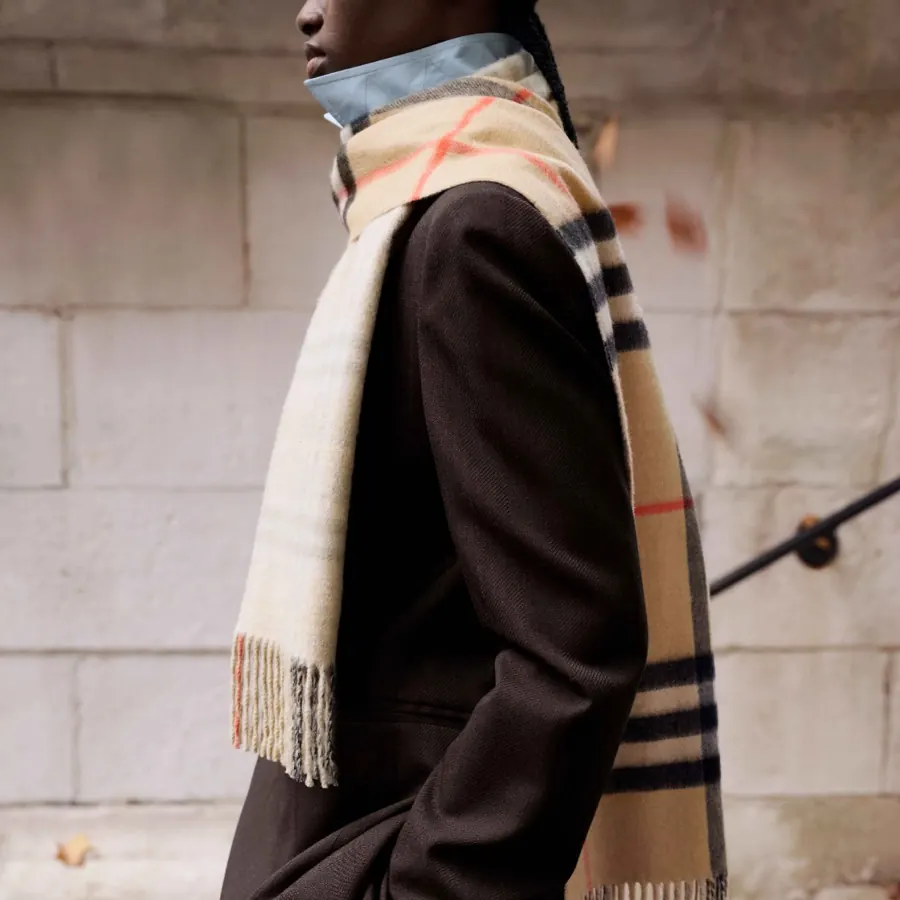
A pattern without its coat
Burberry check scarf history begins between the inside of a coat and a separate length of cloth worn around the neck. A check pattern previously encountered as lining becomes an external surface. Placement changes visibility even when a motif remains recognisable. The shift is not simply one of enlargement: a sign attached to a particular garment becomes an independent accessory that can accompany many different kinds of clothing.
Material matters to Burberry check scarf history because cashmere is more than a prestigious word on a label. A fibrous surface changes how a line reflects light and how sharply its boundary appears. A grid on paper and a grid in cloth are not visually identical. Reading the object therefore requires attention to both the design of its repeat and the physical material through which that repeat becomes visible.
Two different chronologies
Burberry dates its check lining to the 1920s and the scarf’s introduction to the 1970s. These are separate milestones in Burberry check scarf history. The existence of a motif does not establish the existence of every product that later carries it. Keeping the two chronologies apart avoids making the accessory artificially older. It also makes the actual transformation clearer: an existing identifying vocabulary acquired a different format and a different relationship to the body.
Material and place of making
Scottish weaving supplies a material setting for Burberry check scarf history. The house identifies its work with Johnstons of Elgin and describes washing and teasel brushing after weaving. Brushing raises the surface fibres; the woven design is therefore not the final stage of making. This current account should not automatically be projected onto every early specimen. A production description and evidence about an individual historical scarf answer related but different questions.
A grid made from yarn
In Burberry check scarf history, the check pattern depends on the ordered crossing of coloured yarns rather than a single emblem placed at one point. A fragment can still show the rule governing the larger repeat. Scottish weaving is consequently more useful here as an account of making than as a vague regional atmosphere. The loom establishes one kind of regularity, while finishing changes the way the resulting surface is encountered.
A surface changed by folding
Folding introduces another variable into Burberry check scarf history. Laid flat, the scarf displays a field; worn, it alternately conceals and reveals sections of that field. Its ends may show a different orientation from the portion around the neck. This observation concerns form, not a claim that all wearers in a given decade shared one social meaning. The same repeat can create different visible arrangements through an ordinary action rather than through redesign.
Recording a family of objects
Finally, Burberry check scarf history should preserve differences between versions. A cashmere scarf of one period cannot be identified solely by resemblance to a current colourway. Date, scale of repeat, edge treatment and finish help distinguish examples. The archive is strongest when it records those features instead of treating a familiar motif as a guarantee of identical manufacture. Pattern can endure while the particular object carrying it changes.
Timeline
- 1920s
- The check was used as a coat lining.
- 1970s
- The cashmere check scarf was introduced.