Tatsuro Horikawa: Sound and Form at Julius
From sound and moving images to forms surrounding the body.
ÉPOPLI ·
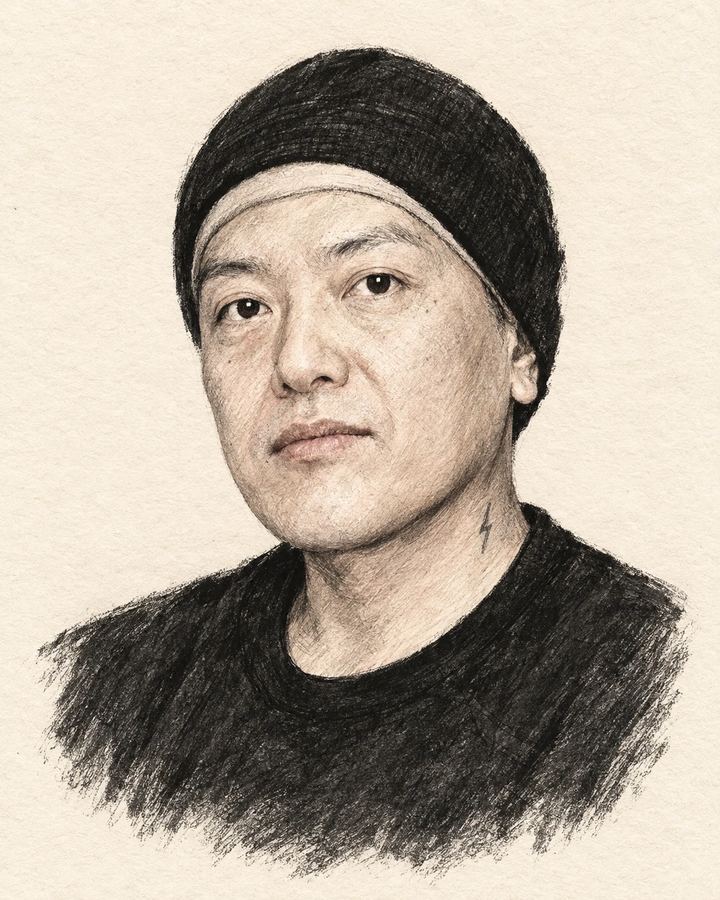
Dressing a Listening Body
Tatsuro Horikawa Julius history begins with a question about clothing for bodies listening to music. For Spring/Summer 2017, Downwards Records and Regis provided an important musical context. Sound disappears after a show, while the length and volume of clothes continue to affect movement. The exchange therefore extends beyond printing a musician’s name on a T-shirt. A moving silhouette and the shadows between layers are part of the experience. Here techno culture suggests a search for another form rather than the restoration of an old club uniform. Look beyond black to the sleeves, hems and projections around the body. For Autumn/Winter 2017, Lotic supplied the soundtrack while the palette referenced Cabaret Voltaire’s Sensoria sleeve: sound and record imagery could produce different results.
Beyond the T-Shirt
His early practice involved graphics and music rather than apprenticeship in a major fashion house. In an interview he placed his start in clothing around age twenty-three or twenty-four, after visual work. Tatsuro Horikawa Julius history has a precursor in Nuke, where techno T-shirts expanded into clothing for his circle. He recalled mid-1990s work connected with the anime Genma Taisen: a T-shirt was insufficient for the world he wanted to create. Julius began in Tokyo in 2001 as a project involving film; its official account distinguishes the development of the clothing line in 2004. A verified school or birth year is not established by these sources, but his account makes the professional transition clear.
Sefiroth: Light and Cloth
Tatsuro Horikawa Julius history cannot be reduced to black. Spring/Summer 2016, Sefiroth, included off-white and beige alongside flowing draping—the formation of volume by folding and hanging cloth. He discussed travel in Morocco, encounters with Tuareg culture and the relationship between technology and nature. These were references for his presentation rather than a comprehensive account of another community’s dress. Harris Elliott handled styling and casting. Historic Paris architecture and large LED lights placed fluid fabric against hard illumination. In this draping, the space between body and cloth matters as much as surface ornament, opening during movement beyond what a frontal photograph records.
Pale Surfaces, Dark Atmosphere
Acid Glaciers, introduced in 2018, used pale surfaces to produce an unsettling atmosphere. Hand-bleached, painted and distressed garments appeared in an installation at H. Lorenzo in Los Angeles. Tatsuro Horikawa Julius history separates colour from mood in this project. Clothing evoking glaciers and soil in the installation disrupted the image of the polished retail object. Such surface treatments create variations within an apparently single colour. From afar a pale mass becomes an uneven field at close range. Delroy Edwards, Gene’s Liquor and The Brvtalist contributed music to the launch. Display and listening spaces made the encounter with the clothes part of the work.
Returning Forms
Permanent Julius began in Autumn/Winter 2020, revisiting established products through a current approach. Tatsuro Horikawa Julius history therefore includes recurring forms as well as successive themes. The official store describes its Bind Boots as a refinement of a Spring/Summer 2014 Ghost design. Supple, substantial cow leather, repeated lacing and a crepe sole create a layered object around the foot. The lace both fastens and draws lines across its surface. Its crossings interrupt the vertical ankle, preventing the boot from reading as a uniform black mass. A familiar component can produce a different proportion beside new trousers or outerwear.
Valis Around the Body
Autumn/Winter 2026 Valis includes a Droid Short Jacket in lamb nubuck. Nubuck is leather finished with a short, soft surface nap. Tatsuro Horikawa Julius history shows a close-fitting approach to volume in this jacket and the related corset. An independent corset component can alter the relationship between upper body and waist. These surface treatments also change the response to light: restricted colour does not mean restricted information. Gas Mask Waist Gear uses bag-derived details and waist adjustment. Equipment-like shapes become devices for changing proportion, without implying certified protective performance.
Images Meet Clothes Again
In July 2026 the Ghost in the Shell: Stand Alone Complex and TechnoByobu collaboration connected visual media with clothing again. Julius interpreted the HAC module in which WEIRDCORE collaged the Laughing Man image; sales began with the exhibition at the Hyogo Prefectural Museum of Art. Tatsuro Horikawa Julius history continues through such exchanges with other image-makers. It connects techno culture, animation and sculptural clothing. The announcement scheduled subsequent store and online sales around November, so that remained a plan at the October research date. Examine surfaces, fastenings and volumes rather than black alone: a folded cloth edge, bootlace and body attachment each produces a different rhythm within the broader atmosphere.
Timeline
- 2001 — Julius project began
- 2004 — Clothing line developed
- 2016 — Sefiroth Spring/Summer collection
- 2018 — Acid Glaciers presentation
- 2020 — Permanent Julius launched
- 2026 — Valis and Ghost in the Shell collaboration
Sources
- SSENSE: An Industrial Feeling
- Julius: About
- OPENERS: Sefiroth interview
- The Brvtalist: Acid Glaciers interview
- Julius: Bind Boots
- Julius: Droid Short Jacket
- Julius: Droid Corset
- Julius: Gas Mask Waist Gear
- Julius: Ghost in the Shell collaboration