Sul Yun Hyoung: Colour into Construction
How patchwork, painted surfaces and wire become clothing.
ÉPOPLI ·
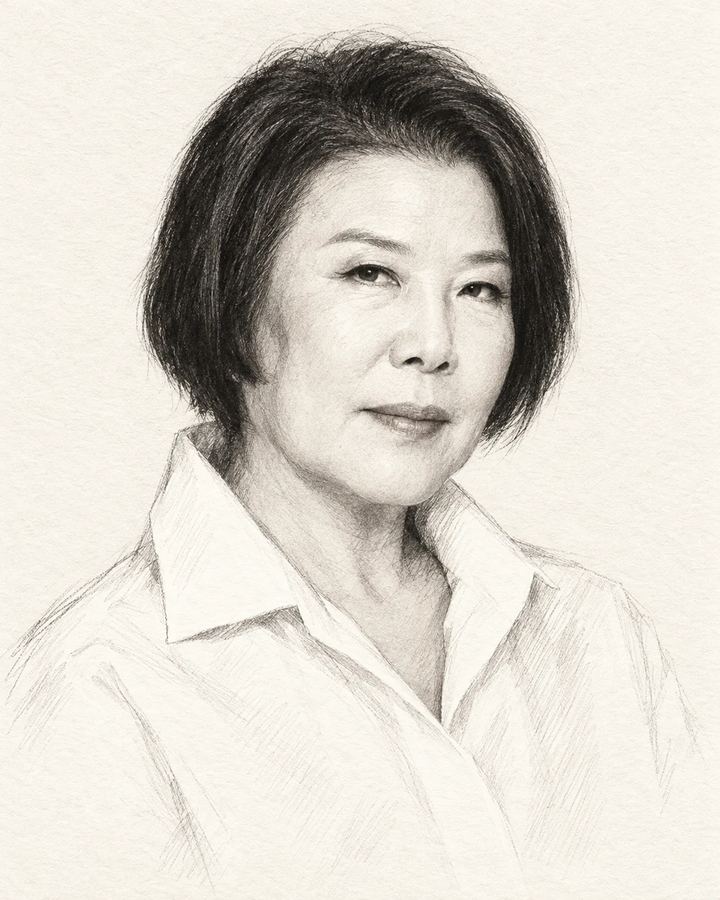
Colour as construction
Sul Yun Hyoung history begins with colour as a means of construction. Her 2019 DDP retrospective, The Varicolored World, brought together peonies, rice-cake mould patterns, patchwork and embroidered pillow ends. Motifs associated with small domestic objects became surfaces surrounding a body. The question is how familiar colours become new structures. A folding skirt conceals parts of an image; a turn moves a side panel into view. This patchwork clothing makes this translation especially clear. A flat arrangement acquires a shoulder, waist and moving wearer, requiring decisions about scale, sequence and weight.
From fragments to a boutique
Sul Yun Hyoung history reaches back to her childhood in Suncheon, where she collected discarded silk from a neighbourhood hanbok shop. Born in 1944, she later worked at a children’s home while attending the Kukje dressmaking institute, and remade garments bought in relief-goods markets. She opened her boutique in 1975. Taking an existing garment apart reveals seams and the available width of cloth, making transformation a practical calculation. She herself associated her interest in colour with these early experiences. In 1984 she presented work in Paris for the following spring and summer, expanding beyond her individual boutique toward international and collective presentations.
A landscape in motion
The Sun, Moon and Five Peaks dress gives Sul Yun Hyoung history a particularly clear example. The finale of the autumn–winter 1996–97 show transferred a royal screen composition onto an expansive skirt. A screen stays still, while the garment moves; folds gather and release elements of its landscape. Translating a horizontal image around a skirt creates multiple viewpoints rather than one front. The Sun, Moon and Five Peaks dress later appeared in the Musée des Arts Décoratifs exhibition Korea Now! in 2015. Display allowed the material construction to be examined beyond the runway finale. The cultural image and the volume required to carry it are equally important to understanding the work.
Coats and shirts
Sul Yun Hyoung history also includes smaller and more wearable formats. A review of a Korean fashion exhibition and show describes colourful fur coats assembled through a patchwork approach, alongside sharply outlined brocade garments. This patchwork clothing changes character when thin fabric gives way to the depth and direction of fur. Patterned brocade within a disciplined outline relies on the density of the textile rather than additional ornament. Hairstylist Oh Min provided windblown hair for that presentation. For spring–summer 2010, mini dresses and shirt dresses explored silk, cotton and silk jersey. Familiar lengths and fastenings created another register for the work. Soft material changes the distance between a shirt form and the body, showing why cultural references and commercial clothes cannot be reduced to one formula.
Weaving with wire
This wire weaving adds a different material question to Sul Yun Hyoung history. A halter dress in Vogue Korea’s 2022 mask editorial was made from coloured wire. Its crossing lines build both the surface and the garment’s structure, with gaps allowing colour and shadow behind them to remain visible. This wire weaving therefore makes fabric-like space from a less conventional material. A 2016 archival editorial layered a wire skirt beneath a folk-painting overskirt, and paired a green tube top with sleeves and a broad red skirt. A tube top encircles the chest without shoulder straps; the narrow upper form contrasts with the skirt’s spread. These were archival works photographed anew, not evidence of a newly launched 2016 collection. Distinguishing the garment from the date of its photograph shows how preserved clothing participates in later image-making.
Shared platforms
Sul Yun Hyoung history includes the creation of shared platforms. She recalled organising the SFAA with colleagues and presenting a collection at a hotel in 1990. Collective shows offered individual designers access to audiences and critics. The 2019 retrospective created another collaboration: art director Suh Young-hee organised the display around processes such as embroidering, joining and weaving. Lee Ju-young, her daughter and the independent designer behind Resurrection, assisted with the garments; Kim Bada made music for the exhibition video. These separate contributions made a setting in which the clothing could be understood again. Editorial photographs similarly depend on photographers, stylists and models, whose choices determine whether an expansive silhouette or the crossing of individual lines first commands attention.
Reading the archive today
As of the October 2026 research check, Sul Yun Hyoung history should not be presented as an uninterrupted sequence of new collections. In 2019 she said she was no longer regularly launching them and was attending younger designers’ shows. Her presence at the joint Caruso and Big Park presentation in September 2024 provides a later public example of that role. It is the most recent public activity verified for this article, rather than grounds to invent a subsequent title or season. Looking at the surviving work, ask where a motif is placed, not only what it represents. A painted skirt, a thick coat made of joined colours and a bodice constructed from fine lines solve different problems. Their materials and movement reveal a broader practice than a single image of national identity.
Timeline
- 1944 — Born
- 1975 — Opened her boutique
- 1984 — Paris presentation for spring–summer 1985
- 1990 — SFAA collective presentation
- 1996–97 — Sun, Moon and Five Peaks dress
- 2015 — Korea Now! exhibition
- 2019 — DDP retrospective
- 2024 — Attended Caruso and Big Park joint show
Sources
- Seoul Design Foundation: 2019 annual report (PDF)
- JoongAng Ilbo: interview and archive, 2019
- DER SPIEGEL: Sul Yun Hyoung profile (birth year)
- DDP: designer chronology
- Musée des Arts Décoratifs: Korea Now!
- Designers Look Back to See the Future
- Seoul Fashion Showcase Starts Next Week
- Vogue Korea: Mode Moments Chapter Three
- Vogue Korea: Behind the Mask
- Korea JoongAng Daily: interview, 2019
- JoongAng Ilbo: Caruso and Big Park, 2024