Shade Thomas-Fahm: Clothes for Working Women
Clothes for Working Women
ÉPOPLI ·
What a fastening changes
Adding a zip to a wrapper changes how it is secured while preserving a familiar appearance. Shade Thomas-Fahm Maison Shade history can begin with this practical adjustment for women moving through a working day.
A pre-tied gèlè similarly reduced the work of arranging a headwrap each time. Both proposals treated established dress as adaptable rather than incompatible with contemporary life. Innovation lay in use as much as appearance.
A change of direction in London
Born in 1933 into a Yoruba family that moved from Oyo to Lagos, she went to Britain in 1953 to train as a nurse. Design studies, including St Martin’s, followed. Shade Thomas-Fahm Maison Shade history also includes work at Stenoff and Sons and modelling, documented by Brighton’s museum.
She later described comparing a European skirt with a Yoruba wrapper as forms that could learn from one another. That comparison placed two clothing systems alongside each other rather than treating one as the incomplete version of the other.
A business in the independence year
Returning in 1960, she opened a boutique and production facility in Yaba, Lagos. Shade Thomas-Fahm Maison Shade history developed alongside the country’s independence. Bespoke work and ready-made lines reached customers through her boutiques and other retailers.
Locally woven cloth and resist-dyed fabric supplied different possibilities. Aṣọ-òkè, àdìrẹ and akwete should not become an undifferentiated category of African cloth: construction and surface processes matter to the resulting garments.
A red ensemble for a colder place
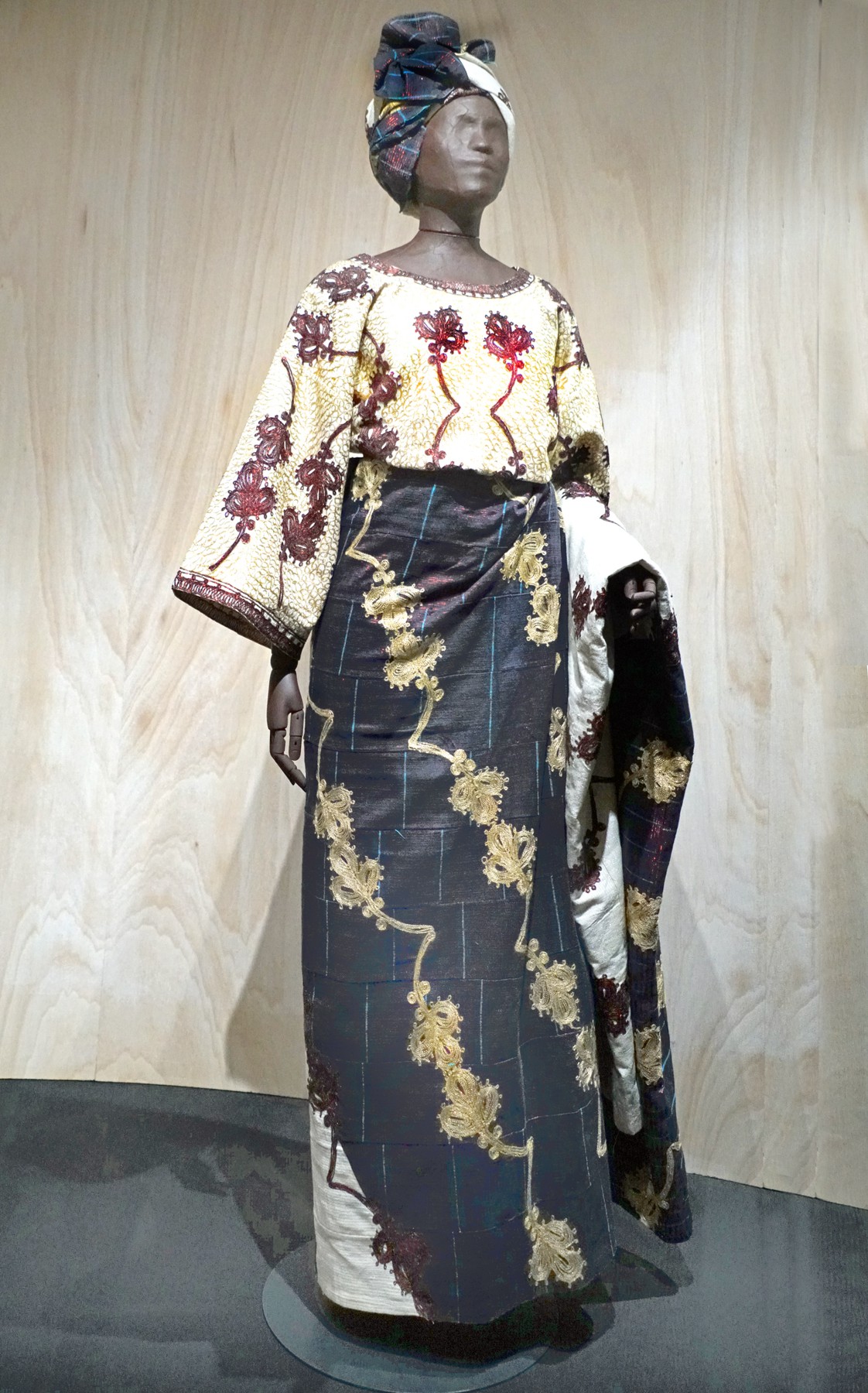
The 1977 ensemble commissioned by educator Lalage Bown offers a specific case in Shade Thomas-Fahm Maison Shade history. Heavy velvet addressed an English setting, while chain-stitch decoration and a gèlè-like hat connected the pieces.
Embroidery at the neckline, sleeves and cuffs articulates a broad red surface. The pile of velvet and metallic thread react differently to light. The surviving ensemble records decisions for a particular wearer and climate, not merely a general house style.
A robe changes wearer and purpose
A 1970s adaptation of the agbada for Bown brings another form into Shade Thomas-Fahm Maison Shade history. Heavy duchess satin, dyed grey and turquoise, carried yellow and green decoration associated with the Ooya comb motif.
The wide form differs from close-fitting tailoring. Bown later turned its matching headpiece into a drawstring bag, showing how a wearer continued to alter an object after purchase. Its history includes that later use as well as the initial design.
What the surviving clothes show
Museum records give Shade Thomas-Fahm Maison Shade history material specificity. The NGV checklist distinguishes an open robe, Princess Robe and a four-part ensemble from the 1970s, with different woven materials and component parts.
Brighton’s tie-dyed blouse, bought in Britain with a Lagos label, records another route of circulation. Checked in October 2026, these museum records establish continuing access to historical work; they are not evidence of an invented new collection.
Practicality without erasure
Shade Thomas-Fahm Maison Shade history demonstrates that convenience need not erase a local language of dress. Fastenings, ready-arranged headwear, climate-sensitive materials and forms adapted for another wearer address distinct problems.
Looking at closures and component parts brings daily life into view. Education in London, production in Lagos and later circulation through private wardrobes connect within the career. The surviving clothes show traditions being used and changed, rather than preserved outside time.
Timeline
- 1933 — Born
- 1953 — Moved to Britain; subsequently studied fashion
- 1960 — Established Maison Shade in Lagos
- 1977 — Made a red ensemble for Lalage Bown
- 2022 — Featured in the V&A Africa Fashion exhibition
Sources
- V&A — Shade Thomas-Fahm
- Brighton Museums — Fashioning the Nation
- V&A — Lalage Bown wardrobe
- NGV — Africa Fashion checklist