Rose Bertin: Ornament and the Authority of Taste
Dress, status and the work of a merchant at the French court.
ÉPOPLI ·
Who designs the ornament?
Rose Bertin Le Grand Mogol history begins with a question of attribution. A robe parée dated about 1780–1790 was presented in the Versailles court-dress exhibition as attributed to Bertin. That wording does not certify that she personally cut and sewed every component. Metallic thread, silk and chenille embroidery cover the skirt front and long train. Chenille is a fuzzy yarn that gives a surface soft volume. Shine and softness establish different visual distances: the whole silhouette can declare rank while close inspection reveals handwork. Ornament therefore participates in the design rather than merely decorating an otherwise complete object. The supporting structure and the embellished surface require different kinds of labour, although they act together when the garment moves.
A merchant becomes an adviser
Born in 1747 as Marie-Jeanne Bertin and known as Rose, she came from Picardy and operated Le Grand Mogol in Paris. Rose Bertin Le Grand Mogol history is consequently a history of commerce and social mobility. The institutional biography consulted here does not provide a detailed account of childhood lessons or her first employer’s working methods; these gaps should not be filled with a modern fashion-school narrative. A decisive change came through private consultations with Marie Antoinette. A commoner advising the queen within a rigid hierarchy acquired more than a prestigious customer. Judgement about what should look new became part of the service being sold. Her position as a fashion merchant joined materials to the authority of taste.
The scale of ceremony
The grand habit de cour combined an expansive skirt, rich textiles and signs of status. Rose Bertin Le Grand Mogol history intersects with this established form without making her its inventor. Versailles describes her influence on its fashions. One useful way to read court dress is to consider the space it occupies rather than its resemblance to an unstructured body. Width determines distances between people, while a train changes the experience of walking and turning. Large outlines remain legible from afar; small motifs reward a closer view. Cutting, structural underclothing, weaving and jewellery are distinct activities. Her importance lies in participating in the coordination of a public appearance, not in replacing every craftsperson with one authorial name.
Above the shoulders
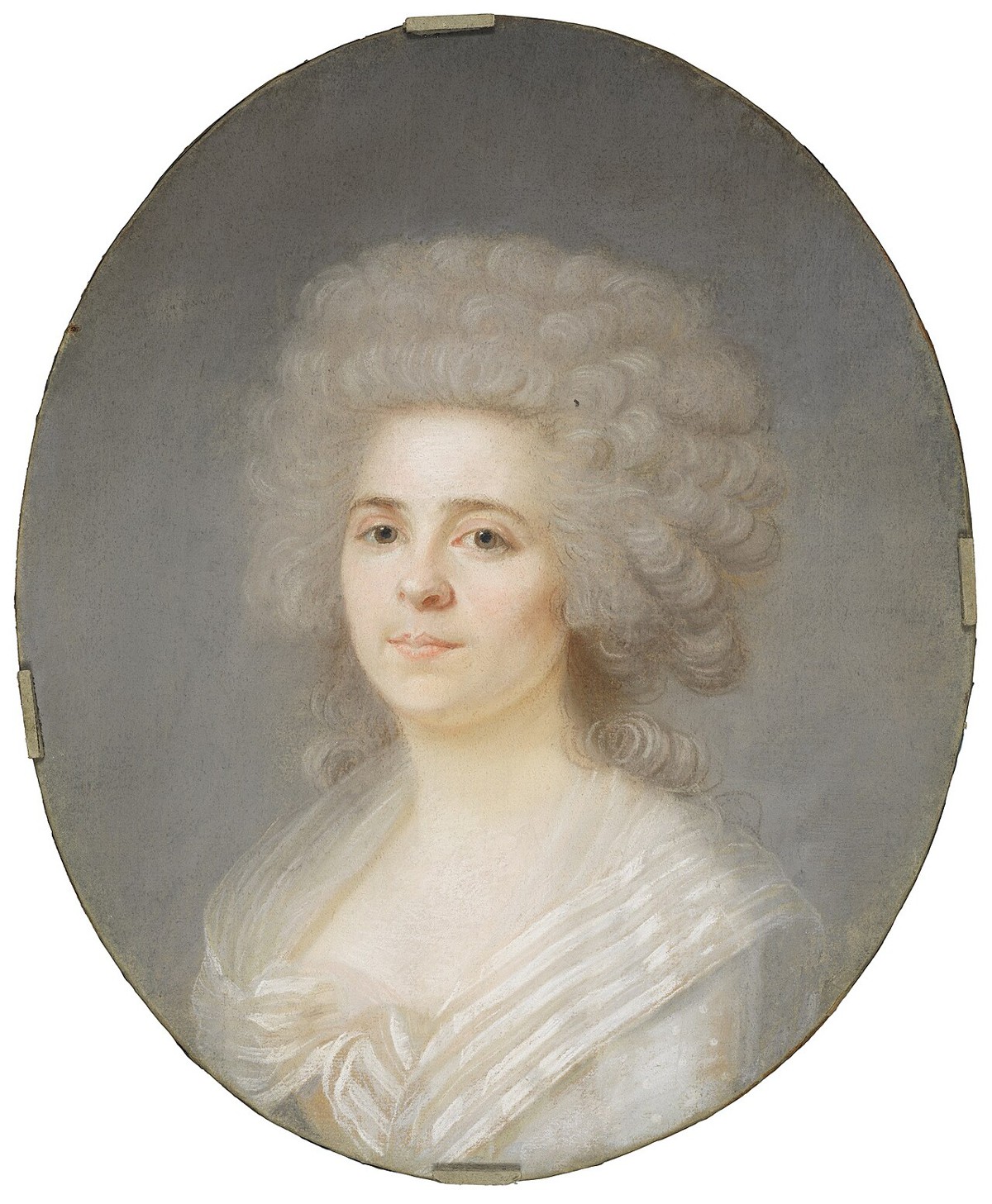
A pouf raised the hair with gauze and additional hair, sometimes carrying small models such as ships or balloons. Rose Bertin Le Grand Mogol history includes this extension of dress beyond the neckline. Height above the face changes the apparent proportions of the same gown. Comparing it with the width below shows how decoration organizes an entire figure. This does not establish that every surviving example was her individual work: hairdressing and the provision of ornaments remain different tasks. Fashion plates also carried appearances beyond the room. Versailles discusses the Galerie des modes of 1778–1787 and Cabinet des modes of 1785–1786. An image selects and transforms what was worn. Keeping the distinction between clothing and its representation helps explain influence without inflating authorship.
The work of looking simple
Versailles associates Bertin with the chemise à la reine worn by the queen from 1781. Rose Bertin Le Grand Mogol history therefore cannot be reduced to abundant trimming. The loose indoor garment used light materials such as cotton, fine linen, gauze or silk, offering a surface unlike the firmly constructed ceremonial silhouette. In a muslin dress, gathering, translucency and movement matter more than a count of decorative elements. Thin cloth can alter its outline with the body. Simplicity, however, is not automatically social equality. The queen’s leisure and the working conditions of ordinary women were different. A muslin dress could construct an image of naturalness within highly particular circumstances. Comparing this clothing with court dress should begin with the different demands of private recreation and public ceremony, rather than assuming an uncomplicated liberation.
When prestige becomes exposure
Rose Bertin Le Grand Mogol history also shows how an influential clientele could become a vulnerability. Royal and foreign clients and the painter Vigée Le Brun extended her reputation; hostility to luxury associated her name with inequality. The politics of dress includes who can purchase it, who labours for it and whose image it serves. Versailles records that she continued supplying more modest clothing to the imprisoned queen, including the clothes worn on her transfer to the Conciergerie. A commercial relationship survived the disappearance of spectacular ornament. The account does not allow a precise reconstruction of that final garment’s cut or fabric. Here the documented connection between shop, customer and political circumstances is more informative than an invented description of an absent dress.
Reading what survives
The Versailles biography describes flight to London during the Terror and return to France in February 1795. Another educational account discusses travel from 1789, so these movements should not be compressed into a single departure. Rose Bertin Le Grand Mogol history ends with a transformed market and her death in 1813. This is a historical business, not a contemporary label under her continuing direction. Later designers may inherit a kind of work without an unbroken corporate succession. An attributed dress, a painted appearance and a shop record are different forms of evidence. The contribution of a fashion merchant emerges by comparing them without pretending they are identical. Her significance lies in the growing recognition of paid creative judgement: arranging materials and people into a new appearance, and attaching a professional name and reputation to that proposal.
Timeline
- 1747 — Born
- 18세기 후반 — Operated Le Grand Mogol and served the queen
- 1795 — Returned to France in February
- 1813 — Died
Sources
- Versailles — Rose Bertin
- Versailles — La mode à Versailles
- Versailles — Court Pomp and Royal Ceremonies, p.23 (PDF)
- City of Paris — Rose Bertin
- Versailles — Michelle Sapori biography overview