Lino Villaventura: Cloth Built Around the Moving Body
Cloth Built Around the Moving Body
ÉPOPLI ·
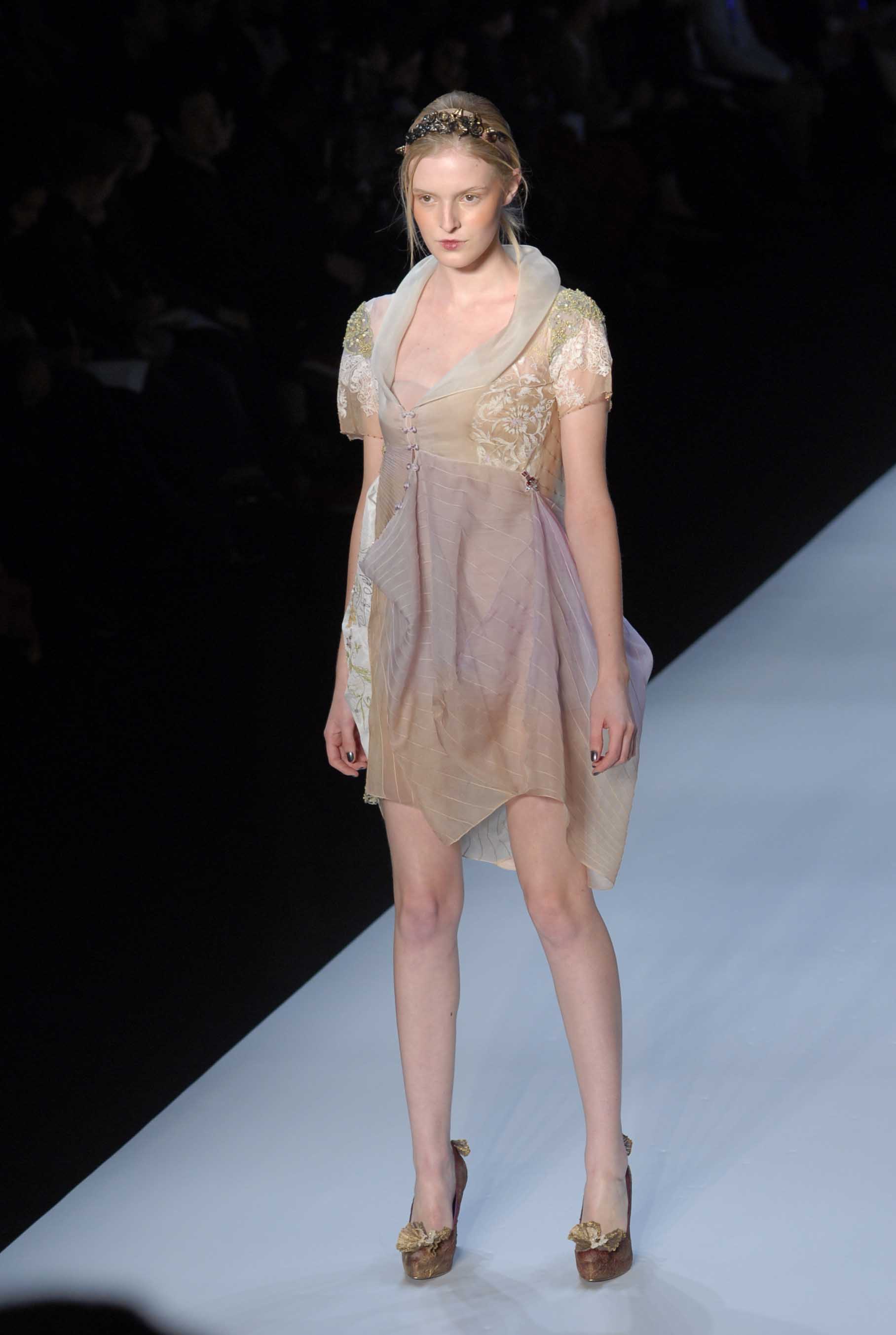
The structure inside a white dress
Lino Villaventura history becomes especially clear when color recedes. Anttónia opened the summer 2025 presentation with a layered white dress whose edges moved in different directions. Draping directly around the body gave flat cloth depth and changing shadows.
The central question is how a material is made to stand away from the wearer. Surface decoration works with an underlying arrangement of projecting and recessed planes. Movement reveals relationships that a single frontal photograph cannot contain.
Belém, Fortaleza and an atelier
Lino Villaventura history began in Belém in 1951. He moved with his family to Fortaleza in 1971. A Ceará legislative chronology records boutique work, a small atelier in 1975 and clothing production under his name after marrying Inez in 1978. The brand itself identifies 1978 as its beginning.
He has described leaving engineering studies without taking a formal fashion course. Making clothes established his own methods. A Fortaleza shop opened in 1980; the company registration followed in 1982. These are distinct stages in the development of his practice.
Lines that alter a surface
Lino Villaventura history is marked by narrow raised lines, assembled surfaces and changing volumes. Parallel folds divide the light; changing their direction changes the apparent flow of cloth. Joining materials of different weights also affects how a garment bends.
The documented 2022 presentation included a structured dress, an asymmetric tunic, a silver cape and an open modular vest. Related techniques operated at different scales. Surface and support became difficult to separate, because the same construction both decorated the garment and shaped its movement.
A rough vest and a shining cape
Lino Villaventura history in winter 2025 brought contrasting materials together. A white tweed-like vest with a frayed hem appeared alongside pearl decoration. Brown, green and purple then entered the presentation.
A quilted nylon cape and a golden, ribbed buriti-fiber skirt offered different kinds of light and texture. The final black garments reduced color contrast and emphasized construction. Such comparisons show how changing the material can transform a familiar vocabulary more profoundly than changing its color. Quilting fixes layers together, so its thickness also helps determine the cape’s outline.
Reconnecting the archive
Lino Villaventura history turned inward for summer 2026, shown in October 2025. Opening patchwork looks combined archive materials. An early garment made for Inez and a coat exported to Japan in the 1980s returned in altered forms and textures.
Silk, linen and cotton moved between generous and close-fitting constructions. Wire supports, thread, stones and crystals shaped the silhouettes and their surfaces. Vivi Orth closed in peach. The archive supplied working material rather than simply a set of images to reproduce.
People who interpret the garment
Lino Villaventura history also includes Inez and Régis Vieira. Earlier interviews distinguished Inez’s administrative work from Régis’s creative assistance. Summer 2026 coverage credited both with helping direct the collection. A 2025 Fortaleza photography-museum exhibition paired twenty-three looks with photographs.
Models reveal how supported areas and freely falling sections interact. Wire is only part of the solution: posture and pace complete its visible effect. In his post-show comments, the designer emphasized that a garment requires a person to wear and interpret it.
A continuing construction language
Lino Villaventura history continued at Fortaleza’s DFB Festival in 2026. The Ponte dos Ingleses presentation used jacquards, metallic-finished silks and voluminous constructions, bringing his established surfaces into outdoor light.
Reading the work means asking which lines support the garment, which sections fall freely and where movement is allowed. The same concerns connect dramatic eveningwear with simpler clothing. His durable contribution lies in treating dress as a space between material and a moving body.
Timeline
- 1951 — Born in Belém.
- 1971 — Moved to Fortaleza.
- 1978 — Official beginning of the label.
- 1980 — Opened the first shop.
- 2025 — Presented an archive-led summer 2026 collection.
- 2026 — Presented at Fortaleza’s DFB Festival.
Sources
- Ceará legislature: career chronology (PDF)
- Official atelier: Quem somos
- Pátio Hype: designer interview
- ELLE: summer 2025 interview
- SPFW: winter 2025
- ELLE: winter 2025
- O Povo: designer discusses 2022 collection
- SPFW: summer 2026
- ELLE: summer 2026 archive
- Metrópoles: post-show interview
- Márcia Travessoni: DFB 2026