Lie Sang-bong: Script, Windows and The Kiss
From Hangul strokes to window grids and Klimt: signs become clothes.
ÉPOPLI ·
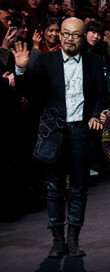
Reading a moving surface
Writing can be read as meaning or seen as line and space. Lie’s use of Korean script brings those experiences together. Lie Sang-bong history asks what happens when a familiar sign becomes a moving surface. His Paris work presented in 2006 treated Hangul as contemporary fashion material. Hangul fashion need not turn a garment into a noticeboard: folds interrupt the rhythm of strokes and wearing changes the relationship between large and small marks. This question links later experiments with windows, butterflies and painting. Each considers how a surface interacts with a body.
From theatre to sewing
He studied broadcasting and entertainment at the Seoul Institute of the Arts and worked in theatre before entering sewing and alterations to earn a living. In a 2015 interview he recalled conversations with a friend working at a sewing machine after rehearsals. Lie Sang-bong history combines the wish to perform with the practical need to make clothes. He opened his eponymous boutique in 1985, attracted attention with Reincarnation in 1993 and presented in Paris in 2002. Theatre need not explain every garment, but presentation and performance recur throughout the career. Technical construction and the order in which an audience encounters clothing both mattered.
Butterflies and regular grids
Hangul fashion did not become his sole formula. Spring–summer 2013 combined butterflies with houndstooth, the broken-check pattern named for its pointed shapes. Lie Sang-bong history brought a regular repeat into contact with expanding, wing-like volume. He described translating childhood memories and 1960s imagery into contemporary forms. These butterfly silhouettes were not simply pictures placed on the back: draping and construction suggested spreading and folding. Draping shapes cloth directly around a body or dress form. A viewer could move between reading the orderly pattern and following the garment’s changing outline. These butterfly silhouettes demonstrate how a natural reference can become structure.
An opening in a paper window
A 2013 window-inspired project recalled puncturing paper screens with a finger. Black marks interrupted the grid. Lie Sang-bong history thus includes a remembered action as well as an inherited motif. These window patterns can resemble checks from a distance, but an apparent opening breaks their regularity. A window divides inside from outside while permitting sight, and clothing also negotiates concealment and display. His mugunghwa graphics simplified the flower into a printable form. These window patterns and floral graphics provided entry points both for viewers who recognised their cultural references and for those approaching them through familiar visual forms.
Klimt and the museum
Autumn–winter 2023 The Kiss developed through collaboration with the Belvedere and Gustav Klimt’s painting. Lie Sang-bong history cannot be restricted to one national repertoire. The museum describes 65 designs using embroidery and pattern work, including motifs connected with its digital Kiss project. Gold and geometric areas became material for translating a flat image into several surfaces around a body. Reproducing a painted costume and reworking a painting’s colour relationships are different tasks. After Seoul, the collection appeared in the palace gardens in Vienna on September 5, 2023. Institutional cooperation, supported by Advantage Austria, made this more than a private encounter with a reproduction.
The organisation behind clothes
Workplace responsibility also belongs in the account. In 2015, controversy arose over low pay for trainees and interns, and Lie publicly apologised for shortcomings as a business manager. Lie Sang-bong history includes this question about the labour behind public presentation; the reported allegations and apology should not be turned into an unverified legal conclusion. In a July 2026 interview he discussed ageing sewing workforces and the need to connect Korean fabric makers, designers and distribution. Ideas depend on people able to make samples and channels through which finished clothes reach buyers. These later industrial concerns do not erase questions about earlier management.
From signs to structures
Reading Lie Sang-bong history today means comparing operations rather than assembling a list of decorative themes. Script becomes rhythm, wings become volume, a window grid meets interruption and painted colour wraps around a constructed form. The clothes need to communicate visually as well as culturally. A viewer unfamiliar with the original reference can still follow seams, spaces and proportions; knowledge of the source then deepens that reading. His official archive and verified 2026 interview document continued engagement with design and its production environment. The translation of signs into clothing, and the relationships among those who make it possible, remain useful ways to examine the career.
Timeline
- 1985 — Opened his eponymous boutique.
- 1993 — Reincarnation collection.
- 2002 — Paris debut.
- 2006 — Presented Hangul fashion in Paris.
- 2023 — The Kiss collaboration with the Belvedere.
- 2026 — Interview on Korean production and distribution.
Sources
- Minumin: Fashion is Passion
- Korea Times: designer interview, 2015
- Financial News: education and chronology
- The Fashion Spot: SS2013 interview
- MK: butterfly and houndstooth interview
- World Korean: window patterns interview
- Belvedere: Klimt Takes the Runway
- Advantage Austria: The Kiss project
- SBS: public apology, 2015
- Seoul Economic Daily: July 2026 interview
- Official collection archive