Junko Koshino: Contrasts for Bodies in Company
Design connecting boutiques, percussion, exhibitions and railways.
ÉPOPLI ·
Wearing Exhibition Light
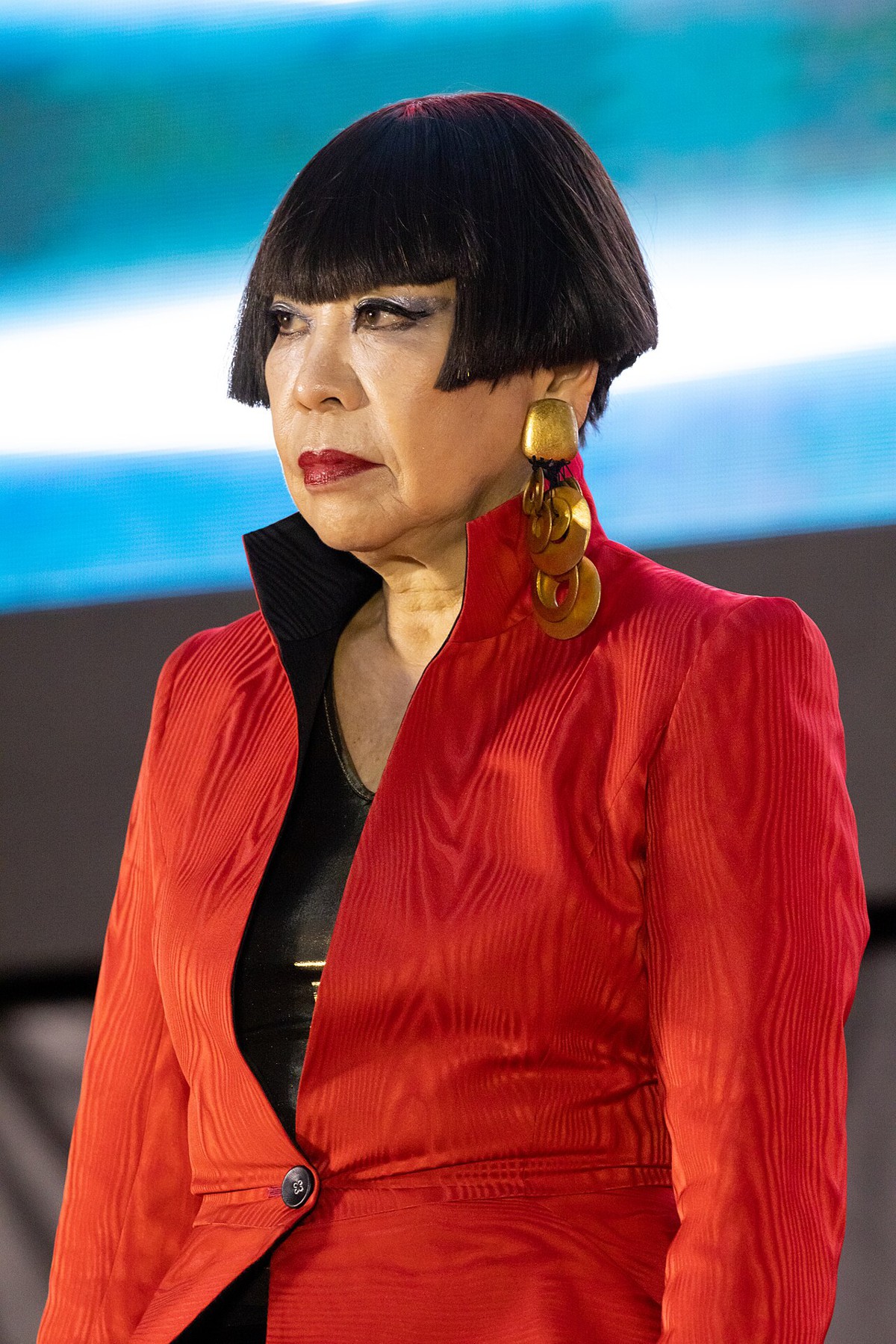
The Takara Belmont staff clothing for Expo 2025 responds to exhibition light through silver and white. Junko Koshino history begins here with a relationship between dress and its surroundings. The company documents a sketch beginning with an asymmetric sculptural hat, followed by repeated workshop prototypes. Head and body are conceived as one visual arrangement. Silver returns light from the space; white makes its divisions legible. The uniform connects staff to the booth while retaining their presence. A single style across age and gender was part of the brief. Individual fashion and clothing for several people solve different problems, but Koshino has repeatedly moved between them to construct a collective image.
The Boutique as Meeting Place
Born in Kishiwada, Osaka, in 1939, she won the Soen Award while studying at Bunka Fashion College in 1960. Junko Koshino history also belongs to Tokyo’s emerging cultural meeting places. She opened COLLET in Aoyama in 1966 and later worked through a boutique called JUNKO. Clothing for groups including The Tigers connected the shop to music and entertainment. Paris collection participation began in 1978. Her practice did not develop within only one category of formal dress. A stage coordinates several bodies; a shop lets a person make an individual selection. Moving between these settings makes appearance relational. Paintings from her school years were included in her retrospective, extending the account beyond finished clothing. Drawing, space and the body remained connected activities.
Working in the Future
For Osaka Expo 1970 she designed clothing for three pavilions. In Junko Koshino history, this was an early problem of making the future visible through people at work. The museum highlights function, new form and a cross-gender approach. A uniform appears repeatedly, so small choices accumulate into a collective rhythm. Colour divisions seen on one wearer become a pattern in a group, while fastening positions supply organising lines. Daily wear and maintenance remain important even within a futuristic exhibition. Staff must be identifiable and able to move. Later railway, hotel and exhibition work revisits that balance. A recurring event name does not make the clothes of 1970 and 2025 equivalent: the image of a future must be redesigned for another set of materials and working conditions.
Armour in Rhythm
DRUM TAO’s 2018 Contemporary Armor costumes connect the suggestion of protection to percussion. This stage costume in Junko Koshino history makes music visible. Large arm movements and changing torso directions animate an outline in time with sound. Armour implies rigidity, yet a performing garment cannot obstruct playing. The relationship of shoulders, waist and space for action matters alongside a still photograph. Collaboration with the group began in 2012, allowing movement and design to meet repeatedly. A mannequin and a musician do not communicate the same information in the same clothes. Choreography, lighting and the distances between performers alter perceived scale. The costume becomes something like a visual instrument within a production authored through several disciplines.
Circles and Corners
Her concept of opposing forces brings circles and squares, curves and straight lines into relationship. In Junko Koshino history this is a means of organising tension rather than dividing dress into two camps. A circle leads the eye continuously; a corner interrupts it. On a curved body, geometry and volume modify each other. The retrospective includes a 2010 Spike Dress and a 2004 pine-patterned haori, a Japanese outer garment. One directs attention to a projecting outline, the other to the relation of a large image and a familiar clothing type. Close and distant viewing reveal different information. This stage costume likewise uses expanded silhouettes to address an audience across space. A prominent form and the presence of the person inside it must remain in balance.
Continuity at the Station
Nankai Electric Railway’s 140th-anniversary staff clothing in 2025 offers another answer. Junko Koshino history connects it to memories of Kishiwada’s Danjiri festival attire and to daily work. The official design account calls the concept UNITY, emphasising simplicity, manageable materials and movement. Instead of transplanting theatrical exaggeration, the design addresses repeated use by many people. Consistency also helps passengers identify someone who can assist them in stations and on trains. Functional recognition and the pride of belonging operate together. Comparing this project with the silver Takara Belmont clothing reveals different requirements within collective dress. One participates in a special exhibition environment; the other belongs to recurring transport service.
Materials and Partnerships
The official record checked on 11 October 2026 includes the Kino-Colle spring/summer 2026 collaboration, published in December 2025. Junko Koshino history continues through material choice as well as outline. Created for the fiftieth anniversary of Meiji’s Kinoko no Yama, the project used a synthetic leather incorporating cacao husks. A food by-product entered a clothing surface, although that fact alone does not establish the environmental impact of the entire process. Collaboration affected material as well as imagery. The 2025 Order of Culture and retrospective exhibitions publicly recognised a long career without confining it to museum display. Across boutiques, Paris collections, percussion and railway clothing, continuity lies in adjusting contrasts to a setting. What a body must do, and how it is seen by others, guides the next form.
Timeline
- 1939 — Born in Kishiwada, Osaka.
- 1960 — Won the Soen Award
- 1966 — Opened COLLET
- 1970 — Osaka Expo clothing
- 1978 — Began showing in Paris
- 2012 — Began DRUM TAO collaboration
- 2025 — Received the Order of Culture
Sources
- Takara Belmont — Expo staff clothing
- Niigata Bandaijima Art Museum — retrospective
- Junko Koshino — official biography and chronology
- Junko Koshino — Nankai staff clothing
- Junko Koshino — Kino-Colle 2026
- Expo — attendant clothing competition authorship
- National Diet Library: Junko Koshino authority record