Junichi Abe: Familiar Clothes, Altered
How Kolor’s founder changed familiar clothes through materials and fastenings.
ÉPOPLI ·
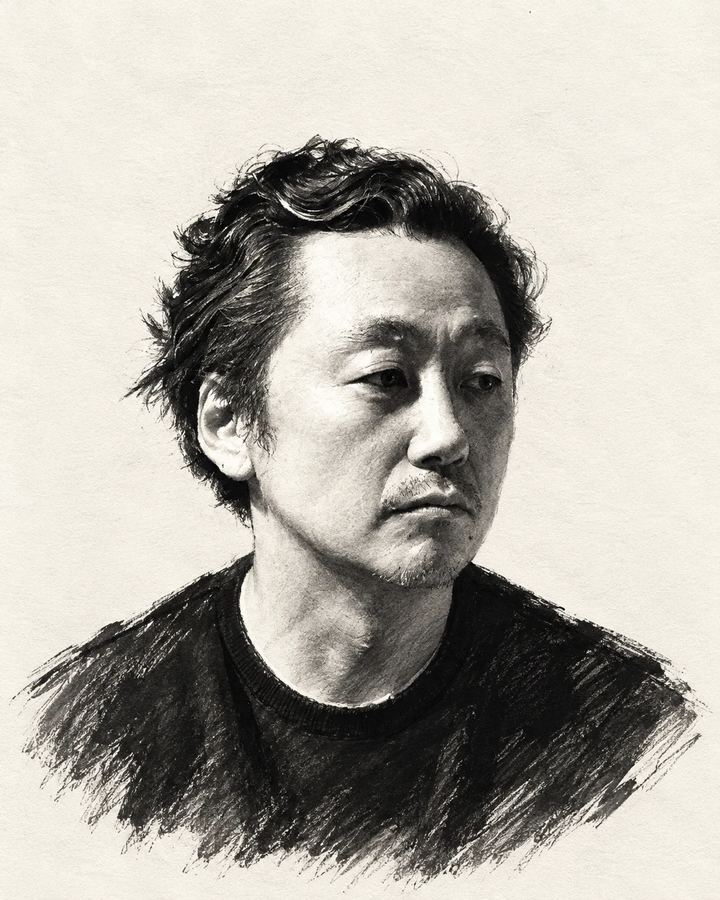
Where Should a Pattern Go?
Junichi Abe Kolor history asks how changing one familiar part can alter an entire garment. For Spring/Summer 2014, tropical motifs appeared in selected sections of shirts and around waistbands and hems rather than covering everything. Presented at Pitti Uomo in Florence, the collection made placement as important as pattern. Spain’s Museo del Traje holds a shirt-and-trouser ensemble from the season. These fabric combinations introduce differences into recognizable menswear. From a distance the clothes remain approachable; closer viewing reveals contrasting decisions about texture and proportion. The interest lies in the space between those readings. Narrow bands of pattern interrupt the vertical line without erasing the trousers beneath. Each component can still be read as a separate garment, connecting the runway combination to an actual wardrobe.
Samples and Patterns
Born in 1965, the designer grew up in a family that ran a kimono shop. His mother also liked Western clothing and dressed him in jackets and knitwear, as he recalled in interviews. Junichi Abe Kolor history connects that background with concrete tools: a colour book from his father and fabric samples sent from home. He studied at Bunka Fashion College before working within Yohji Yamamoto’s organization and at Comme des Garçons. His patternmaking work at Tricot preceded a role in the new Junya Watanabe line. A pattern translates flat cloth into a structure around the body. Working in a small team also exposed him to the practical demands of establishing a label, beyond producing an isolated design.
An Independent Responsibility
In 1994 he established PPCM with three colleagues, then founded Kolor in 2004 as their individual ambitions diverged. Junichi Abe Kolor history developed through showrooms before its first Paris runway for Autumn/Winter 2012. Blue carpeting helped connect the presentation with the atmosphere of its retail space. In an interview about that debut, he described a show as another way to communicate existing work. Discussions with staff moved from an elusive mood toward buttons, interlinings and sewing decisions. Colour was never simply a fixed palette attached to the name. The relationship between a knit, shirt and jacket mattered more than any isolated hue.
Clothes That Must Perform
For Spring/Summer 2015, mesh, nylon, knits and denim changed the meaning of sportswear. The silhouette began with an oversized T-shirt; perforated layers crossed coats while light fabrics emerged beneath denser materials. Junichi Abe Kolor history demonstrates here that fabric combinations can reorganize dressing rather than merely decorate a surface. Transparency makes the layer underneath part of the visible composition. The adidas collaboration, launched for Autumn/Winter 2015, introduced a further requirement: performance clothing had to work during exercise. Conversations with the adidas team therefore concerned materials and shapes as well as the limits within which they remained usable. The two projects developed alongside one another.
One Garment Inside Another
Junichi Abe Kolor history becomes especially legible in garments documented around 2021. A corduroy skirt opened by a zip to reveal denim; a coat incorporated flight-jacket sections; a satin dress combined jacket shoulders and chiffon. Their reconstruction differs from styling separate garments together because the object determines its own boundaries. A recognizable collar or fastening gives the viewer a reference against which to measure change. Following a seam around the side, or observing how much of an interior colour becomes visible when a zip opens, reveals the structure. Contrasting weights and flexibility make those transitions physical as well as visual.
Showing Movement
After Autumn/Winter 2017 he paused runway presentations, later preparing a return that encountered the pandemic. Film and a Tokyo show offered different ways forward. Autumn/Winter 2021 was presented at Happo-en. Junichi Abe Kolor history also concerns this relationship between a finished object and a moving body: spaces between layers change during walking. He had questioned the pressure to design for a forceful show opening rather than the eventual wearer. This reconsideration connected presentation with production again. His reconstruction could be found in a displaced knit neckline or trouser hem, not only in an elaborate showpiece. Collaboration likewise meant negotiating different product requirements rather than simply adding another name.
Kolor After Its Founder
After the Autumn/Winter 2025 show, creative responsibility passed to Taro Horiuchi, whose first collection was Spring/Summer 2026. FHCM described the founder as remaining involved with the company. Junichi Abe Kolor history must therefore distinguish these new collections from his own designs. The 2024 business succession and subsequent creative handover moved the organization into another phase. Earlier exchanges between sportswear and tailoring remain a useful point of comparison. Start by identifying the familiar garment—a collar, fastening or neckline—then follow where another element interrupts it. This makes his contribution visible as an adjustment to the order of everyday clothing, rather than an account of unusual colour alone.
Timeline
- 1965 — Born
- 1994 — Co-founded PPCM
- 2004 — Founded Kolor
- 2012 — Paris runway debut
- 2015 — Launched adidas collaboration
- 2025 — Handed creative responsibility to Taro Horiuchi
Sources
- Interview: Junichi Abe
- OPENERS: Designer interview
- Museo del Traje: Kolor ensemble
- Interview: Pitti Uomo
- DA MAN: Designer interview
- AnOther: SS15
- Vogue Japan: Abe interview
- WWD Japan: Handover
- FHCM: Taro Horiuchi