Hardy Amies: Clothes for Public and Everyday Life
From royal rainwear to shop-floor clothing: form follows a task.
ÉPOPLI ·
A raincoat in the royal wardrobe
A transparent 1960s raincoat offers an unexpected opening to Hardy Amies history. The Royal Collection explains that it kept the Queen’s bright daywear visible to crowds in wet weather. Protection and public recognition worked together. A 1968 evening dress worn at the Guildhall for the Press Association centenary provides a contrasting example: its impact, the collection says, depends on cut rather than embellishment. These garments begin with different duties, suggesting that practical function and formality need not be opposites.
Commerce before couture
Born in London in 1909, Hardy Amies history followed no conventional dress-school route. After Brentwood School he lived in France and Germany, learned languages and returned to commercial work for a weighing-machine company. He entered Lachasse in 1934, later worked at Worth and served in wartime intelligence. Moving to Savile Row late in 1945, he opened his house in 1946. A boutique followed in 1950, connecting personal orders with simpler clothes available to a wider clientele.
Room inside a fashionable outline
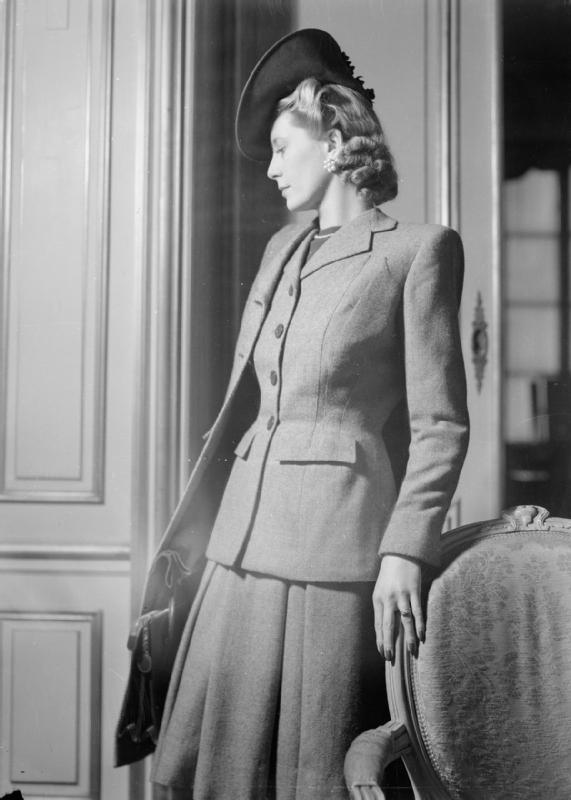
The ribbed wool coat of spring–summer 1949 gives Hardy Amies history a measurable relationship to Dior’s New Look. Broad, squared shoulders and a less restricted waist adapt its expanding skirt silhouette. The coat retains the period’s contrast while allowing more room around the wearer. Its prominent collar and fastening organize attention without added ornament. Tailoring concerns where to leave space as well as where to fit closely: a shared fashionable outline can accommodate different circumstances of use.
Menswear in motion
Hepworth’s collaboration brings performance and manufacture into Hardy Amies history. The 1961 Savoy presentation showed menswear on moving bodies. Danielle Sprecher’s research records joint model selection by company and designer; Tony Armstrong-Barnes recalled interviews at Hepworth’s office and Savile Row. Rehearsals involved studio personnel, including Ken Fleetwood. Production, casting and presentation all contributed to translating a couture name for a broader market. The work continued beyond completing an individual garment.
Laundry as a design requirement
The Sainsbury’s workwear commissioned in 1963 makes Hardy Amies history unusually concrete. A March 1964 staff journal explains the need for garments employees could wash and dry at home. Pale blue accommodated preferences and store surroundings. Nylon brought convenience but retained fats associated with handling unpackaged food, so use was limited to self-service shops. Sleeve and neckline adjustments also related to work. Unlike the royal raincoat’s visibility requirement, this garment had to return ready for another shift. Function depended on a specific environment rather than universal suitability.
A workshop beyond the first fitting
Hardy Amies history includes design director Ken Fleetwood and licensing specialist Roger Whiteman; Jon Moore succeeded Fleetwood after his death in 1996. Their different roles supported a business spanning several markets. UAL preserves 1950s couture garments alongside alteration invoices and receipts. These records show work continuing after sale. Tailoring was not finished by the first publicity photograph: adjustment and maintenance helped clothes remain useful as the wearer’s needs changed. The archive therefore records a service as well as objects.
Clothing that continues to work
After his death in 2003, Hardy Amies history continued through objects and institutions, distinct from later businesses using his name. Brentwood states that its girls still wear the uniform he designed. Royal Collection material for the 2026 exhibition reintroduces his transparent raincoat. Court dress, a roomy wool coat and washable workwear address different people and prices, yet each equips a body for a particular situation. His legacy can be read through space, material, visibility and maintenance rather than conservative appearance alone. Tailoring knowledge could operate well beyond the salon.
Timeline
- 1909 — Born in London
- 1934 — Joined Lachasse
- 1946 — Opened his Savile Row house
- 1955 — Received the Royal Warrant
- 1961 — Menswear presentation at the Savoy
- 1963 — Designed Sainsbury’s workwear
- 2003 — Died
Sources
- UAL — Hardy Amies biography
- London Museum — Coat, 1949
- Royal Collection — Evening dress, 1968
- Sainsbury staff journal, March 1964 (PDF)
- London Museum — Hardy Amies
- UAL — Couture collection and alteration receipts
- Brentwood School — Uniform and Amies
- Royal Collection — Her Life in Style exhibition
- Danielle Sprecher — Menswear fashion parades research (PDF)
- The Independent — Sir Hardy Amies obituary