Edward Molyneux: Construction Within Restraint
Velvet gowns, tailored outlines and the changing conditions of couture.
ÉPOPLI ·
A line through velvet
The green velvet evening dress from autumn/winter 1935 makes Edward Molyneux history a question of cut before ornament. The Kyoto Costume Institute garment follows the torso before widening into a mermaid hem. Bias cutting places cloth diagonally to its grain, allowing it to follow curves, while gathers at the seams control its drape. Velvet changes in brightness with the direction of the surface, creating variation without an applied picture. Length and close fit register the shift from shorter, straighter 1920s clothes to 1930s evening dressing. The question is how much construction a apparently simple outline contains.
From drawing to a house
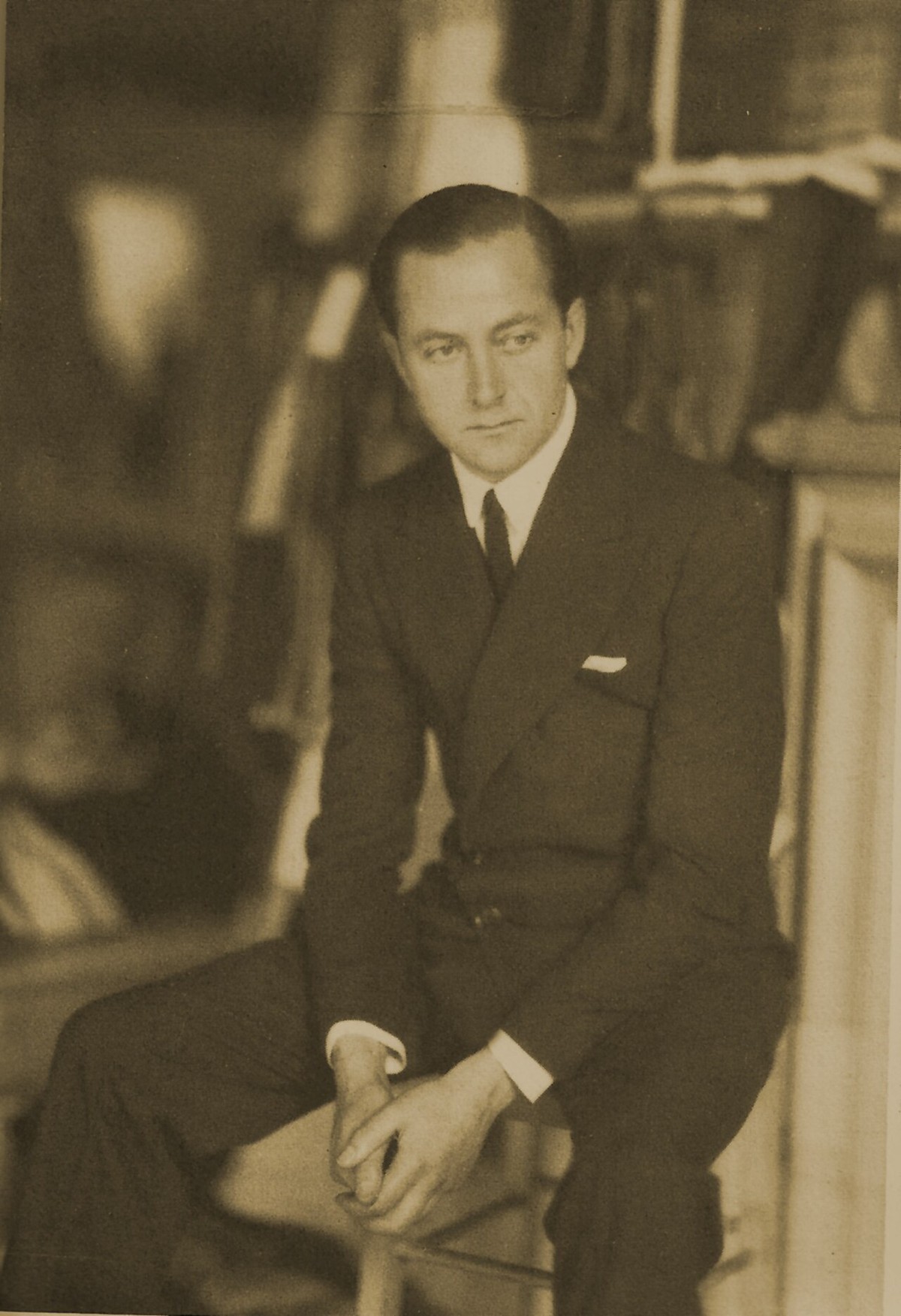
Born in 1891, Edward Henry Molyneux studied art and entered fashion through drawing. He won a Lucile design competition in 1911 and became a sketcher. Edward Molyneux history therefore began inside a house known for evocatively named dresses and model presentations. His later restraint did not arise from ignorance of theatrical fashion. He joined the army in 1914, lost an eye in the First World War and retained the title Captain. After the war he moved to Paris, opening his own house in 1919. Drawing an appearance expanded into directing a business that worked with bodies and fabric. Branches in London, Monte Carlo, Cannes and Biarritz connected different social and holiday wardrobes.
Another velvet, another movement
Palais Galliera’s blue evening dress of autumn/winter 1935–1936 offers a comparison within Edward Molyneux history. A round neckline, gathered side waist and train combine with slashed sleeves that extend into exceptionally long, two-pointed panels. Where the green garment widens below the body, this one adds long lines around the arms. Moving panels follow the wearer at a different pace. Its drape, the hanging and folding of cloth, depends on movement as well as a still view. Both garments bear labels from the same Paris address, demonstrating related principles expressed through different constructions.
An evening in 1939
The Met’s Winterhalter evening dress supplies a documented occasion in Edward Molyneux history. Made in silk and metallic thread for autumn/winter 1939–1940, it was worn by Madame Paul-Louis Weiller at the 1939 celebration of Lady Mendl’s seventy-fifth birthday, hosted by the Weillers. Fabric and an identified occasion provide firmer points of analysis than assumptions prompted by the painter’s name. Metallic thread introduces reflected light beside silk’s softer surface. Comparing it with velvet shows that simplicity did not require an absence of brilliance. Couture clients helped define the setting in which the garment would act, rather than simply purchasing an already finished object.
An environment for another designer
Pierre Balmain worked as an assistant here from 1934 to 1938 before joining Lucien Lelong and later opening his own house. Edward Molyneux history includes this professional environment as well as individual garments. Tailored suits, pleated skirts and evening clothes served different purposes while sharing an ordered outline. A tailored suit depends on the balance between a line close to the body and sufficient ease. Apparently effortless drape likewise requires careful seams and finishing. With less conspicuous decoration, small differences in proportion become more legible. Translating sketches into garments offered experience in judging those differences.
Wartime conditions
Utility clothing made in London during the Second World War changes the conditions of Edward Molyneux history. These practical garments responded to restrictions on materials and production. The task differed from creating an evening-party appearance: fabric use and manufacture entered the brief at the beginning. Experience in shaping a tailored outline provides a way of understanding this work. The business did not continue indefinitely after the war. Poor health accompanied the closure of the London house in 1949 and Paris in 1950, followed by retirement to the West Indies. War, health and the operation of branches belong beside the society clientele in this career.
Ready-to-wear and painting
Studio Molyneux opened in 1964, a late restart within Edward Molyneux history centred on high-quality ready-to-wear. Standard sizes and production units changed how clothes reached customers compared with individually fitted couture. He retired again in 1969; John Tullis continued the studio until its closure in 1977. Molyneux himself died in 1974. Painting was another continuing practice. The National Gallery of Art holds his early-1960s quay and Provençal chapel scenes and a 1953 painting of a Chinese statue and dog. Fashion and painting need not be treated as equivalent to recognize the persistence of visual work. With the surviving dresses, looking first at the overall line and then at seams, grain and drape makes the construction beneath restraint visible.
Timeline
- 1891 — Born
- 1911 — Joined Lucile as a sketcher
- 1919 — Opened his Paris house
- 1935 — Made velvet evening dresses
- 1950 — Paris house closed
- 1964 — Opened Studio Molyneux
- 1969 — Retired
- 1974 — Died
Sources
- KCI — Evening dress, autumn/winter 1935
- National Portrait Gallery — Edward Henry Molyneux
- Museum of Fine Arts Houston — Edward Molyneux
- Paris Musées — Robe du soir, 1935–1936
- The Met — Winterhalter
- The Met — Pierre Balmain, Evening dress
- National Gallery of Art — Captain Edward H. Molyneux