Chitose Abe Sacai history: familiar clothes, new forms
From five knitted pieces to hybrid garments and Gaultier couture.
ÉPOPLI ·
A different story at the back
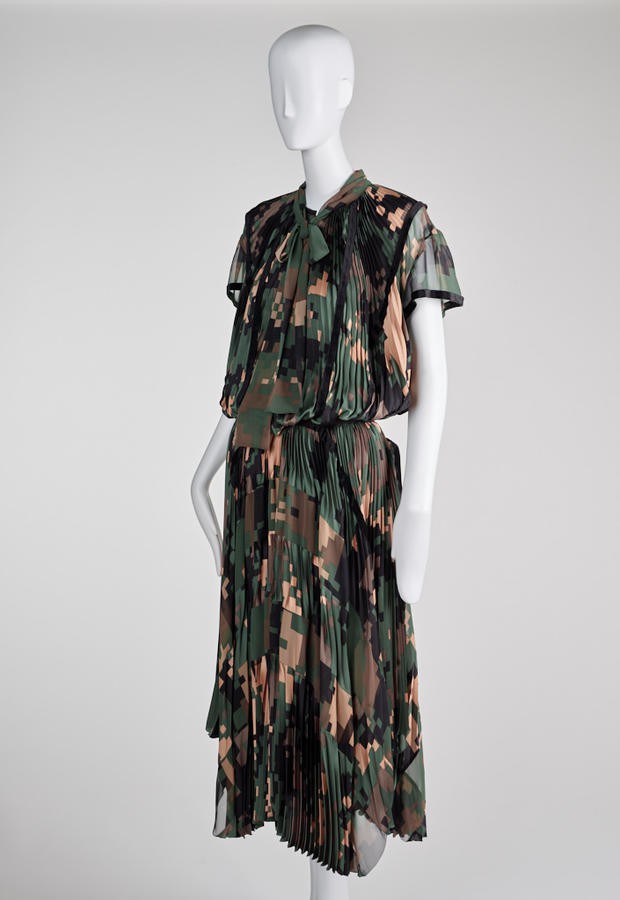
Chitose Abe Sacai history begins with the possibility that a garment’s front and back need not tell the same story. Jean Paul Gaultier recalled noticing a Sacai sailor dress with lace at the back. Familiar stripes met another kind of surface. This hybrid construction joins different garment types or materials, but the effect is more than an illusion of wearing two things. A composed front can become light and mobile as the wearer turns. The question is where to alter something already understood. Shirts, sweaters and coats are not only style categories: they carry different weights, movements and construction habits.
Returning with five pieces
Born in Gifu in 1965, Abe studied fashion in Nagoya before starting at the clothing company World. She subsequently worked at Comme des Garçons and with Junya Watanabe. Chitose Abe Sacai history includes both this practical experience and a break after the birth of her daughter in 1997. Wanting to make again, she produced five hand-knitted garments and established Sacai in Tokyo in 1999. Samples preceded a large collection or ambitious public launch. Corporate procedures and experimental design offered different foundations for running a business around clothing. Her husband Junichi Abe’s Kolor and Sacai are separate labels led by their respective designers.
Where knit and woven meet
Knitwear was a starting point rather than a limit in Chitose Abe Sacai history. Stretching knitted fabric and fine woven cloth respond differently to the body. This hybrid construction turns that difference into a new outline. The point where a fine layer emerges beneath a sweater has to look deliberate and remain wearable. Spring/summer 2015 juxtaposed army clothing, paisley and flowers, shirtdresses and floating ruffles. A ruffle gathers fabric into a moving edge, changing the impression of an otherwise straight form. This textile development is part of making those differences work together. Selecting attractive surfaces alone does not resolve their different responses to tension and weight.
A method translated into footwear
The Nike LDWaffle transfers Chitose Abe Sacai history to a smaller object. Nike describes it as a combination of the LDV and Waffle Racer. Joining familiar garment forms becomes a question of footwear components and outline. The later Cool Grey edition with CLOT uses translucent mesh, fused construction and a reflective Swoosh. Its upper—the part covering the foot—makes protection appear layered and partly transparent. This collaboration can therefore involve the underlying product rather than only shared branding. A shoe’s specific function and compact scale show that Sacai’s identity need not depend on one dress shape or colour.
Gaultier and the couture atelier
The first guest-designed Gaultier couture collection in 2021 offered another working environment for Chitose Abe Sacai history. Abe reinterpreted the house’s archive through her own method. Sailor stripes and tartan met in a drop-waisted dress with a long train. Light fabric pieces allowed a familiar grid to move differently. This collaboration included the atelier’s fitting and making capacities, as well as other designers such as Pierre Hardy for footwear. Couture, with its detailed work for an individual wearer, supplied different conditions for an approach developed in ready-to-wear. It expanded the experiment without removing Sacai’s interest in bringing existing types of clothing together.
Wrapping and turning garments
Wrapping the body became particularly evident in autumn/winter 2025. Chitose Abe Sacai history continued through military shapes with knitted panels, elongated skirts and poncho-like volume. This textile development negotiates protection and movement as well as contrasting surfaces. Spring/summer 2026 then turned garments upward, including cargo-trouser legs folded into skirt-like forms. Pockets and seams retained memories of their original function in unfamiliar positions. In a 2026 interview, Abe discussed refocusing on what Sacai could uniquely do amid changes and noise around the industry. Continuity meant clarifying a working method rather than reproducing every previous shape.
Unfamiliar forms in everyday life
Chitose Abe Sacai history remains active in October 2026, with spring/summer 2027 documented on the official site. The label also extended its approach into menswear in spring 2009. From initial knitting to Paris presentations, shoes and couture, the question of unfamiliar but usable clothes remains. What matters is not how many elements enter a garment but how they function together on a body. A sweater and fine cloth, a solid sole and translucent upper, or stripes beside checks do not have to erase their differences. Looking closely and watching someone turn reveals those relationships. Her experiments depend on a memory of ordinary clothing: recognising the familiar makes each alteration more visible.
Timeline
- 1965 — Born in Gifu.
- 1997 — Left her job after the birth of her daughter.
- 1999 — Established Sacai in Tokyo.
- 2009 — Launched menswear in spring.
- 2021 — Guest Gaultier couture collection.
- 2026 — Presented spring/summer 2027.
Sources
- Vogue: Gaultier and Abe conversation
- The Gentlewoman: Chitose Abe interview
- Interview: Chitose Abe
- Sacai: official brand history
- Nike: LDWaffle sacai CLOT Cool Grey
- W: Gaultier couture interview
- AP: autumn/winter 2025 review
- Wallpaper: spring/summer 2026
- Vogue Japan: 2026 interview
- Sacai: spring/summer 2027
- Palais Galliera: Love Brings Love, French press dossier, p.16 (PDF)