Tod’s history: design beginning under the foot
Tod’s developed from the Della Valle family’s shoemaking business into footwear, bags and clothing centred on everyday use.
ÉPOPLI ·
- Brand
- Tod’s
- Origins
- Marche, Italy
- Focus
- Footwear, leather goods and clothing
A workshop and a later brand
The small rubber elements extending around a heel can look like pattern. Tod’s history becomes more informative when they are first considered in relation to the foot and ground. The roots lie in Filippo Della Valle’s small shoemaking workshop in the early twentieth century. A later generation, associated with Diego Della Valle, expanded the family business into an international brand. Those are distinct stages. Regional making knowledge and product presentation meet in the Gommino: neither workshop skill nor advertising alone explains the object. Its significance lies in a useful detail becoming a recognizable sign that could travel beyond the original context.
Reading the Gommino from below
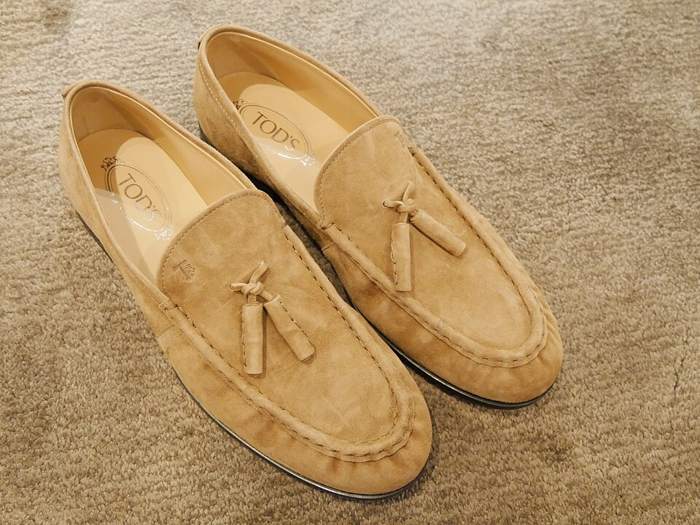
The Gommino is the first object through which to read Tod’s history. Museo Omero dates Diego Della Valle’s model to 1983. Sources discussing earlier business activity need not be describing the same event, so product chronology should remain separate from family origins. The moccasin form combines leather surrounding the upper foot with repeated rubber elements below. Instead of emphasizing one thick continuous sole, the arrangement divides the underside visually. It belongs to a driving shoe context, but that does not establish that the house invented the entire category. Proportion, materials and presentation explain its interpretation of an existing functional type.
A functional surface becomes a sign
The underside continues around the heel, giving another view of Tod’s history. Rubber elements become a repeatable graphic vocabulary as well as functional parts. Changing their scale or spacing changes the rhythm of a surface. On a Gommino, compare the leather’s wrapping from toe to heel and how much of the underside becomes visible. Soft uppers may suggest flexibility, but that impression cannot establish the performance of every version. Materials and construction differ by model and season. The transition from useful component to decorative-looking signature is common in fashion; this shoe makes that process unusually easy to observe within a compact object.
The broad planes of the D Bag
Bags introduce a different surface into Tod’s history. The official chronology identifies the D Bag in 1997 and distinguishes a Di Bag reinterpretation for autumn–winter 2022/2023. Broad leather planes and their relationship with handles differ from the shoe’s fragmented underside. Consider how the body holds its shape when loaded and where the handles transmit weight. A famous user’s photograph provides a social setting, not a substitute for construction analysis. The original and later variations should not be treated as objects from the same moment. A continuing name can coexist with changes in scale, material and internal arrangement, which deserve to be recorded.
Different conditions of use
Changes in conditions of use provide a third case within Tod’s history. Winter variations and other footwear types show how a recognizable rubber element can move into different settings. The question is whether a visually related feature performs exactly the same role. A more continuous sole and isolated rubber sections may produce different structures despite a family resemblance. The light impression of a driving shoe should not be generalized into all-season performance. Compare upper thickness, shoe height and contact area instead. Continuity emerges when a recognizable element is adjusted to new requirements, not only when an old component is repeated without alteration.
Students reinterpret established objects
The academy collaboration begun with Central Saint Martins in 2020 offers a later reading of Tod’s history. Its official account describes young designers interpreting established objects, including the D Bag and the moccasin, through their own perspectives. Educational proposals should be distinguished from regular commercial collections. Their purpose includes testing what can change while an object remains recognizable. Moving a silhouette or repeated element into new materials reveals where identity may reside. Learning craft and questioning established design are consequently not opposites. They can form complementary parts of a process that transmits knowledge without requiring every result to reproduce its starting point.
Function becoming image
Across Tod’s history, workshop expertise develops into a broader picture of daily life. Footwear, bags and clothing occupy different places and have different structures, yet connect through materials handled or worn close to the body. Junctions between rubber and leather, handle and body, or stitch and edge describe those objects more clearly than a vague promise of Italian ease. Family business history, individual designers and student interpretations should each remain in their own period. A shared label does not make them all the founder’s work. Following the movement from functional detail to recognizable image provides a specific account of the brand’s continuity.
Timeline
- Early 1900s — Filippo Della Valle’s shoemaking workshop.
- 1983 — Gommino date in Museo Omero’s record.
- 1997 — D Bag in the official chronology.
- 2020 — Academy education collaboration.
Questions and answers
Did the workshop and Gommino begin together?
No. The family workshop predates the model, which Museo Omero dates to 1983.
Are D Bag and later Di Bag the same period?
The official chronology distinguishes the original and its reinterpretation.
Are academy proposals regular products?
Educational interpretations should be distinguished from commercial collections.