Loro Piana history: From cloth to everyday objects
Loro Piana developed from a textile company founded in Quarona in 1924 into a house of clothing, footwear and objects.
ÉPOPLI ·
- Brand
- Loro Piana
- Origins
- Quarona, Italy
- Focus
- Textiles and ready-to-wear
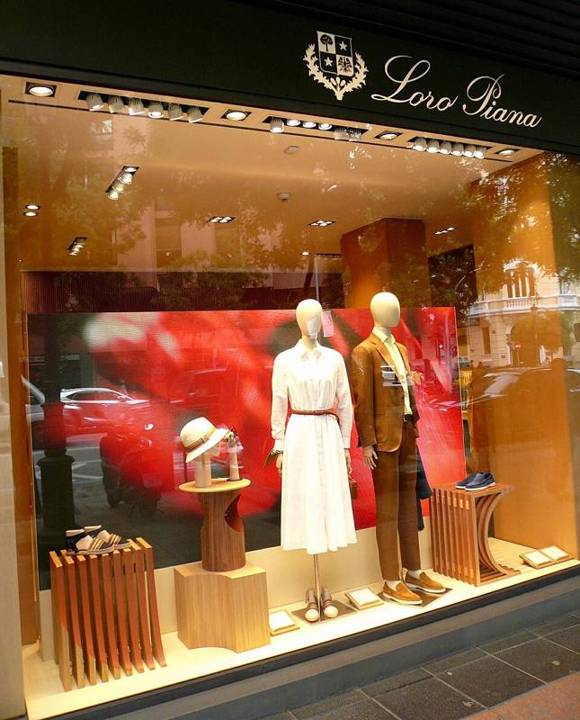
The cloth before the garment
Loro Piana history starts with a textile business rather than a finished wardrobe. Pietro Loro Piana founded the company in Quarona, Piedmont, in 1924, building on a family background in wool trading. Franco expanded fine wool and cashmere fabrics, while Sergio and Pier Luigi later developed finished products and retail. The textile business is not merely a preliminary stage hidden behind design. Choosing fibre and constructing cloth already shapes weight, movement and light. The same cut can behave differently in a raised surface or a smooth fabric. Material decisions therefore belong inside the design story, not outside it.
Between fibre and finished object
A fibre name alone cannot explain a garment. Yarn thickness, construction density and finishing all change the result. In Loro Piana history, the emphasis on raw materials becomes concrete only when these stages are considered together. Softness describes one sensation; it does not automatically describe stretch or shape retention. After reading a composition label, examine thickness, weight and the bulk around seams. A surface can communicate through density and depth of colour without a large emblem. Comparing a jacket, shoe and umbrella also shows why a shared material vocabulary does not imply identical construction across every object.
A jacket for a seated, moving body
The Roadster jacket, first created in 2004 for the seventy-fifth anniversary of the Concorso d’Eleganza Villa d’Este, connects Loro Piana history with driving. A seated body presents different demands from a standing figure: the torso folds, arms move forward and fabric gathers near the waist. The jacket should therefore be read through both its composed outline and its accommodation of movement. The documented silk version shows that a continuing model can change material. Its present specification should not be projected onto the original. Continuity lies in adapting a recognisable idea to different fabrics and seasons.
How a pale sole changes a shoe
The Summer Walk combines a suede upper with a rubber sole. Official documentation connects its conception with yachting and identifies hand stitching at the front. In Loro Piana history, it extends material-led design beyond clothing. Suede scatters light across its short surface fibres, while a pale sole draws a separate line at ground level. The junction between these surfaces matters even when the outline looks simple. Read the Summer Walk through toe length, coverage of the instep and its relationship with a trouser hem. Leisurely associations emerge from these proportions and combinations rather than from the product name alone.
Natural surfaces and protective layers
A technical umbrella makes another side of Loro Piana history visible. The documented model combines a maple handle with a three-layer cashmere canopy incorporating a Storm System membrane. Here the cloth must address rain as well as touch and appearance. Moving a familiar wardrobe material into the street requires additional protection. Storm System should not be mistaken for a natural fibre: in this example it describes a protective construction. When the umbrella opens, flat panels become a curved surface and seams distribute tension. The object is therefore more than a logo applied to an accessory; it tests another use for textile knowledge.
From family knowledge to a brand vocabulary
Loro Piana history cannot be reduced to one designer’s sequence of collections. Generations of a family, sources of fibre, textile processes and decisions about finished objects all participate. A place associated with a raw material should not be treated as the identity of every production stage. As the company moved towards finished products, material knowledge also had to become visible through colour, cut and styling. Handling a fabric sample is different from wearing a completed jacket. The transition involves translating a supplier’s expertise into a vocabulary legible to the person using the final object.
Reading from surface towards structure
Today, Loro Piana history can be approached by moving from a soft-looking surface towards structure. A jacket’s moving sleeve, the meeting of upper and sole, and an umbrella’s opened curve are all points where materials encounter use. These objects share attention to surfaces but perform different tasks. Reducing them to restrained colour would erase that distinction. Identify the precise model and material, then consider its working situation. Product documentation establishes construction and dates; looking closely helps explain their visual effects. The underlying question is how a material has been organised for a particular body, action or environment.
Timeline
- 1924 — Company founded in Quarona
- 1940s — Franco expands the textile activity
- 1970s — Next generation develops the business
- 2004 — Roadster introduced
Questions and answers
When was the company founded?
Pietro Loro Piana founded it in Quarona in 1924.
What prompted the Roadster?
It began in 2004 as a driving jacket marking the Villa d’Este event’s seventy-fifth anniversary.
Is the protective system a fibre?
No. It adds protection to a textile and should be distinguished from its fibre.