Jil Sander history: The Decisions Behind Simplicity
Jil Sander’s story asks how clothes with fewer decorative elements can retain a strong presence.
ÉPOPLI ·
- Brand
- Jil Sander
- Origins
- Founded in Hamburg, Germany
- Focus
- Luxury fashion
Jil Sander history: The Decisions Behind Simplicity
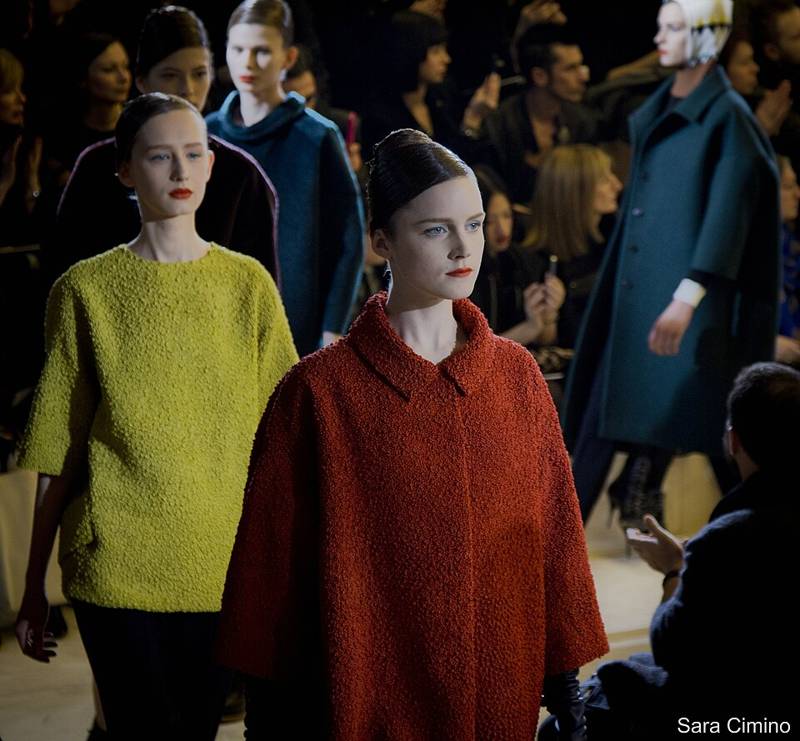
Jil Sander history asks how clothes with fewer decorative elements can retain a strong presence. The brand began in Hamburg in 1968. Its work can be approached through the relation between material and form. Here minimalism means reducing elements to clarify decisions, not avoiding design. With fewer surface distractions, shoulder width, sleeve direction and fabric thickness become more visible. Early womenswear, the introduction of menswear and the Cannolo bag provide different scales of enquiry. A wardrobe and a container perform different tasks, yet each depends on decisions that make a shape appear resolved rather than merely empty.
A modern wardrobe from Hamburg
The official chronology records the first womenswear collection in Hamburg in 1973. Distinguishing that presentation from the 1968 launch makes Jil Sander history a sequence rather than a single founding moment. The brand associates its clean-lined early clothes with a new generation of working women; that is its institutional account, not a claim that every wearer had an identical experience. A wardrobe also involves relationships between garments. Jacket length changes the amount of shirt or trousers visible, while similar colours appear different across materials. Everyday use does not remove experimentation: it locates small formal decisions within repeated wearing.
Extending the language into menswear
The first menswear presentation in Milan in January 1997 extended Jil Sander history into another set of conventions. The official account emphasises clear, comfortable cuts. Suits and shirts are not simply enlarged womenswear: they carry their own expectations. Examining proportion means comparing the relations between parts, including shoulder allowance, trouser width and jacket length. A button’s position can alter the apparent length of the torso. With less ornament, such decisions become harder to overlook. Restricting minimalism to black and white would therefore miss the structural issue. A coloured garment can also organise its outline and surfaces with precision.
The circle behind Cannolo
The Cannolo bag offers a small-scale construction question within Jil Sander history. The house explains its volume through rolling and folding a circle of leather. A flat element becomes a container without requiring elaborate ornament. Yet the folding point, ends and body-facing surface must still be resolved. Simplicity of appearance is not equivalent to ease of manufacture. Side views reveal information that a frontal silhouette conceals. When considering proportion, the strap, container and wearer belong together. Roe Ethridge’s London photographs are dated June 2024; the photographic date should not be mistaken automatically for the design’s first introduction.
Clothing, photography and space
The 2017 Present Tense exhibition at Frankfurt’s Museum Angewandte Kunst placed Jil Sander history beyond garments alone. Its installations considered fashion, product design, architecture and gardens. This allows comparison across media without claiming that all share identical construction. A garment in an open space directs attention differently from one surrounded by objects. Light can make leather appear smooth, dense or reflective; the material and the photograph’s decisions are related but distinct. The exhibition’s wider framing encourages viewers to notice presentation as well as the thing presented. A brand image is assembled through such choices rather than residing entirely in a product.
Founder and contemporary house
The founder’s name does not identify the author of every contemporary product. Jil Sander history includes changes in organisation and creative responsibility. The official chronology records OTB’s acquisition in 2021 and Simone Bellotti’s arrival in March 2025. Early collections and current garments should therefore not be presented as work made by one person at one moment. Continuity can be examined through specific comparisons: how a surface moves when its material changes, or how a looser outline alters the distance from the body. A statement of respect for heritage cannot replace observation of a successor’s actual decisions and their differences.
What to examine after simplicity
Jil Sander history returns the reader to three different tasks: connecting garments into a wardrobe, cutting cloth around a body and folding a flat shape into a useful volume. Each can appear simple, but that simplicity resolves a different problem. Alternating frontal and side views helps reveal the decisions involved. A long sleeve’s vertical line and the rounded end of a bag are not interchangeable expressions. Close viewing reveals seams and edges; greater distance reveals the whole mass. Moving between these scales suits design that creates an impression with relatively few elements. Simplicity becomes the beginning of examination rather than its conclusion.
Timeline
- 1968 — Brand launches in Hamburg
- 1973 — First womenswear collection
- 1997 — First menswear presentation in Milan
- 2021 — OTB acquisition
- 2025 — Simone Bellotti joins
Questions and answers
Where did the brand begin?
It launched in Hamburg, Germany, in 1968.
When did menswear begin?
The official chronology records the first Milan presentation in January 1997.
How is Cannolo structured?
The house describes rolling and folding a circle of leather into volume.