Issey Miyake history: fabric, folds and changing form
Issey Miyake connects textile development with the movement of the wearer. Pleated clothing, triangular-panel bags and A-POC offer different ways to examine the relationship between material, manufacture and use.
ÉPOPLI ·
- Brand
- Issey Miyake
- Origins
- Established in Tokyo, Japan
- Focus
- Experimental design
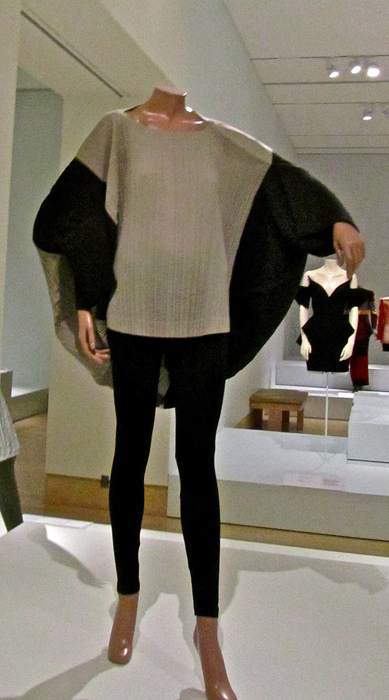
What changes when a finished garment is pleated?
A garment lying flat becomes wider and more animated when someone puts it on. That transition offers a useful opening into Issey Miyake history. The defining sequence described by Pleats Please is to sew the garment before applying its pleats. This asks the maker to anticipate volume and movement together. Seen close up, the surface is a field of narrow ridges; from farther away, it becomes a larger plane of colour. Reading across those two distances helps explain why pleating is more than applied decoration. Comparing the garment at rest and in motion reveals information a single silhouette cannot provide.
Studio, company and collection are different things
The design studio was established in 1970, followed by the manufacturing and sales company in 1971. Issey Miyake history therefore involves both an experimental organisation and a system for bringing products into use. Founder, main collection and independent lines should not be treated as interchangeable names. The idea of a piece of cloth can connect projects without making their structures identical. Textile development, cutting, sewing and fitting involve different decisions. A studio’s founding date is not the launch date of every later accessory. Likewise, a familiar label cannot by itself establish who designed a particular garment.
Dates and the evidence of movement
Accounts of the Pleats Please launch use different milestones. The founder’s chronology records 1993, the brand introduction identifies spring/summer 1994 as its first independent collection, and the corporate history lists February 1994. Preserving those formulations makes Issey Miyake history clearer than silently selecting one. The chronology also records pleating experiments in 1988 and work with William Forsythe’s Ballet Frankfurt in 1991. Dance provides a concrete comparison with everyday clothing: observe folds opening as an arm extends, gathering when a person sits, and changing again on standing. This is a way to study movement, rather than to turn one stage performance into a universal claim about product performance.
A bag whose contents help make its shape
Bao Bao became an independent brand in autumn/winter 2010. Its linked triangular pieces change their orientation as objects fill the bag. Within Issey Miyake history, this makes accessories a distinct structural investigation. A conventional fixed outline contains volume; here, volume also helps rearrange the visible surface. Empty and filled states therefore matter equally. To read Bao Bao, look at connections between pieces rather than only the outline of a triangle. Different angles catch light differently, creating a rhythm without a printed picture. This is not the same technique as pleating, but it offers another example of appearance changing through use.
A-POC asks about the route from textile to garment
The A-POC project presented in 1998 should be distinguished from the commercial brand recorded in 2000. Beginning with a piece of cloth shifts attention toward the relationship between textile production and garment making. Issey Miyake history here includes Dai Fujiwara, whose collaboration is recorded in the founder’s exhibition chronology. The later A-POC ABLE line, launched in 2021, describes an integrated approach involving Yoshiyuki Miyamae and an engineering team. Method is not simply an explanation attached after a silhouette is finished: it changes which forms are possible. Readers can follow seams, continuity and opportunities for wearer choice to connect a production process with its result.
Several teams work under a continuing name
The corporate chronology identifies Satoshi Kondo with the main collection from spring/summer 2020. It also records the 2021 launch of IM MEN and that line’s Paris Fashion Week presentation for autumn/winter 2025. Following Issey Miyake history requires separate timelines for these teams. A main-line designer and a research-line leader are not a single interchangeable role. Continuity also need not mean identical results: length, thickness and the way a garment is put on can change while an underlying question remains. Comparing lines should disclose both shared interests and differences in production. That distinction helps readers separate founding-era objects from later proposals.
Three questions to take back to the object
Issey Miyake history becomes approachable through three questions: how does the flat object differ from the worn one, how does movement change its surface, and which material or manufacturing decision enables that change? Pleats Please answers through continuous folds; the bag answers through connected planes. Neither observation justifies assuming that all products have the same weight, comfort or care requirements. Those belong to individual specifications. In photographs, examine where fabric touches or leaves the body, the direction of folds and the volume of contents. Adding documented dates and collaborators turns an impression into a grounded reading of a continuing investigation.
Timeline
- 1970–71 — A design studio is followed by a manufacturing and sales company.
- 1988 — Pleating experiments enter the womenswear collection.
- 1993–94 — The founder’s chronology records a 1993 launch; the brand introduction dates the first independent collection to spring/summer 1994.
- 1998 / 2000 — A-POC project presented / commercial brand recorded in the corporate history.
- 2010 — Bao Bao develops as an independent brand.
- 2019 — Satoshi Kondo takes responsibility for the main collection from spring/summer 2020.
- 2021 — A-POC ABLE and IM MEN launch.
Questions and answers
Did the pleated line begin in 1993 or 1994?
The founder’s chronology gives a 1993 launch. The brand introduction names spring/summer 1994 as the first independent collection, while the corporate history lists February 1994. These source formulations are kept distinct.
Is the triangular-panel bag part of the main clothing line?
The bag line became an independent brand in 2010 and should be distinguished from the main clothing collection.
How are A-POC and A-POC ABLE connected?
The 1998 project investigated the production of clothing. The line launched in 2021 develops that inquiry through Yoshiyuki Miyamae and an engineering team.