Balenciaga history: The space between body and garment
Balenciaga developed from Cristóbal Balenciaga’s couture practice and continued through a distinct revival after his retirement.
ÉPOPLI ·
Balenciaga Product histories →
- Brand
- Balenciaga
- Origins
- San Sebastián and Paris
- Focus
- Couture and clothing
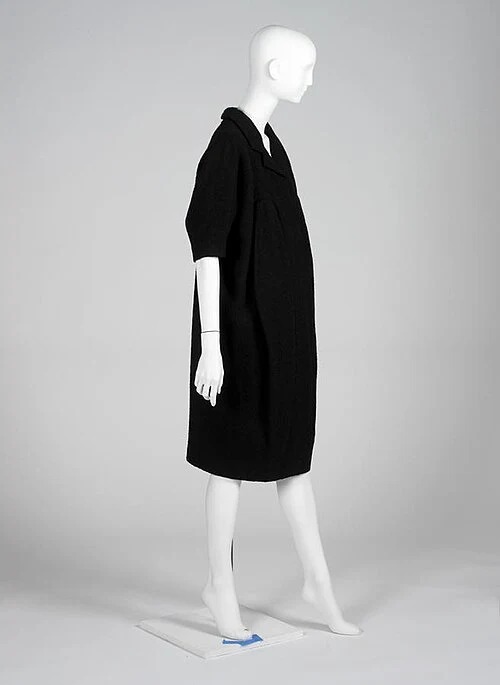
Where the waist disappears
The 1957 sack dress allows its line to continue past the waist rather than emphasizing it. Balenciaga history begins here with a question: must clothing follow the body’s outline? Concealment alone does not explain the design. Space between wearer and garment produces another silhouette and another appearance in movement. The V&A describes an initially challenging form that later entered familiar dress. Compare shoulder and waist relationships rather than assuming that any simple contemporary shift uses the same construction. A decision not to emphasize a part of the body can alter clothing as substantially as adding decoration or reshaping its visible surface.
From Spain to Paris
The business roots of Balenciaga history reach San Sebastián in 1917, before the Paris house opened in 1937. Keeping both places visible prevents a fully formed practice from appearing suddenly in Paris. Cristóbal’s knowledge of cutting and sewing supported experiments in shape, but couture also required fitting, preparation, finishing and workshop collaboration. References to Spanish clothing and painting provide context without explaining every design through birthplace. Ask what a particular object does with proportion and material. Movement between cities and accumulated technical experience together give the foundation a more useful meaning than a date detached from the work that preceded it.
Cutting a garment away from the body
After the sack dress, consider pattern cutting: arranging flat pieces into a garment’s volume. Simplicity in Balenciaga history does not mean fewer decisions. Holding cloth away from the body requires an understanding of support and release. Small changes at the shoulder affect the direction of the whole garment, while front and back allowances may differ. Museum reconstruction makes these relationships observable rather than leaving them to assumptions from photographs. A loose appearance does not prove an absence of structure. Concealed attachment points may sustain broad surfaces. Count neither embellishments nor seams alone; ask why the shape stays where it does.
The tulip dress from front and back
The 1965 “tulip” dress contrasts a restrained front with a substantial rear form. Stiff silk gazar supports volume away from the body. In Balenciaga history, this example prevents material and cut from being discussed separately: a more fluid cloth would not necessarily hold the same outline. The museum examines central joins and an additional panel descending from the shoulders. The point is not to memorize technical labels but to understand how another view reveals construction. A single frontal photograph misses much of the design. Despite its sculptural appearance, the dress presumes a moving wearer; volume unfolds as the person turns and the observer’s position changes.
Dress and cape in 1967
The 1967 dress-and-cape ensemble directs attention towards broad planes and space around the neck. Here pattern cutting involves carefully limiting joins as much as adding them. Late Balenciaga history makes fabric increasingly important as decoration recedes. With silk gazar, weight and stiffness should not be mistaken for the same property: a relatively light material can sustain considerable form. Museum analysis distinguishes the dress’s large body section from the pieced cape neckline. Apparent simplicity contains several adjustments. A line separated from the neck frames the face; the descending plane follows a direction independent of bodily curves. Clothing establishes another outline around its wearer.
A closure and a later revival
There is a clear break in Balenciaga history. The founder closed his house in 1968 and died in 1972; the label’s 1986 revival belongs to another period. Later clothing and bags cannot simply be attributed to him. When successors consult an archive, ask which shape or construction problem they translate into different conditions. The V&A identifies Nicolas Ghesquière’s 1997–2012 tenure as important to the revival. Its ready-to-wear context differed from the original fitting-based couture business. The present house spans clothing and leather goods and describes couture craft. Distinguishing these periods makes continuity more precise, not less meaningful.
Comparing spaces
The most concrete connection from Balenciaga history to clothing today is the distance between cloth and body. A line bypassing the waist, rearward volume and a detached neckline make different spaces. Calling all of them oversized erases those differences. Examine shoulder support, side direction and folds in movement. The same choice between following and departing from the body appears in sleeves and coat backs. Similarity alone does not establish direct influence; compare evidence. Understanding begins with a recognizable outline and continues towards the material and cutting that sustain it. The lasting question concerns the space clothing makes for a person moving inside it.
Timeline
- 1917 — Business begins in San Sebastián
- 1937 — Paris house opens
- 1957 — The sack silhouette is introduced
- 1968 — Founder closes the house
- 1986 — Label is relaunched
Questions and answers
When did Balenciaga open in Paris?
After working in Spain, Cristóbal opened the Paris house in 1937.
What does sack mean in sack dress?
It refers to a sack; the 1957 design is known for a line that bypasses the waist.
Are present products the founder’s designs?
No. Work following the 1968 closure and 1986 revival must be distinguished from Cristóbal’s own designs.