Max Mara 101801 Coat History: Room to Move
Max Mara 101801 coat history traces Beretta’s 1981 design, roomy sleeves, wool and cashmere, and Wegman’s photographs, distinguishing origins from later examples.
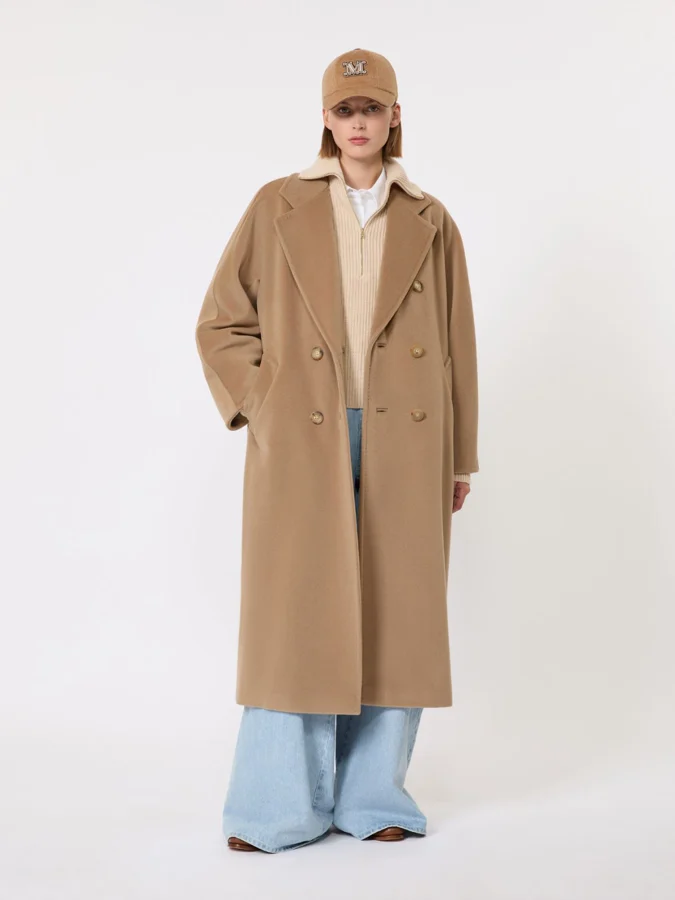
A generous shape with a clear outline
Max Mara 101801 coat history begins with a practical visual question: how can a generous garment retain a legible shape? In the current photograph, broad lapels, two rows of buttons and a long front establish its outline without requiring a tightly fitted waist. Open, the coat reveals the clothes underneath; closed, its own surface becomes the main composition. This is an interpretation of the visible garment, rather than a claim that every wearer experiences it identically. Volume can be considered as space for layering and movement, not simply an oversized label.
Dating the design, not every surviving coat
Max Mara credits Anne-Marie Beretta with designing the model in 1981. Naming its designer matters: a house signature should not automatically be attributed to a company founder. The chronology also requires care. A 2016 San Francisco Chronicle account distinguishes conception in 1981 from a debut in 1982, while the house uses 1981 as its design date. These descriptions should not be compressed into an undocumented manufacturing date. Here, 1981 identifies the design’s official origin, not the production year of any later coat bearing the number.
Reading the sleeves and front together
The present product description identifies kimono sleeves whose ends can be turned up. The term describes a sleeve configuration; it does not make this Italian overcoat equivalent to a traditional Japanese garment. The listing also describes room for a blazer underneath. When examining kimono sleeves, look at their relationship to the broad body rather than treating them as an isolated detail. In visual terms, fastening the front or using the belt changes where that volume gathers. The coat offers more than one outline through ordinary acts of dressing.
Camel is a colour, not a fibre declaration
The examined camel-coloured version specifies 90 percent virgin wool and 10 percent cashmere. A colour name must not be mistaken for proof of camel-hair content. Wool and cashmere should also be considered alongside surface, thickness and construction; composition alone cannot establish how every historical example felt. In this photograph, uninterrupted areas and shadows beneath the lapels are particularly noticeable. Such details offer a way to discuss the material without inventing tactile evidence. The present wool and cashmere specification does not establish the composition of every earlier version.
When a coat became a photographic subject
For the company’s fiftieth anniversary in 2001, William Wegman made eight photographs of his Weimaraners wearing the coat. The resulting Dogs in Coats series was later exhibited in Vancouver in 2017. Placing clothing on these unfamiliar bodies invites attention to drape, folding and volume; that is a reading of the pictures, not an assertion about the artist’s private intentions. Max Mara’s own archive also presents interpretations by François Berthoud and Martine Barrat. The recurring garment becomes a subject through which different image makers can work.
A continuing model, a particular example
Max Mara 101801 coat history concerns the relationship between an enduring pattern and specific objects made later. Anne-Marie Beretta’s authorship should remain visible, but so should the distinction between an origin date and the date of an illustration. The photograph here depicts a current camel-coloured version, not an original photographed in 1981. Compare the space beneath the sleeves, the width of the fastened front and the outline without a tied belt. Those observations give the reader a more useful vocabulary than simply describing a coat as timeless.
Timeline
- 1981
- Max Mara dates Anne-Marie Beretta’s design to 1981.
- 2001
- William Wegman photographed Dogs in Coats for the brand’s fiftieth anniversary.
- 2017
- Dogs in Coats was exhibited at the Pacific Centre store in Vancouver.