Celine Triomphe history: an emblem becomes a clasp
Celine Triomphe history connects a 1970s emblem with Hedi Slimane’s 2018 shoulder bag, examining its clasp, proportions and the difference between motif and model.
An emblem operated by hand
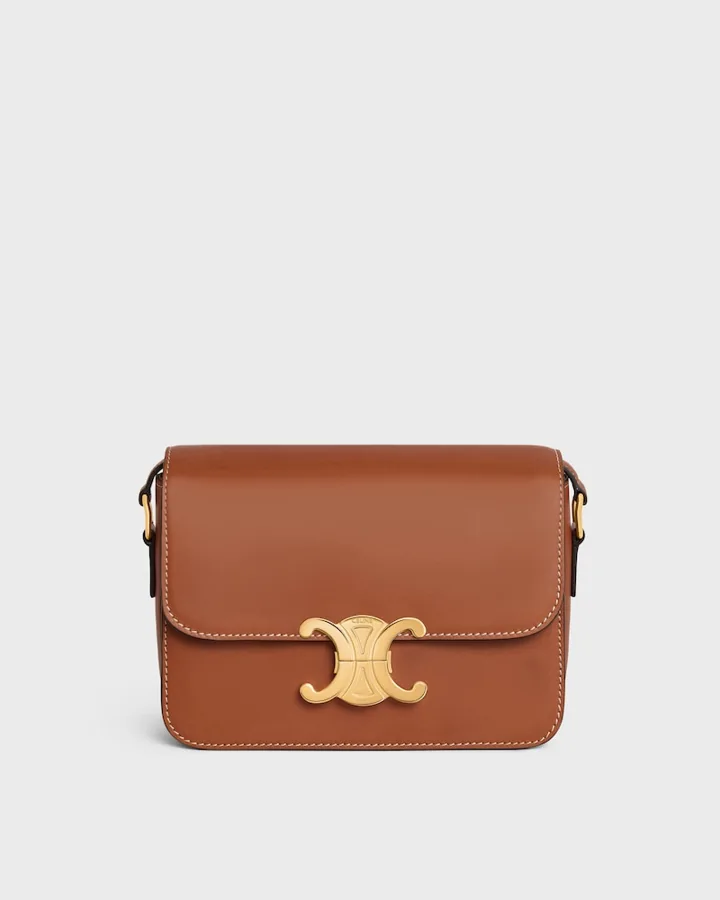
Celine Triomphe history is most immediately legible in the metal clasp on the front. It is both a means of opening the object and a means of recognising it. Curved metal establishes a strong centre against a comparatively spare body. This shoulder bag gives its broad leather plane and small fitting different visual weights. An emblem is not merely read as a name; it becomes an object operated by hand.
The motif and the bag have different chronologies in Celine Triomphe history. Celine dates the historical monogram’s unveiling to 1972 and identifies the bag as a Hedi Slimane design created in Los Angeles in 2018. An older sign does not make the newer object equally old. Using an archive can involve changing an element’s scale, position or function, rather than reproducing an earlier product without alteration.
Different dates for motif and bag
The 2018 introduction is part of the setting for Celine Triomphe history. Contemporary Vogue Italia reporting presented the 16 and C bags alongside the Triomphe, describing the latter through its logo closure. That evidence preserves what was visible during the launch, before later reputation could reshape the story. Several distinct bag types participated in the new direction, so no single model needs to be made responsible for the whole collection.
The 2018 introductions
Metal and leather create a particularly clear contrast in Celine Triomphe history. The reflected light of the clasp interrupts the broad plane behind it, while its rounded forms soften the impression of the surrounding rectangle. The meeting of the two sides draws attention towards the centre. This formal analysis connects the place where a hand opens the bag with the place where an eye is directed: operation and composition coincide.
Metal against leather
The official account describes versions including Classique and Teen. Scale within Celine Triomphe history is consequently a question of proportion, not simply a statement that one object is smaller. The fitting can occupy a different share of the front, and the strap can establish another relationship to the body. A shoulder bag family can maintain recognisable principles while containing material and dimensional differences between individual references.
Variation within the outline
The monogram also moves between pattern and component in Celine Triomphe history. Repeated over canvas, a sign creates a field; cast as a single fitting, it creates a focal point. These uses share a visual vocabulary without performing the same job. Distinguishing the house-wide motif from the named model clarifies how an individual design belongs to a wider system. The sign’s appearance elsewhere does not turn every object bearing it into this bag.
Between pattern and component
The significance of Celine Triomphe history is therefore more specific than a general return to the past. A historical form remains recognisable while its setting and practical role are reorganised. Choosing an archive element is also choosing where it will sit and how it will be used. Here, that decision is concentrated at the front of a bag. A small reallocation of visual emphasis establishes the centre of an otherwise restrained object.
Timeline
- 1972
- The house dates the unveiling of its historical Triomphe monogram to this year.
- 2018
- Hedi Slimane designed the Triomphe bag.