Bottega Veneta Cabat history: structure through weaving
Bottega Veneta Cabat history follows Tomas Maier’s 2001 design, its woven construction and the later Maxi Cabat, distinguishing original ideas from new versions.
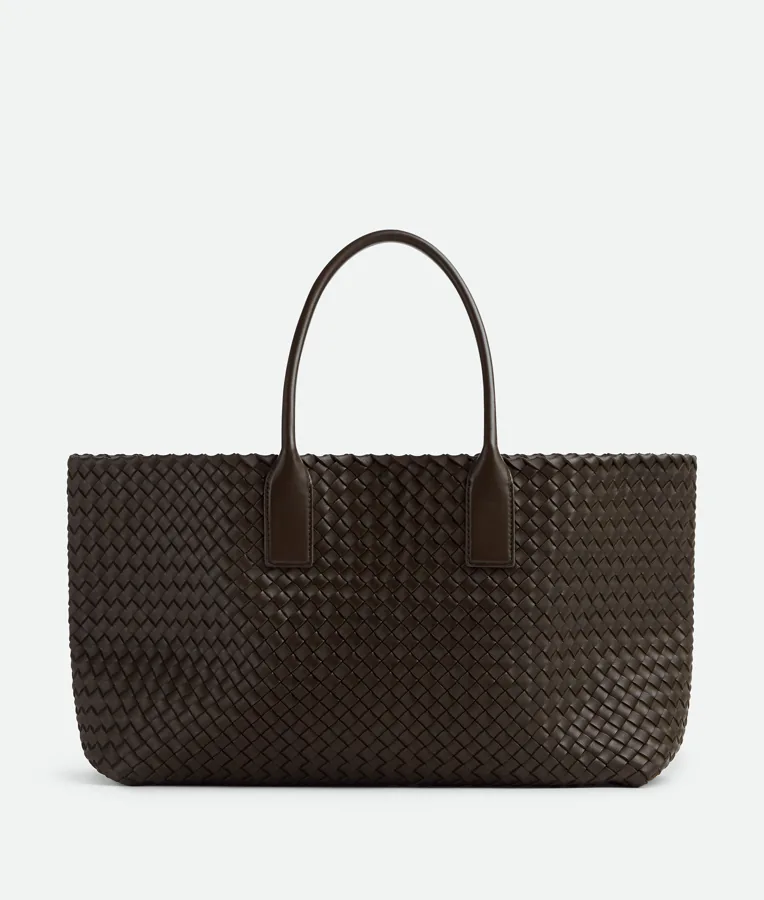
What an open bag reveals
Bottega Veneta Cabat history begins with an opening rather than a clasp. The bag presents an expansive woven surface beneath two handles, allowing its construction to carry much of its visual identity. Intrecciato, the interlacing of leather strips, is not a printed imitation of weaving. It gives the surface a physical rhythm. Reading the bag as an open tote brings its practical shape and decorative effect into the same discussion.
Tomas Maier introduced the design in 2001. That date in Bottega Veneta Cabat history identifies a particular bag, not the founding of the house or the invention of woven leather. The distinction matters: a designer can change the significance of an established technique without creating the technique itself. Here, a broad body makes a familiar material vocabulary the principal event rather than a small decorative accent.
Maier’s starting point
Maier’s later Vogue interview provides context for an approach centred on the object rather than a conspicuous written signature. In Bottega Veneta Cabat history, restraint should not be confused with an absence of visible labour. Every crossing remains available to the eye. The repeating surface acts as a means of recognition, while the absence of a large central emblem lets attention travel across the whole bag instead of stopping at a badge.
Surface becomes structure
Intrecciato introduces tiny changes of height wherever the strips overlap. Looking closely at Bottega Veneta Cabat history therefore means examining light and shadow as well as pattern. The official Cabat reference documents an unlined interior. That construction allows the woven leather to be encountered inside as well as outside. It describes the cited version; it should not be treated as proof that every material or historical edition has identical internal finishing.
Handles and the opening
An open tote also establishes a particular relationship between the hand, the handles and the body. Bottega Veneta Cabat history can be read through the contrast between narrow curved grips and the broad opening beneath them. A frontal image flattens that relationship. Side and interior views reveal where a flexible surface bends, how the upper edge behaves and how the handles meet the body. These are questions of design rather than claims about universal comfort.
A later change of scale
Kering’s 2019 activity report lists the Maxi Cabat among Daniel Lee’s spring/summer introductions. This extends Bottega Veneta Cabat history beyond one author’s initial design. Changing the scale of a weave changes how far away its pattern can be perceived. The later model should therefore be identified separately, rather than retroactively credited to Maier or treated as an unchanged original. Continuity exists in the principle while proportions permit another interpretation.
Reading the Cabat today
The lasting interest of Bottega Veneta Cabat history lies in that negotiation between repetition and variation. Strip width, handle proportions and the opening offer concrete points of comparison across documented examples. Colour alone cannot explain those differences. A woven surface can behave as both the fabric of an object and its identifying sign. The Cabat makes that relationship legible without requiring every subsequent version to be folded into a single, supposedly timeless specification.
Timeline
- 2001
- Tomas Maier introduced the Cabat.
- 2019
- The Maxi Cabat appeared among Daniel Lee’s spring/summer introductions.