Sabyasachi Mukherjee: Craft and a Luxury House
Craft and a Luxury House
ÉPOPLI ·
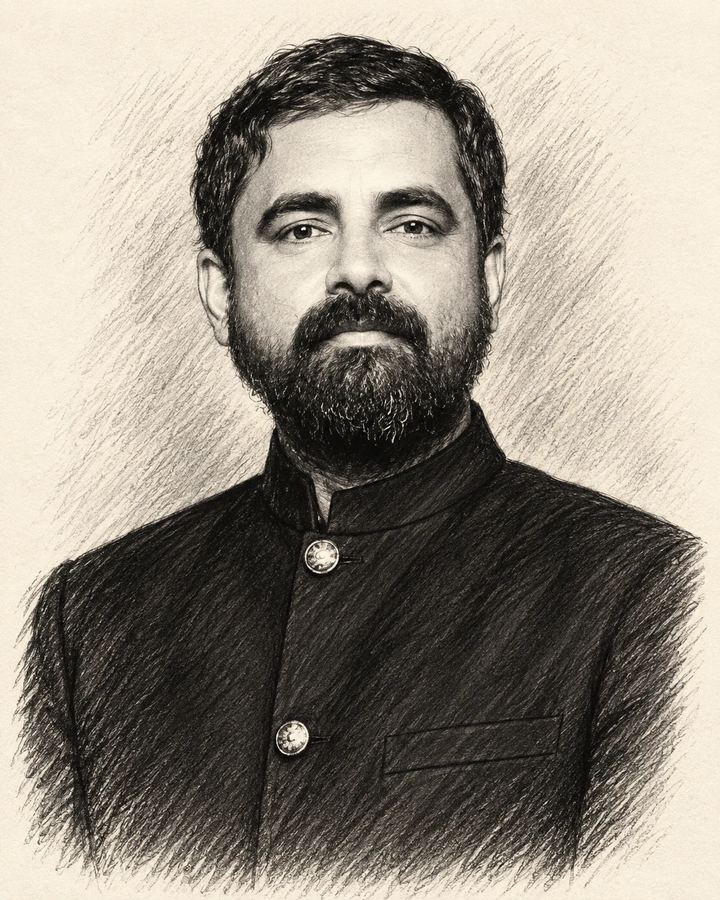
From an image to an object
Paintings become prints on textiles, sculpted forms become jewellery models and related imagery enters the stores. Sabyasachi Mukherjee history is therefore a story about a production system as well as finished garments. The useful question is how craft becomes continuing work.
Shah Rukh Khan’s 2025 Met Gala look demonstrates the system: an elongated black wool coat with a hand-canvassed construction and broad lapels, a silk shirt and satin waist wrapping. Layered jewelry and a tiger-headed cane placed concentrated light against the dark tailored planes.
Beginning in Kolkata
Born in 1974 to a Bengali family, with a chemical-engineer father and an art-teacher mother, he recalls travelling to school by boat and making clothes for dolls. Sabyasachi Mukherjee history reaches an independent label in 1999 after graduation from NIFT Kolkata, according to the official chronology. He also recalls staging student fashion shows in small clubs and hotels.
The early Kashgaar Bazaar and Milan’s The Frog Princess established an overlapping vocabulary. In 2019 he revisited the first collection through hand-dyed color, block prints and woven materials. Familiar techniques were reorganized rather than discarded with each new presentation.
Embroidery beside a red sole
The 2017 Christian Louboutin project brought archive sari materials onto boots and studded pumps, a change of scale within Sabyasachi Mukherjee history. A broad woven surface became a small fitted one, meeting the footwear designer’s red sole.
This collaboration involves a change of scale and function. A shoe bends and presents its side, front and sole in motion; it cannot be treated simply as a miniature skirt. The two designers’ contributions remain distinguishable even within a coordinated appearance.
A travelling wardrobe
Released in August 2021, the Wanderlust collaboration with H&M added a travelling wardrobe to Sabyasachi Mukherjee history. Long kaftans, a chiffon blouse and belted shorts offered different proportions. Sequins spread reflected light across a loose garment, while a sheer blouse relied on print and its translucent ground.
Menswear included a Henley shirt, high-waisted wide chinos and a photographer jacket. Art Foundation imagery crossed the women’s and men’s ranges, with Maria Gemzell involved in product development. The collaboration connected an ornamental vocabulary with roomy, combinable shapes.
Two kinds of support
Founded in 2014, the Art Foundation provides artists with working facilities, income and mentorship according to the house. Sabyasachi Mukherjee history must preserve its stated identity as a for-profit collective rather than casually calling it a charity.
Save The Saree used another model: selecting work from weaving centres, reducing intermediaries and returning proceeds to artisans, as the brand reports. Here selection and distribution are contributions distinct from authorship of every woven motif. A sari also makes the act of wrapping part of its form.
Quilted silk and interior surfaces
His own 2025 Met Gala outfit provides a contrasting example in Sabyasachi Mukherjee history. A large court jacket and sherwani used hand-dyed Murshidabad silk with quilting, paired with a satin shirt, dark trousers and waist wrapping. Its volume and stitched surface differed from Khan’s elongated wool tailoring.
For Nilaya interiors, painted imagery moved into furnishings and wallpaper. The different scale changes a pattern’s rhythm. In October 2026 the official site continued to present Heritage Menswear 2025–26, jewelry and anniversary projects alongside this broader visual world.
A new object with a historical appearance
Sabyasachi Mukherjee history connects contrasting surfaces: broad satin highlights, quieter wool, concentrated jewelry and quilted silk volume. These relationships create a language broader than any single repeated motif, placing historical references inside contemporary formal and travelling wardrobes.
Looking closely at textiles, image sources, makers and retail settings connects the aesthetic with its conditions of production. Shoes, travel clothes, saris and interiors remain different objects even when sharing imagery. The useful question is which kinds of work gain continuing opportunities, rather than whether a promotional declaration of preservation sounds convincing.
Timeline
- 1974 — Born into a Bengali family
- 1999 — Founded the label in Kolkata
- 2014 — Established the Art Foundation
- 2021 — Released Wanderlust with H&M
Sources
- Sabyasachi — Official history
- Sabyasachi — The Art Foundation
- Vogue India — Wanderlust direct interview
- Condé Nast Traveller India — Wanderlust release
- Sabyasachi — Social initiatives
- Sabyasachi — Current collection navigation
- Asian Paints — Sabyasachi Heartland catalogue (PDF)
- STIR — Direct childhood interview
- Sabyasachi: Met Gala 2025 garment specifications
- H&M official press release: collection garments
- H&M Japan: kaftan and chiffon blouse
- AFP: Louboutin and sari fabrics, 2017