Nora Noh: From Hanbok Fabrics to Working Wardrobes
Korean womenswear considered through its wearers and ways of buying.
ÉPOPLI ·
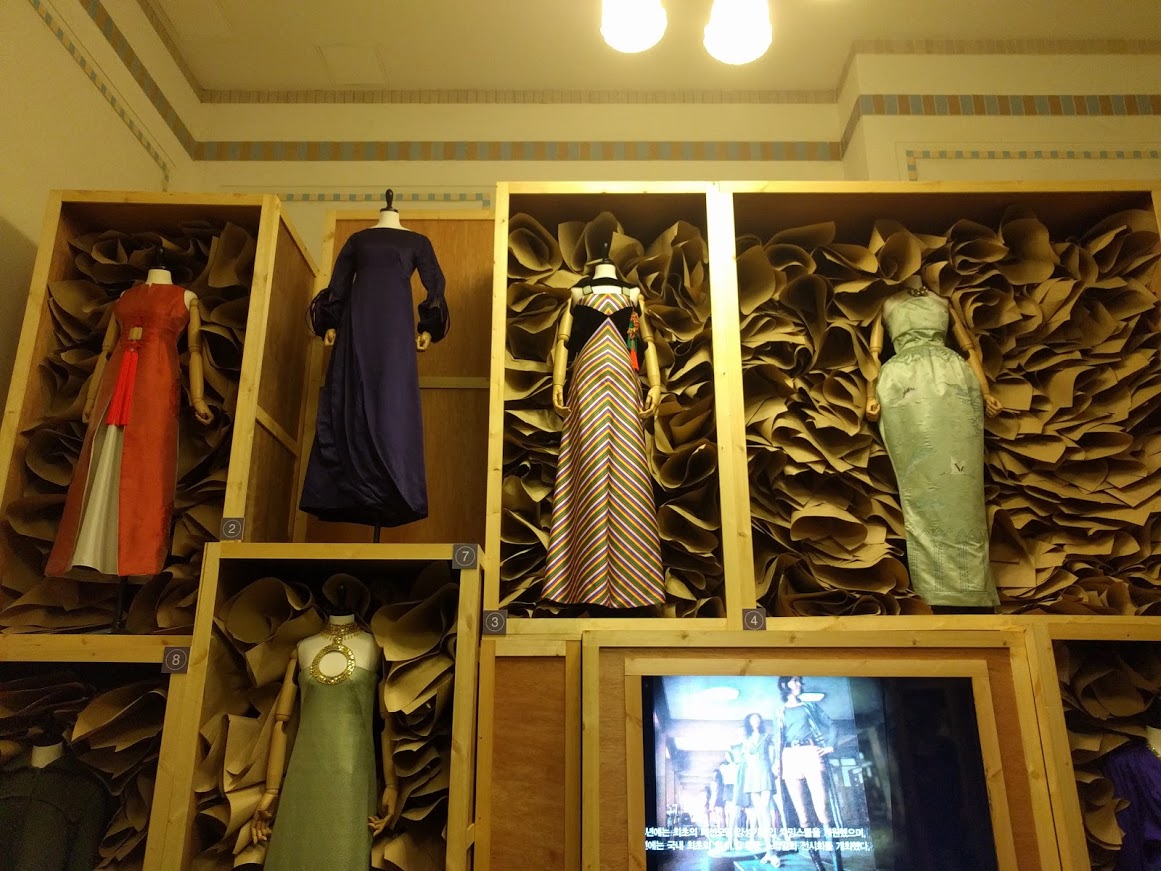
Print and Ease at the Waist
The striped silk wrap dress from the 1984 New York collection brings print and fastening into the same view. A wrap dress overlaps across the front and can be secured or adjusted at the waist. Nora Noh history places this example between a public fashion image and a working woman’s wardrobe. Exhibition reporting identifies style 5075 and describes engineered printing, with patterns placed for the garment’s components, and elastic at the back waist. Decoration therefore works with construction rather than simply covering it. Adjustment matters when sitting or moving, not only when looking at a stationary museum display. Noh wore the design again for photographs in 2026, inviting attention to how it was made to be worn before declaring it timeless.
From Myung-ja to Nora
Born Noh Myung-ja in Seoul in 1928, she was the daughter of broadcasting figures Noh Chang-sung and Lee Ok-kyung and attended Gyeonggi Girls’ High School. After divorce she gained office and interpreting experience, then studied clothing in America. Nora Noh history also involves a name taken from Ibsen’s character. She recalled using Nora on her passport when leaving for the United States. Sources differ on the exact early study and shop-opening dates; the oral-history record traces study and return in the late 1940s, wartime work in Busan and the House of Nora Noh on Toegyero in 1952. Early theatre and ballet commissions connected her with Shinhyeop and the Seoul Ballet. This stage costume needed to accommodate moving bodies rather than merely create an attractive frontal outline.
A Shared Stage and Arirang Variations
The 1956 Bando Hotel show presented clothes to an audience under their maker’s name. Park Choon-seok played piano and actress Cho Mi-ryung wore the closing wedding dress. Nora Noh history includes this shared presentation by musicians, performers and customers. Arirang dresses subsequently translated hanbok fabrics and lines into social dress. The brocade example made for Oh Hyun-joo’s 1959 Miss Universe appearance retained Korean colour and atmosphere while serving an international event. Several versions exist; one photograph cannot represent the entire series. Arirang dresses selected between materials and forms rather than simply preserving a traditional ensemble or importing a Western gown. Their decoration remained part of clothing made for someone participating in public life.
Choosing Instead of Commissioning
The 1960s changed purchasing as well as hemlines. Nora Noh history tracks a shift from choosing fabric and returning for fittings to selecting completed garments. Scholarship distinguishes a ready-to-wear section in the 1963 show, a 1965 exhibition for working women and the 1966 shop and presentations near Ewha Womans University. Standard sizes, price and intended customers had to be considered before manufacture. These garments were not simply smaller versions of bespoke commissions. Student clothing and premium export lines required different channels. A new silhouette on a runway and a product that could be supplied repeatedly thus became connected tasks. Greater choice for wearers depended on production and distribution as well as design.
Performers and Ceremonies
Yoon Bok-hee’s short 1967 performance dress, the Pearl Sisters’ blouse-and-trouser outfits and Yoon So-jung’s 1968 wedding gown addressed different occasions. Nora Noh history makes stage costume more than a designer credit attached to celebrity photographs. A short dress makes leg movement visible; trousers and a blouse establish a different stage image from a single gown. A bridal dress and veil create length and ceremonial movement. No single trend describes all three. The song, performer and occasion helped determine the final impression. This stage costume survives in public memory partly because the wearer contributes gesture and expression, becoming a collaborator rather than a neutral display stand.
Domestic Fabrics and Export Markets
The 1973 Paris ready-to-wear fair and expansion into New York in the late 1970s brought Korean clothes and fabrics into wider circulation. Nora Noh history follows the silk wrap dress as both an export product and clothing intended for use. Domestic wool, cotton and silk required suppliers and factories capable of repeated production. American magazine appearances in the 1980s, including a three-piece suit and silk clothing, showed a place for Korean design in everyday wardrobes beyond special national dress. She later recalled reducing the business after the late-1990s financial crisis and continuing with longstanding customers. Expansion and contraction belong to the same account. When commercial conditions changed, relationships with people who kept wearing her clothes provided another basis for continuing work.
From Customer Wardrobes to the Museum
The Kyungwoon Museum retrospective ran from 21 March to 16 July 2026. Nora Noh history now includes organising surviving garments rather than only presenting a new season. In a 2026 Morning Calm interview she described concentrating on records in recent years and keeping customer donations. That account should replace an assumption that her routine remains unchanged from much older interviews. Exhibition direction by Seo Young-hee, lenders and oral-history researchers all help turn personal memory into public evidence. The fastening of a striped dress, the selection of hanbok cloth and the selling arrangements for students and working women connect through attention to actual use. Her clothes become clearer when the wearer and occasion are included. A customer’s years of keeping a garment form part of the history too.
Timeline
- 1928 — Born in Seoul.
- 1952 — Works at the House of Nora Noh on Toegyero.
- 1956 — Bando Hotel fashion show.
- 1959 — Brocade Arirang dress for Oh Hyun-joo.
- 1973 — Participates in the Paris ready-to-wear fair.
- 1984 — Silk wrap dress in the New York collection.
- 2026 — Kyungwoon Museum retrospective and archival work.
Sources
- 경운박물관: 2026 특별전
- 아르코예술기록원: 노라노 구술채록
- 문화일보: 노라노 인터뷰, 2012
- 한국복식학회: 최경자와 노라노 비교 연구
- 연합뉴스: 2026 전시와 소장 의상
- 오마이뉴스: 5075 드레스와 전시 취재
- Morning Calm: 노라 노 인터뷰, 2026
- 경운박물관: 전시 도록 출간