Marine Serre: Giving Existing Objects a New Body
Giving Existing Objects a New Body
ÉPOPLI ·
A flat image acquires a body
Marine Serre history comes into focus through the 2026 Louvre project. A Mona Lisa puzzle became a dress: Serre explained that the pieces were moistened, shaped and stitched. The familiar portrait breaks and reconnects over a moving body. Her question is what new action an existing object can acquire. Here upcycling combines technique with visual estrangement, letting shoulders and waist replace the frame around a picture.
From Corrèze to Brussels
Marine Serre history begins with her birth in Brive-la-Gaillarde in 1991 and upbringing in Corrèze. She recalled wearing family clothes and secondhand finds. After studying in Marseille she entered La Cambre in Brussels in 2011, graduating with Radical Call for Love in 2016 and winning the LVMH Prize in 2017. Student experience included Alexander McQueen, Maison Martin Margiela and Dior. She joined Balenciaga in October 2016 and founded her company with her partner and sister in summer 2017. A repeated crescent on close-fitting clothes connected an athletic base with older textile ornament.
Two fabrics, different responses
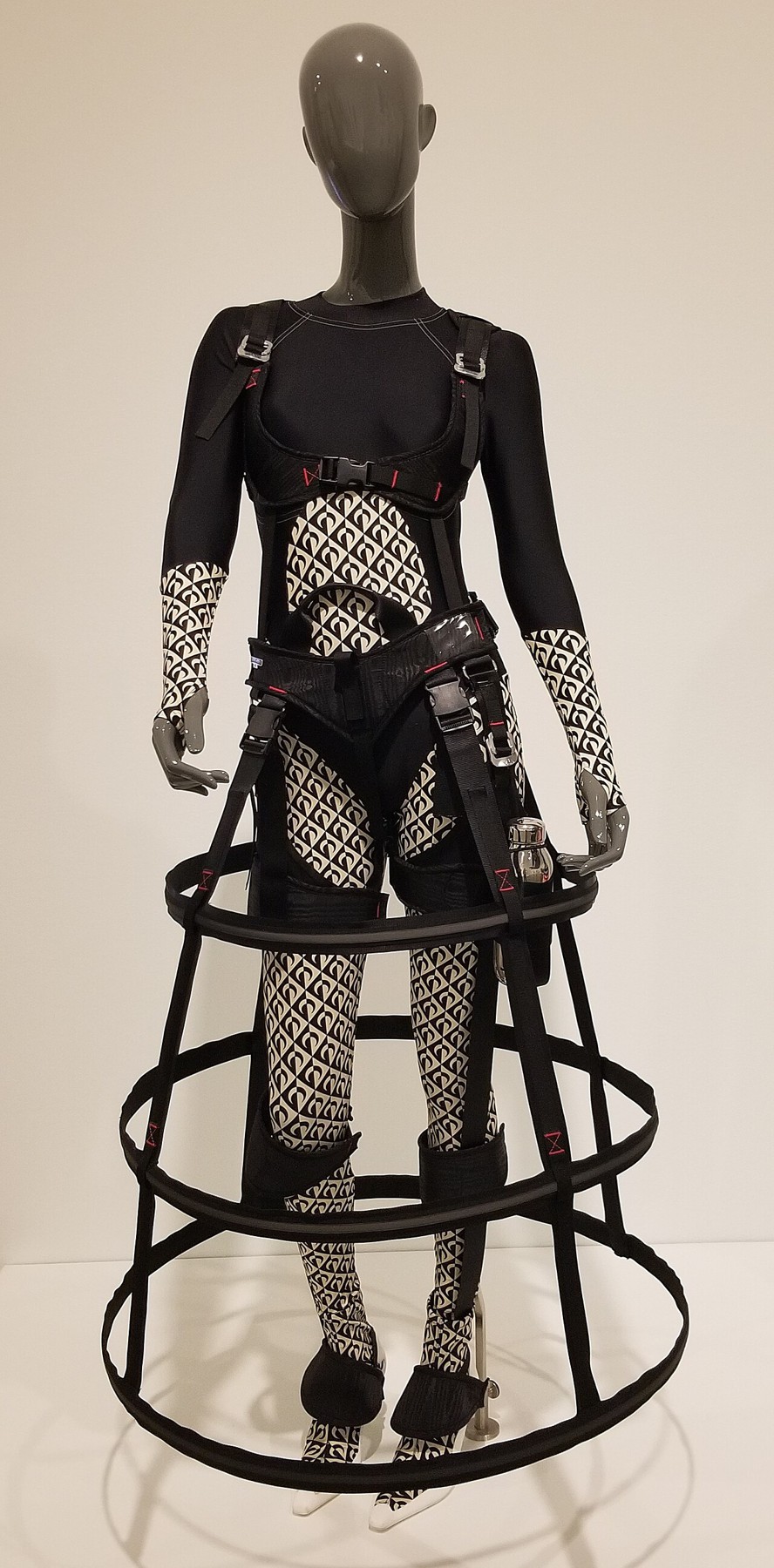
Marine Serre history shows how materials determine form in the Regenerated Silk Scarves Long Dress. Its high-necked, close-fitting upper section uses polyester and elastane, while the skirt introduces silk panels and their lighter movement. A concealed back zipper keeps the front uninterrupted. Different existing prints make individual garments vary. Rather than erasing these differences, seams interrupt or extend their images. As the wearer walks, old patterns and the new outline remain visible together. Each section responds differently to the same body.
Keeping a second skin in place
Marine Serre history also includes the Moon Jersey Bustier Dress, an elongated strapless form. An internal elastic band with anti-slip tape supports it, while elastic lace introduces a softer edge at the hem. Repeated crescent motifs follow the body’s curves. Compared with the scarf dress, it demonstrates the contrast between a regular emblem and irregular inherited prints. Recycled fibers made into fabric and existing objects cut into new clothes represent distinct processes, each contributing its own material behavior.
Puzzle and paint-tube armor
Marine Serre history takes a different turn in the Louvre paint-tube dress. Serre described hammering tubes flat and attaching them individually over a corset. The supporting structure holds the torso while metal fragments create a colored outer layer. A puzzle reconstitutes one picture; tubes assemble disparate traces into a new surface. Both must connect hard objects with a flexible body. Dividing them into small units permits articulation. The interest of upcycling lies in the scale and connections that make the transformed object wearable.
Paper color draws attention into an image, while metal redirects surrounding light. A moving viewpoint changes the apparent edges and gives different information from a still photograph.
A sequence of hands
Marine Serre history depends on sorting, cleaning, cutting and sewing. A visit to the Paris studio documented household textiles moving through these stages. Available fragments require adjustments from selectors, pattern makers and sewers. The Louvre’s merchandise archive also supplied T-shirts and medals for a capsule distinct from the elaborate dresses. Everyday products and sculptural garments offered different uses for the same dialogue. Alice Mann’s photographs placed the dresses within the museum. Production and presentation involved several collaborators rather than a solitary act of transformation.
Continuing through a business crisis
Marine Serre history includes a difficult recent development. Vogue reported bankruptcy proceedings in October 2026, alongside the release of Spring 2027, The Deep Shine. This was not confirmation of closure: Serre said orders were proceeding. Concert T-shirts became flowing handkerchief dresses, retaining previous imagery while changing the hem. The episode makes continuity a question of sustaining a working organization as well as reusing materials. Comparing the starting object with the completed garment reveals what survives. Memory on the surface and room for movement remain connected questions in her work.
Timeline
- 1991 — Born in Brive-la-Gaillarde
- 2016 — Graduated from La Cambre
- 2017 — LVMH Prize and company founding
- 2026 — Louvre project and The Deep Shine
Sources
- Palais Galliera biography
- LVMH Prize profile
- 2016 direct interview
- ANDAM biography
- Regenerated silk dress
- Moon bustier dress
- Louvre project interview
- Louvre official press release
- Louvre press dossier (PDF)
- Studio visit
- Spring 2027 and current business