Geoffrey Beene: Seams Between Sport and Evening
American dressmaking read through movement and material boundaries.
ÉPOPLI ·
From Stadium to Evening
A football jersey became a floor-length evening dress in 1967. The Metropolitan Museum preserves a version whose strong colours and relaxed outline remain recognisable beneath a sparkling surface. Geoffrey Beene history begins with that decision to keep two identities legible at once. Expensive material alone does not explain the transformation: the garment does not first tighten the waist to conform to conventional eveningwear. The jersey dress retains its sporting outline. Small sequins scatter light across the surface while length changes the implied setting from stadium to reception. Ornament and a straightforward silhouette coexist rather than cancel each other. The useful question is what has changed and what has deliberately survived. A familiar public symbol enters formal dress without turning the wearer into a fixed sculptural object.
Study and Production
Geoffrey Beene history begins in Haynesville, Louisiana. Raised in a medical family, he entered Tulane University’s medical programme before leaving to pursue design. Institutional records disagree over his birth year: the Met and LACMA give 1927, while the current CFDA biography states 1924. This account therefore does not assert an exact year. Nor does medical study prove a psychological explanation for his cutting methods. RISD records two years studying French dressmaking in Paris before his arrival in New York in 1950. After work for ready-to-wear manufacturers, he established his company in 1963 and bought out his business partner in 1981. Founding a label and gaining full independence were different events. His making process also exceeded drawing: fabric placed directly on a body or dress form introduces weight and stretch that a flat sketch cannot settle.
Short Length, Dense Surface
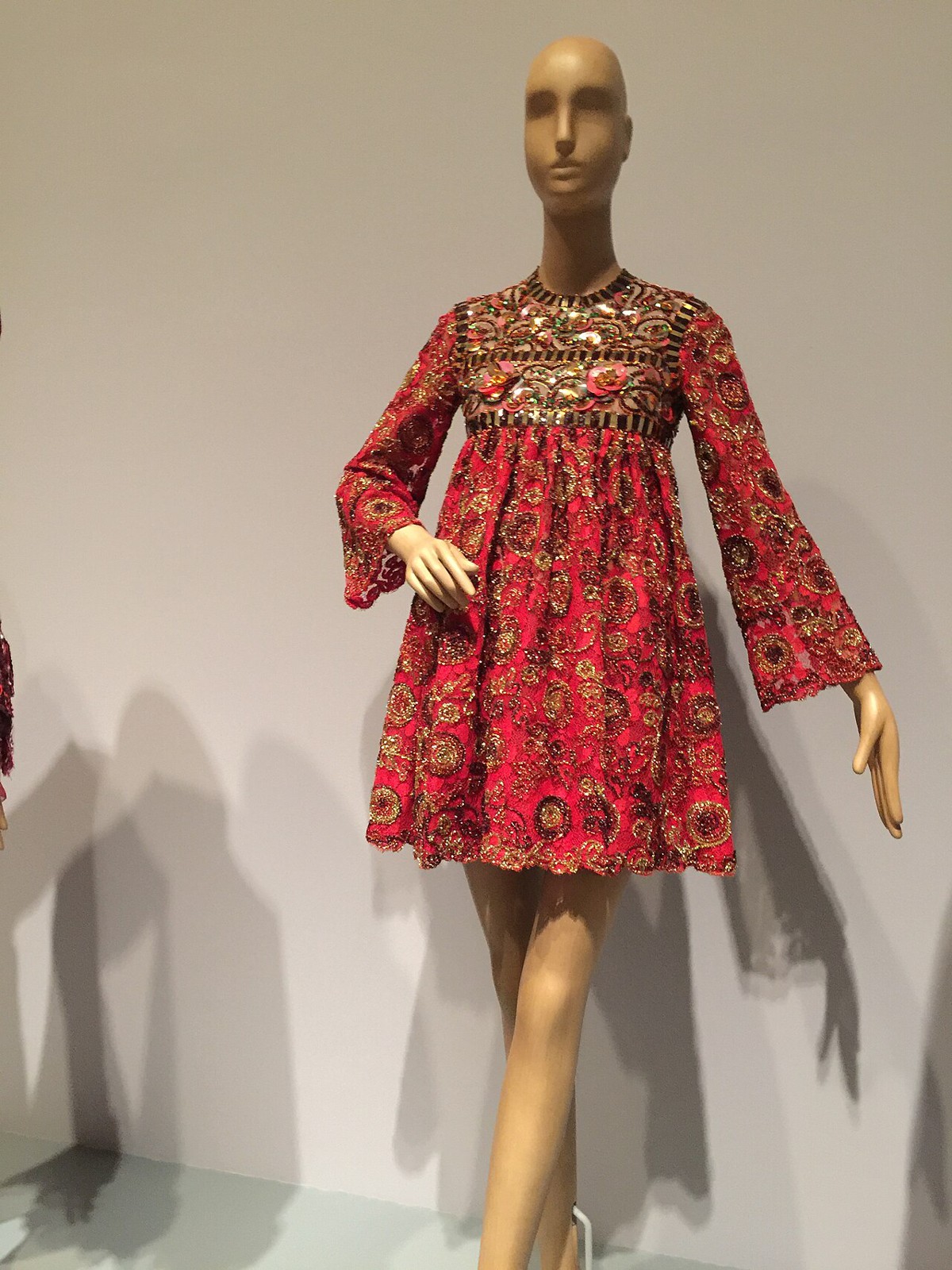
A red mini dress dated 1968–69 changes formality through a different proportion. The Philadelphia Museum describes lace embroidered with metallic yarn and a sheer upper section crowded with dimensional beads and jewel-like ornament. In Geoffrey Beene history, sequins therefore do not perform a single task. The football design spreads brilliance over a broad field; here a short, economical outline contrasts with concentrated decoration near the face. The legs remain free to articulate movement. It is possible to read this as eveningwear without the volume of a conventional ball skirt, but that interpretation does not establish every customer’s motive. Looking at the openings in the lace alongside the depth of the ornament reveals layers that the word exposure misses. Reducing a silhouette and reducing decoration are separate design decisions.
Where Different Fabrics Meet
A fall/winter 1986–87 dress joins black jersey to silver velvet. The Met’s analysis identifies the technical problem of connecting a knit to a woven textile with different behaviour. Geoffrey Beene history cannot be reduced to a graphic surface because the visible boundary is also a working seam. If the fabrics respond differently to tension, their junction can pull or ripple. This curved cutting distributes that relationship around the figure. The museum also connects his piecing to an admiration for Adrian, so there is no need to invent an isolated origin for every technique. A jersey dress is not necessarily unstructured simply because it looks fluid. Its apparent ease may depend on exact control at the junction of materials. Following the black and silver boundary allows the reader to examine how front and side meet.
Colour Across Two Garments
A coat and dress dated about 1990 at LACMA build a relationship through coloured edges. Coral trim outlines a teal coat, while related pink lines mark the neckline, sleeves and divisions of the dress beneath it. In Geoffrey Beene history, this ensemble shifts attention from the impact of one garment to the coordination of two. An A-line coat, rounded collar and glass buttons create small intervals within a quiet overall shape. Removing the coat does not break the colour relationship. This curved cutting need not announce itself only through spectacular asymmetry: an edge or sleeve attachment also organises movement. The listed wool crepe and knitted trim indicate different structures within a restrained palette. Comparing the bodice and skirt boundary, and the relative lengths of the two garments, shows how the ensemble places the apparent waist and frames the body.
Making on the Body
Reading Geoffrey Beene history through production gives models and workshop staff a more substantial role. RISD describes his practice of working fabric directly on a model or dress form. A fitting can therefore generate a shape rather than merely test a finished idea. Cloth changes when shoulders rise or the torso rotates. Darts are stitched folds used to create volume; his objections to conventional darts and side seams concerned their interruption of continuous form. This curved cutting relocates construction rather than abolishing skilled sewing. Cutters and machinists must manage the accuracy of the junction for the final outline to hold. RISD’s 1998 exhibition separated front and back, body parts and curved seams into distinct areas of inquiry. A jersey dress deserves this kind of examination instead of being dismissed as merely comfortable.
The Name After the Designer
He died in 2004. Geoffrey Beene history requires a distinction between his own designs and later business or philanthropic activity under his name. The foundation states that estate executor Tom Hutton established it in 2006, with cancer research a central purpose. That work is not a posthumous collection designed by the founder. As checked on 11 October 2026, museum collections and research continue to make the clothing available for study. A garment’s intellectual life can outlast its selling season. Even when the borrowing of a football jersey now feels familiar, the choice of which features to keep remains instructive. The short lace dress, the junction of contrasting textiles and the coordinated coat and dress do not repeat one stylistic formula. They adjust the boundaries between ornament, structure, movement and occasion at different scales. Those specific choices provide a more useful starting point than reputation alone.
Timeline
- 1963 — Established his company
- 1981 — Bought out his business partner
- 1998 — RISD exhibition
- 2004 — Died
- 2006 — Posthumous foundation established
Sources
- The Met — football jersey dress, 1967–68
- CFDA — Geoffrey Beene
- Philadelphia Museum — evening dress, 1968–69
- The Met — Seam Simple
- LACMA — coat and dress, circa 1990
- RISD — Geoffrey Beene exhibition
- Geoffrey Beene Foundation — establishment and mission