Alphadi: Cloth, Metal and a Travelling Stage
Cloth, Metal and a Travelling Stage
ÉPOPLI ·
A metal torso above moving cloth
Alphadi history opens with a dress made around 1988: a gold-coloured metal bodice, centred on a diamond shape, above a spreading black-and-gold patterned cotton skirt. The rigid upper surface and yielding lower fabric establish different visual rhythms. Conceived as a tribute to Tuareg metalworkers, it makes jewellery-scale craftsmanship part of the garment itself. The central question is how regional making practices can become contemporary clothing structures.
Here metalwork determines the proportions of the torso rather than merely decorating it. A broad reflective surface meets cloth that folds and moves. Following the shoulder-to-waist line and then the skirt reveals a relationship between material and silhouette. The preserved garment offers a specific construction decision through which to approach the label.
Between tourism and dress
Alphadi history begins with Sidahmed Alphadi Seidnaly, born in Timbuktu, Mali, in 1957 to a Moroccan mother and a Nigerien father. Raised in Niger, he also studied in Togo. After graduating in tourism in Paris in 1980, he worked in tourism administration in Niamey. Paris had brought daytime study alongside evening fashion shows. He later trained at Atelier Chardon Savard.
A first collection followed in Niger in 1983, alongside a weaving and embroidery workshop. He recalled using a voluntary civil-service departure programme in 1986 to help establish production. Museum records date the house to 1984, distinguishing its business history from the first presentation. Machines, financing and employment turned an individual practice into a workshop.
Raffia becomes an ensemble
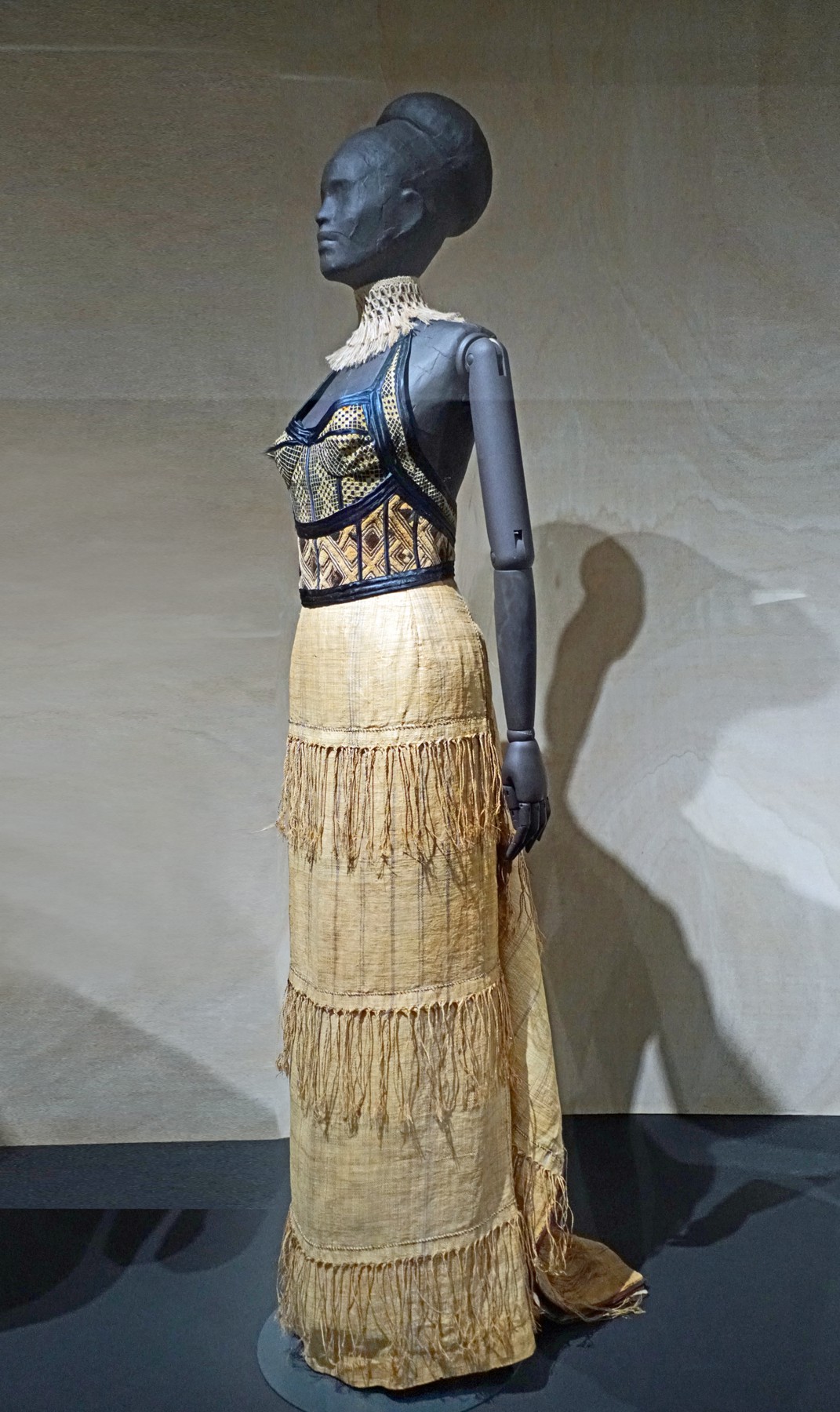
Alphadi history takes another material direction in a 1993 bustier and skirt. A bustier is a close-fitting torso garment. This ensemble uses Kuba cloth, a woven raffia fabric associated with central Africa, worked into a halterneck upper piece and a skirt in beige and black. Texture and thickness participate in the design alongside pattern.
The cut-pile surface of Kuba cloth is formed by drawing fibres through the ground and trimming them short. From a distance it reads as geometry; close up, it becomes raised texture. Concentrating that texture on the torso and extending it over a skirt changes its scale. The shared palette holds the ensemble together while different areas of the body alter how its surface is perceived.
Téra-Téra reshapes a black suit
Alphadi history also includes a 1993 jacket and skirt that set colourful Téra-Téra panels against black. Traditionally woven in Tera, Niger, the fabric has a history of covering brides at weddings. Orange, white, green and red enliven the tailored outline; a larger decorated area on the jacket back establishes a second focal point.
Black operates as visual space around the brighter Téra-Téra strips. A limited area of colour can have a strong effect when its placement is precise. Front, side and back offer different densities of decoration, making movement part of the reading. Unlike the metal dress, this suit changes through the position of inserted cloth within a familiar form.
Workshops and everyday clothes
Alphadi history rests on collaboration between weavers, sewing specialists, embroiderers, beadworkers and jewellers. Jewellery made with Nigerien artisans developed from accessories for looks into a separate line. A designer establishes the composition, but the material precision of an ensemble depends on several crafts. Metalwork and sewing meet directly where bodice and skirt join.
In 2005 he introduced sportswear including jeans and T-shirts for younger customers at more accessible prices. Separates meet a different rhythm of use from occasion dresses: they combine with an existing wardrobe rather than completing a single ceremonial image. This broadened the label’s situations of wear as well as its audience.
A travelling stage
Alphadi history includes FIMA as an expansion of where fashion can be shown. Founded in Niger’s Tiguidit desert in 1998, the International Festival of African Fashion brought designers and audiences together outside Europe’s established capitals. Landscape became part of the presentation, while emerging practitioners gained a meeting place.
The 2022 edition in Rabat demonstrated the platform’s mobility, bringing together shows and professional exchange. His designation as a UNESCO Artist for Peace in 2016 also recognised work across culture and dialogue. Maintaining such an event involves selecting venues and coordinating participants as well as presenting clothes; this organisational practice forms a substantial part of the career.
The caravan and the surviving clothes
Alphadi history, reviewed in October 2026, includes an officially documented peace caravan in Bamako in August 2025. An opening at Mali’s National Museum and a fashion show brought together practitioners from Mali, Niger, Burkina Faso and Côte d’Ivoire. UNESCO’s account shows presentation continuing as a setting for regional encounters and younger designers’ work.
Place the metal-and-cotton dress, the raffia ensemble and the 1993 suit together: one organises rigidity and softness, another texture, another the position of colour. Their materials determine structure and the sequence of looking. Following these differences offers a more precise understanding than treating a continent as a single pattern: distinct making practices become distinct languages of dress.
Timeline
- 1957 — Born in Timbuktu, Mali.
- 1980 — Tourism degree in Paris; administrative work in Niger.
- 1983 — First collection presented in Niger.
- 1988 — Metal-and-cotton dress.
- 1993 — Raffia ensemble and Téra-Téra suit.
- 1998 — Founds FIMA.
- 2025 — Peace caravan in Bamako.
Sources
- V&A: Magician of the desert: Alphadi
- NGV: Africa Fashion checklist (PDF)
- UNESCO Courier: direct interview with Alphadi, 2017
- UNESCO: culture is a lever for development, 2016 interview
- V&A: Cloth of a continent, Kuba
- UNESCO: Artist for Peace designation
- UCLGA: FIMA 2022 in Rabat
- UNESCO: Alphadi 2025 caravan in Mali