
How do we trace the beginnings of clothing?
The first thing we encounter when studying prehistoric clothing is often an absence, rather than an elaborate garment. Hides and plant materials decay easily, so complete examples rarely survive. Researchers therefore examine bone needles, awls and traces left on materials together. The starting point is to distinguish evidence from uncertainty, rather than project a familiar modern image of hide clothing onto the past. Finding an ancient tool does not establish that everyone in that period wore the same kind of garment.

Piercing and joining materials
A Late Palaeolithic awl found in Church Hole Cave, England, was made by shaping a hare's shinbone to a point. The British Museum describes it as a tool used to pierce animal skins for sewing. Making prehistoric clothing therefore involved more than simply draping a hide over the body. Distinguishing a tool that makes a hole from a bone needle that carries thread helps us understand the range of skills needed to make a garment. This is why small objects matter to the history of finished clothes.

Warmth and freedom of movement
Covering more of the body does not automatically make a garment better. To raise an arm, bend down or travel long distances, its material must accommodate movement. From this perspective, warmth and mobility are connected requirements of prehistoric clothing. Hide clothing could also feel different depending on how it wrapped around the body and where it fastened. These are questions about construction, not claims about the precise appearance of a particular artifact. They help explain why joining tools such as bone needles matter.

Processing matters as much as material
The expression hide clothing sounds simple, but turning an animal skin into something wearable is a separate task. It involves choices about thickness, joining pieces and retaining the parts needed. Studying prehistoric clothing means asking what resources people obtained and how they worked them, as well as imagining the finished shape. We should not treat different animal skins as interchangeable or assume they were processed like modern leather goods. The surviving tools set the limits within which we can reconstruct the making process.

What an artifact can and cannot tell us
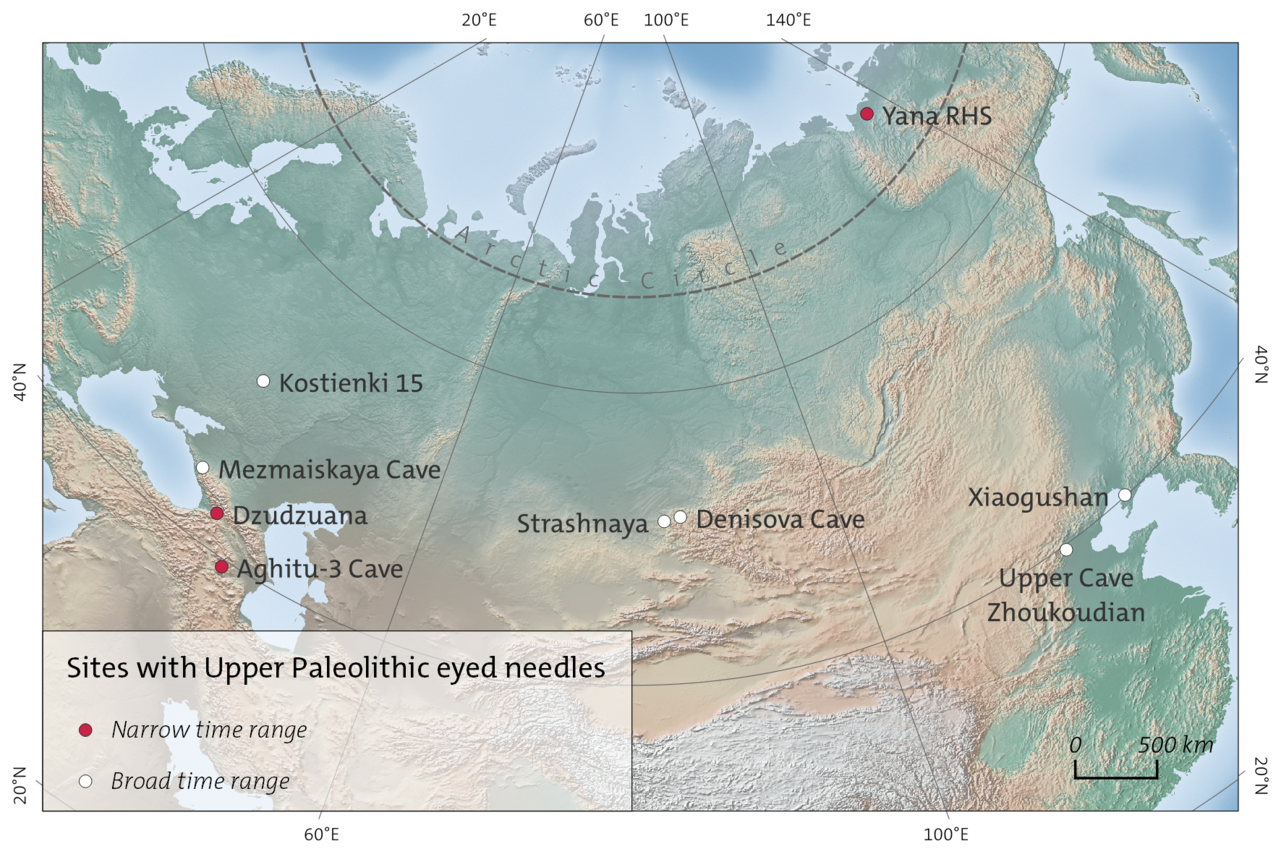
Examples with a surviving eye, such as a needle from Courbet Cave in France, offer evidence of how thread could pass through a tool. The length, point and opening of bone needles suggest functions distinct from simple ornament. They cannot, by themselves, reveal the color or length of prehistoric clothing, or the wearer's age. Start with an object's scale, findspot and museum description. When a reconstruction accompanies it, distinguishing the actual find from the researcher's interpretation makes the evidence much clearer.

Reading reconstructions
Museum reconstructions help us imagine the past, but they are not photographic records. When looking at an image of prehistoric clothing, ask which finds support it and how gaps in the evidence were filled. In particular, check whether the decoration, color and arrangement of hide clothing are directly documented. One familiar illustration should not stand for all humanity's dress. Similar-looking reconstructions from different regions or periods do not prove identical techniques or living conditions. Use the image as an interpretation to investigate, rather than a complete record.
Questions that continue into later dress history
The central question of prehistoric clothing is less who created fashion than how people protected their bodies and joined materials. Bone needles show that clothing history is also a history of tools and manual skill. Even as attention shifts from hide clothing to woven garments, questions about material, seams and movement remain useful. Examine what kind of evidence survives before relying on a famous image. When enlarging a tool photograph, first distinguish a point from an eye: objects made from the same bone can serve different purposes. Check the scale and actual size, and record the museum's identification alongside your own observations to avoid remembering a guess as a fact.