Moynat history: from travelling trunks to curved bags
Founded by Pauline Moynat in Paris in 1849, Moynat translates travel-goods construction into bags and patterned canvas.
ÉPOPLI ·
- Brand
- Moynat
- Origins
- Paris, France
- Focus
- Trunks and leather goods
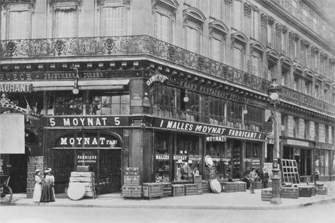
Beginning with travel goods
The way a traveller protects luggage differs from carrying a shoulder bag. That distinction provides a beginning for Moynat history. Official material identifies Pauline Moynat’s Paris trunk business in 1849; it does not imply that all present handbags existed then. Trunk construction responded to transport space and the protection of contents. Shapes and materials developed around those circumstances and later became references for new products. A record based only on the age of a name loses those original problems. The archive is more useful as a collection of decisions about scale, curves and closures that later designers can reconsider for another relationship with the body.
The problem of protective canvas
The English Trunk dated 1873 supplies a material case within Moynat history. The house describes canvas coated with gutta-percha, a plant-derived substance used here for protection. That historical specification should not be generalized to every product sold today. Trunk construction required responses to moisture and abrasion as well as the organization of the interior. A rigid shape alone could not solve every requirement, making surfaces and junctions significant. It is more precise to retain the documented date and material than repeat an unlimited promotional claim to being first. The experiment becomes legible through conditions of travel rather than the modern category of luxury.
Rapin’s letter becomes a pattern
The repeated letter M introduces a second object into Moynat history. Official craft material dates Henri Rapin’s monogram to 1920, while the M Collection describes its later reuse. An initial becomes a surface rhythm when repeated. The amount visible on a large tote differs from that on a small wallet, and leather handles or edges interrupt the pattern. An M monogram is therefore more than a name enlarged into a logo: colour, scale and material boundaries participate in the result. Rapin’s design and the shape of a current bag belong to different periods. The origin of a pattern should not be confused with the introduction of each object carrying it.
Gabrielle’s curve and clasp
Gabrielle supplies a third case within Moynat history. The official description links its lines to a vintage Limousine trunk and identifies an M-shaped clasp and detachable strap. Calling it merely a reduced copy would ignore its new use. A hand-carried or shoulder-worn bag distributes weight and allows access differently from luggage placed on a vehicle. The clasp both decorates and organizes a hand movement; curves connect the visible planes. What matters is not only that a historical reference exists, but which parts have been retained and which transformed. Inheritance can involve new decisions about scale and the body rather than exact preservation.
Making images by joining material
The use of leather marquetry brings Moynat history to the making of a surface. Marquetry joins separate pieces into an image or pattern. The house’s craft account describes arrangements intended to read as one continuous plane, alongside edge finishing and hand-painted personalization. A printed M monogram and a joined leather image may look related while being produced differently. In leather marquetry, thickness and boundaries affect the balance of the whole; a small discrepancy can become a visible line. Looking for joins and the direction in which an object bends makes the technique more understandable than accepting a generalized claim that a bag is a work of art.
Is a small bag a small trunk?
Contemporary product variety adds another distinction to Moynat history. The M Collection includes totes, duffles and bucket forms alongside rigid small cases. The same M monogram does not give them identical structures. A bag whose shape responds to its contents faces different requirements from an empty case retaining its outline. Gabrielle’s curve and strap also belong to a particular use. A trunk-making name cannot explain every function automatically. Handle length, opening width and base area reveal different imagined movements. Recording those differences produces an archive of design choices rather than a single attractive image standing in for the whole business.
Distinguishing inheritance and reinterpretation
Finally, Moynat history should keep Pauline’s founding role, Rapin’s pattern and later bag designs in their respective periods. Collapsing them into one person’s continuous creation hides collaboration and reinterpretation. A useful sequence of observation moves from outline to repeated surface to the action of a closure. Close-up techniques and immediately recognizable patterns communicate identity in different ways. Some features change use while others preserve a visual memory. Distinguishing those functions replaces vague language about tradition and modernity with specific decisions. The story of travel is not simply reproduced in a present bag; it is edited through new relationships between material and the body.
Timeline
- 1849 — Pauline Moynat’s trunk business.
- 1873 — English Trunk in the official account.
- 1920 — Rapin’s M pattern.
Questions and answers
Did Moynat begin with handbags?
The official account starts with a trunk business in 1849.
What does Gabrielle reference?
Its official description identifies the lines of a vintage Limousine trunk.
Is marquetry the same as printing?
No. It joins pieces of material to form an image or pattern.