Manolo Blahnik history: buckles, straps and proportion
Manolo Blahnik grew in London, connecting drawing with shoemaking to develop both embellished footwear and restrained pumps.
ÉPOPLI ·
- Brand
- Manolo Blahnik
- Origins
- London, United Kingdom
- Focus
- Footwear
From drawing to footwear
Manolo Blahnik history begins where a London shoe business meets a culture of fashion collaboration. The current official chronology dates the namesake label to 1970. It also records the founder’s interest in theatre design, his encounter with Diana Vreeland and visits to English and Italian makers. Reducing this development to a single encouraging conversation would overlook the learning that followed. A striking drawing and a shoe that supports weight solve different problems. A curve on paper must become an upper, a heel and a sole. Early sketches and completed shoes consequently provide different kinds of evidence about the passage from imagination to production.
A drawn line and a real foot
Craft is not the opposite of decoration within Manolo Blahnik history. The official archive presents workshop processes alongside finished footwear. A last is the three-dimensional foot-shaped form around which an upper is shaped; it helps translate a drawn line into volume. A visually elongated toe is also distinct from the space occupied by actual toes. Heel position affects both profile and support. Thinking through these conditions makes clear why an embellished shoe still needs a balanced underlying form. Equally, an undecorated shoe exposes small differences in line and material. Cutting, shaping and finishing describe separate decisions that the general term “handmade” can otherwise obscure.
Campari’s single strap
Campari, introduced in 1994, interprets the Mary Jane through a pointed toe and a strap across the instep. It shows a restrained direction within Manolo Blahnik history. In a Vogue interview, the founder described the design as a move away from his preceding ornate work. Campari’s horizontal strap interrupts and balances the longer line towards the toe. On glossy black leather, the boundary against skin becomes especially clear. Its significance therefore extends beyond subsequent screen recognition. One added strip can establish a recognizable composition without a dense accumulation of ornament, illustrating the difference between a decisive detail and a heavily decorated surface.
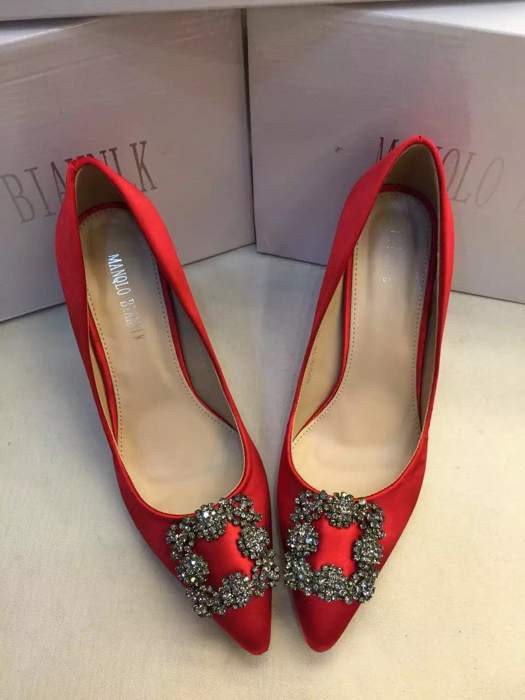
Where Hangisi gathers light
Hangisi entered the Spring/Summer 2008 collection and became widely associated with Manolo Blahnik history. The official account identifies references to European court footwear and cinematic costume; the modern shoe should not be mistaken for a surviving historical court shoe. Its jeweled buckle concentrates light within a small area while satin gives a broader, softer reflection. Hangisi changes as those reflective surfaces move. Although a blue version became particularly recognizable on screen, the family cannot be reduced to one colour. Different materials and heel heights show how the same focal detail behaves within altered proportions, separating cultural familiarity from the construction of an individual version.
The undecorated BB
The official archive dates BB to 2009 and identifies its tribute to Brigitte Bardot. Within Manolo Blahnik history, BB provides an example without a prominent strap or buckle. Opening, pointed toe and heel become the main visual relationships. A light-absorbing suede and a reflective smooth material can make the same outline appear different, so material changes are more than additions to a colour chart. A narrow-looking frontal view should also be considered alongside the volume visible from the side. The actor’s name supplies context, not a requirement that every wearer reproduce a single image or ideal.
A detail across different forms
A recognizable detail can migrate between categories within Manolo Blahnik history. The official account describes Hangisi developing into flats, mules, bags and belts as well as pumps. Changing the surrounding area changes the buckle’s role: a detail above a moving foot occupies a different position from one at the waist or on a handheld bag. Comparison with Campari’s strap and BB’s outline reveals several methods of identification within the same label. Not every product depends on the same ornament. Lines, surfaces and small components can develop separately, and those distinctions should remain visible when different generations of designs are presented together.
Between a shoe and an image
Reading Manolo Blahnik history requires moving between cultural images and actual objects. Film and magazines make colours and decorations memorable, but do not fully communicate an opening’s depth or a heel’s placement. Specifications alone, conversely, cannot explain the scenes through which a shoe became familiar. The reflective front of Hangisi, the boundary made by a strap and an unadorned pump’s curve bring these readings together. Lower heels and different settings also change the role of a familiar detail. Looking at front, side and worn views offers a way to follow an idea from drawing into the practical and visual experience of getting dressed.
Timeline
- 1970 — Current official chronology dates the London label to 1970.
- 1994 — Campari introduced.
- 2008 — Hangisi appears in Spring/Summer.
- 2009 — BB launched.
Questions and answers
Is Hangisi only one colour?
No. The design began in Spring/Summer 2008 and expanded into many materials, colours and heel heights.
What does BB refer to?
The official archive identifies a tribute to Brigitte Bardot.
What distinguishes Campari?
It combines a pointed pump with a Mary Jane strap across the instep.