Goyard history: travel written in trunks and pattern
Goyard took its name under François Goyard in 1853, developing trunk construction and personalized markings in Paris.
ÉPOPLI ·
- Brand
- Goyard
- Origins
- Paris, France
- Focus
- Trunks and leather goods
The change of name in 1853
Goyard history is easier to understand when the business preceding the 1853 name is included. The official account describes the Martin and Morel lineage before François Goyard continued the enterprise under his own name. This was a transfer of established packing and travel-goods knowledge rather than the invention of an occupation from nothing. Edmond later expanded the business and its visibility. Trunk making depends on how objects move, by what transport and over what distance. Names and dates alone remove that context. Separating successive owners from the workshop practice turns longevity into a concrete question of continuity rather than a vague claim to authority.
Building a rigid container
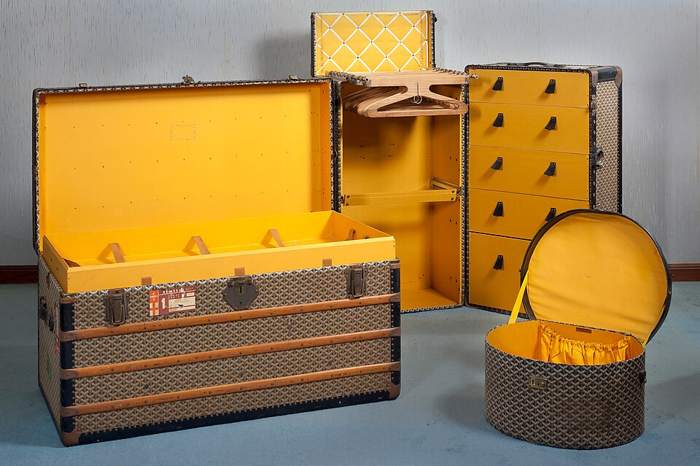
A rigid trunk provides the first object in Goyard history. Canvas, leather edging and metal fittings work with the internal structure to support contents. Trunk making cannot therefore be reduced to a printed surface. Corners receive impact, the lid junction repeatedly opens and closes, and handles transfer weight. Different forces call for different material and assembly decisions. The house’s workshop account describes numbering trunks and adding the maker’s initials. This links an object to its making rather than treating it as an anonymous container. Present-day descriptions should nevertheless not be projected indiscriminately onto every historical example without checking its date.
Dots and branching lines
Dots forming repeated Y-like branches give another visible entry into Goyard history. The official chronology dates Edmond’s Goyardine to 1892 and connects its pattern to the family’s timber-transport background. That is the house’s explanation of its own symbol. As a surface, the arrangement reads differently close up and at a distance: individual marks become an apparently dimensional branching rhythm. A large trunk and a smaller object expose different amounts of that repetition. Goyardine canvas should also be distinguished from leather components. Once a familiar pattern has been recognized, attention can return to which materials occupy which parts and what those parts do.
Marking an individual object
Personal initials and coloured stripes form a third subject in Goyard history. Marquage means adding identifying marks to an object. When luggage travelled alongside other people’s belongings, such signs could serve a practical purpose; they also provide a language of personal expression. The official service describes hand-applied decoration. A stripe placed over an existing pattern establishes another visual axis, so the operation involves relationships between letters, lines and the underlying rhythm. It is not simply filling an empty space with a name. Availability and scope should be checked for the particular object rather than assuming that every item can be altered in the same way.
Travel translated to a small bag
Smaller bags change the scale of travel in Goyard history. The official Alpin Mini description presents a compact interpretation of a backpack drawing on traditional mountaineering bags. Detachable, adjustable straps and hooks permit different ways of carrying it. This does not literally repeat the structure of a trunk. Instead, the question of transporting belongings continues at another scale. Marquage identifies an individual object while straps change how that object meets the body. Shrinking dimensions and redesigning use are distinct operations. Looking at load-bearing points and the opening helps reveal the choices made even within a relatively small format.
One pattern, different structures
A shared pattern does not mean a shared structure. Goyard history viewed only through a tote image would lose the difference between a rigid container and a flexible bag. An object holding its empty shape faces different requirements from one responding to its contents. Personal decoration may occur on both while their surfaces move differently. Compare side folds, base construction and handle placement. Recognition supplies a relationship between products but cannot explain function by itself. A brand’s continuity need not mean that everything is made alike; it can mean maintaining legible connections among objects answering substantially different requirements.
Making the idea of travel specific
To read Goyard history today, translate travel into actions: packing, closing, lifting and recognizing belongings among other luggage. Structure, handles, pattern and individual markings each address different parts of that sequence. François and Edmond’s periods, later small bags and present services should remain distinct moments. The useful question is not only whether an old name survives, but which problems have continued to be addressed under it. The house then becomes more than a collection of recognizable motifs. Its record concerns knowledge of travel objects moving into daily carrying, with continuing adjustments in material, scale and identification.
Timeline
- 1853 — Business continues under the Goyard name.
- 1885 — Edmond takes over.
- 1892 — Goyardine introduced in the official chronology.
Questions and answers
Was there a business before Goyard?
The official history includes the earlier Martin and Morel enterprises.
Is Goyardine the same as leather?
Patterned canvas should be distinguished from leather components.
What is marquage?
It is the application of individual markings such as initials or stripes.