Delvaux history: the leather structures of its bags
Delvaux began as a Brussels travel-goods workshop in 1829 and developed a documented vocabulary of handbag forms.
ÉPOPLI ·
- Brand
- Delvaux
- Origins
- Brussels, Belgium
- Focus
- Leather goods and handbags
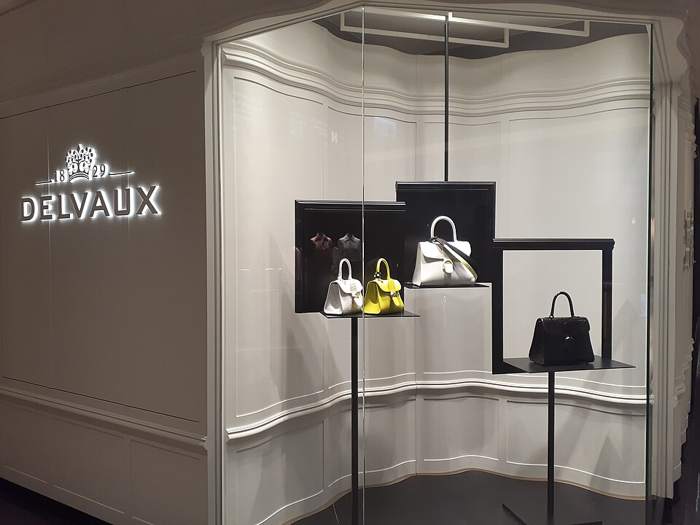
A workshop before Belgian independence
Putting a workshop beside national history makes its location more than decoration. Delvaux history begins with Charles Delvaux opening a Brussels travel-goods workshop in 1829, a year before Belgian independence. This does not mean that all present handbags existed then. The movement from luggage towards objects carried close to the body belongs to later developments. Age alone explains neither shape nor use. Questions about opening, carrying and contents remain necessary. Considering Brussels alongside workshop knowledge also preserves a particular story rather than folding every European leather house into a generalized account centred on France or Italy.
Keeping a record of bags
The Livre d’Or, recording designs from 1908, makes Delvaux history a genealogy of objects. The official account describes thousands of entries. The useful point is not the size of that number but the existence of a system for comparing forms. Leather construction can differ through folds, closures and handle positions even when outlines look similar. Sketches and records make these choices traceable. The house associates rights relating to the Princesse in 1908 with a narrative of handbag invention. That should not be expanded into a claim that every kind of bag first appeared then. Documented events and broad claims to priority need different treatment.
Brillant’s curve and buckle
Brillant provides a first specific object in Delvaux history. Introduced in 1958, the year of the Brussels World Expo, it brings a rounded flap, D-shaped buckle and dimensional sides together. The official description connects it to the Philips Pavilion. This is best read as a design reference, not a claim that building and bag have the same structure. The Brillant buckle is both an identifying sign and an emphasis on fastening. From the side, the relationship between internal volume and handle becomes clearer. Bag design includes access and contents as well as frontal decoration, so several views are needed to understand its combination of curves and firmness.
Opening the sides of Tempête
Tempête, dated 1967 in the house’s model chronology, extends Delvaux history through different lines. A broader horizontal impression and distinctive sides create another balance. The official account emphasizes two gussets: folded sections that open to provide space. Tempête makes clear why a front photograph cannot fully explain depth. As the sides open or fold, volume changes, while metal components make the relevant positions visible. Architectural comparisons can be useful, but this remains a flexible object handled by a person. Open and closed views, empty and filled states, show how space and decorative emphasis interact.
Pin and different bag bodies
Pin appears in the official emblematic-model list with the date 1972. Within Delvaux history it helps demonstrate that the house does not endlessly repeat one angular body. A model’s origin should be distinguished from details of later versions. Leather construction changes through thickness, softness and the relationship between base and opening. Where a firm bag proposes its own outline, a more yielding one may reveal movement and the weight of contents. Neither condition is inherently superior. Comparing this family with other models is useful for understanding different relationships between space and the body, rather than arranging them into a prestige ranking.
What Brillant Tempo changes
The official presentation of Brillant Tempo makes inheritance and change visible in Delvaux history. Recognizable features remain while softer materials and altered carrying possibilities modify the result. This is a later reinterpretation, not an object made at the same time as the 1958 reference. A familiar buckle does not guarantee an identical behaviour of the bag around it. Before judging the new design, record what remains and what changes: the opening, the folding sides and the way weight is carried. Such differences supply the substance of an archive, instead of allowing one model name to conceal several distinct objects.
Reading a long-lived model
Finally, Delvaux history separates Charles Delvaux’s workshop from models developed much later. The founder cannot be made the direct designer of bags introduced in 1958 or 1967. Records, workshops and later makers provide continuity. A viewer can move from a recognizable fastening to side folds, base width and the height at which handles place the bag against the body. A museum and a design register matter because they preserve differences as well as names. A long-lived model is not an object outside time: it is a form interpreted through successive versions and users, connecting a place with concrete decisions about making.
Timeline
- 1829 — Workshop established in Brussels.
- 1908 — Designs recorded in the Livre d’Or.
- 1958 — Brillant introduced.
- 1967 — Tempête introduced.
- 1972 — Pin introduced.
Questions and answers
Where did Delvaux begin?
Charles Delvaux opened a travel-goods workshop in Brussels in 1829.
Are Brillant and Tempête one model?
No. They are dated 1958 and 1967 and have different forms.
Is Tempo identical to the original?
It reinterprets recognizable features through altered materials and carrying possibilities.