Brunello Cucinelli history: Colour and surface
Brunello Cucinelli began with coloured women’s knitwear in 1978 and expanded into a complete clothing offer.
ÉPOPLI ·
- Brand
- Brunello Cucinelli
- Origins
- Umbria, Italy
- Focus
- Knitwear and ready-to-wear
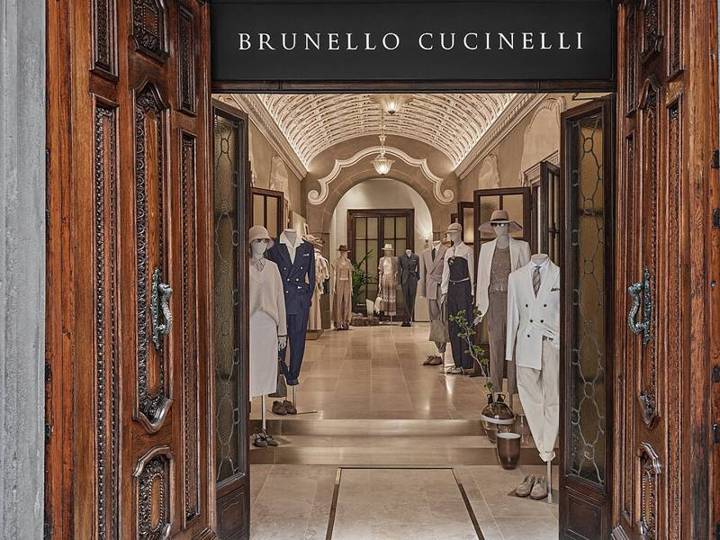
Colour changing a material’s character
Brunello Cucinelli history begins with coloured women’s cashmere knitwear in 1978. This need not become a claim that the company invented dyeing the fibre. The more useful question is how an established material acquired a different place in a wardrobe. Colour can make the same knitted structure appear lighter or heavier and alter its relationship with skin. Interlocking loops, fine surface fibres and small shadows prevent colour from behaving like paint on a flat sheet. Reading cashmere knitwear therefore involves an actual surface, not simply a shade name. Material character and visual character develop together.
Placing a region within the business
Solomeo plays more than an address’s role in Brunello Cucinelli history. Corporate records connect the village with family life and the purchase of a castle in 1985 that served as headquarters. Yet a place’s image is not identical to every step of production. The village helps the company describe itself, while garments require several skills and workshops. Both aspects deserve attention. A stone building and a garment may seem to share a palette without proving an undocumented intention. Solomeo is best approached as a way to ask how place, representation and the practical organisation of work relate.
Positioning a small point of light
A sweater with monili offers a precise surface study within Brunello Cucinelli history. The documented design retains a crew neck and regular body and sleeve proportions, placing a sparkling detail at the back of the neck. Information changes as the wearer turns. Knitwear disperses light softly, while the small embellishment reflects it more distinctly. Here monili does not replace the garment’s construction; it briefly directs attention across an already organised shape. Its limited size does not make it irrelevant. Location, surrounding empty space and the movement of neck and shoulders are essential to understanding the effect.
A leather jacket with its lining removed
An unlined suede jacket expands Brunello Cucinelli history beyond sweaters. The documented short model has a stand collar and zip fastening. Suede’s fine surface nap changes the way light reveals colour, unlike a smooth leather face. Lightness here concerns construction as well as visual impression. Removing a lining makes the treatment of the reverse surface more significant and allows the leather’s movement to become apparent. Fastening and hem organise that fluidity at particular points. This example challenges the assumption that every leather jacket must be rigid or heavy, without making its specification a rule for the entire range.
From a knitted piece to a complete outfit
Corporate records identify the mid-1990s expansion into a total look and menswear as a turning point. In Brunello Cucinelli history, this means more than a larger assortment. Design could organise the jacket above a sweater and the trousers below it. Choosing one colour differs from balancing several garments. Similar shades need texture to establish boundaries; different thicknesses divide the figure. Generous shapes can look composed or loose depending on length and sleeve position. Product details and complete outfit photographs therefore answer different questions. Together they show how an early material vocabulary operates within a more complex wardrobe.
Workshops connected through different skills
Production in Brunello Cucinelli history is associated with a village image but is not confined to it. The official workshop account distinguishes Umbrian knitwear from tailoring sites in Penne and Carrara. Managing knitted loops and constructing a jacket shoulder are different skills. A complete outfit requires their differences to remain useful while colour and proportion become coordinated. The founder’s human-centred business philosophy should be identified as the company’s stated vision. Looking at identifiable processes gives craftsmanship a more concrete meaning: a jacket line and a sweater’s elasticity arise through different work yet operate together on the wearer.
Reading the distance between matte and shine
Today, Brunello Cucinelli history can be read by distinguishing surfaces that initially seem similar. Early coloured sweaters, an embellished top and an unlined jacket organise material in different ways: depth of colour, contrast in reflection and flexibility in movement. Calling them all comfortable luxury would obscure these decisions. Examine backs and interiors as well as fronts, and notice folds when the arm moves. Regional imagery and company philosophy provide context, but the object remains the basis for observation. Small differences in colour, surface and internal construction explain how a complete impression is made.
Timeline
- 1978 — Coloured women’s knitwear begins
- 1985 — Village castle acquired
- 1990s — Total look and menswear expand
- 2012 — Milan stock exchange listing
Questions and answers
What was the starting product?
The business began with coloured women’s cashmere clothing in 1978.
Where is the embellishment placed?
The sweater examined here places a sparkling detail behind the neck; placement varies by model.
Does all production happen in one place?
Official documentation identifies several Italian sites for knitwear and tailoring.