Berluti history: colour moving from shoes into clothes
Berluti connects the form and colour of shoes with a later expansion into leather goods and menswear.
ÉPOPLI ·
- Brand
- Berluti
- Origins
- Paris, France, with Italian making traditions
- Focus
- Footwear, leather goods and menswear
Reading different origin accounts
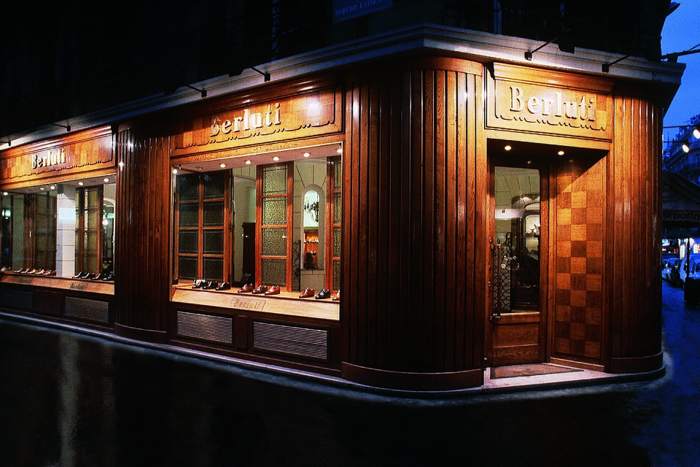
Berluti history benefits from comparing official origin accounts. Comité Colbert and LVMH connect the house’s beginning to Alessandro Berluti and 1895. The current creative-heritage page instead emphasizes his son Torello’s Paris shop in 1929 and the influence of his father. These descriptions should not be silently combined into a detailed chronology that none supplies. A house’s chosen origin date and the contributions of particular family members are related but different matters. The shared emphasis on shoemaking and patina is clear; attribution of every emblematic object to one founder is not. Acknowledging the distinction makes the record more verifiable.
The Alessandro’s broad surface
The Alessandro lace-up offers the first object lesson in Berluti history. Its broad leather surface reduces the interruption of visible seams, bringing the volume over the foot into focus. In an Alessandro shoe, the absence of ornament leaves toe length, height, instep slope and reflected light to communicate the form. A visually simple exterior does not imply simple manufacture: material still has to be shaped around a last and balanced. Since official narratives differ in their allocation of early individual contributions, observation of the form should remain distinct from claims about its first maker. Versions sharing a model name also need not be identical across decades.
The different attitude of the Andy
The Andy loafer provides a second route into Berluti history. Comité Colbert links a commission from Andy Warhol in 1962 to Olga Berluti. Without laces, the opening and the means of holding the foot acquire particular importance. Its low opening and extended outline create a different relationship from a lace-up’s central line. The Andy loafer is therefore not explained solely by the fame of its customer. That association supplies a cultural context, while the relation of opening to toe explains the visual effect. Reading client and maker together reveals a process of interpretation rather than a list of celebrities attached to products.
Depth through patina
Colour is central to Berluti history through patina. Here the term concerns a finish creating layers and variations of tone on leather. This deliberate effect should be distinguished from traces produced naturally through prolonged wear. Official accounts describe contributions from Talbinio and Olga, emphasizing Olga’s development of colour as expression. Darker and lighter areas change how a curved surface is perceived. The broad expanse of an Alessandro shoe makes such differences particularly visible. Colour is thus part of reading form rather than merely a selectable option. Lighting and screens also affect photographs, which should not be treated as absolute measures of subtle shades.
Leather translated into bags
Bags introduce a third object into Berluti history. LVMH dates expansion into leather goods to 2005 and presents the Deux Jours among its representative objects. Moving from the compact curvature of footwear to a bag’s larger surfaces gives finishing another role. A bag carries weight, and its handles, opening and folding sides determine its use. Patina can articulate those broad planes without making the structure equivalent to a shoe. Handle position and the width of an opening are useful observations alongside colour. Material language continues while function changes, offering a concrete way to distinguish a developed product vocabulary from the mere repetition of a name.
Shoemaking language in clothes
Menswear adds another chapter to Berluti history through Alessandro Sartori’s commission in 2011. Haider Ackermann and Kris Van Assche subsequently explored colour, material and cutting in their respective periods. Their garments should not be attributed to the founder. The heritage account’s important proposition is that footwear can become a starting point for the overall silhouette, rather than its last addition. A loafer, leather jacket and trouser width can be considered as a relationship. Translating shoemaking finishes or stitching into garments requires adjustment to a new scale and purpose. That transformation belongs to later designers and their collaborators, rather than being an unchanged inheritance.
A record of several generations
Reading Berluti history today means comparing footwear, bags and clothing at different distances. Outline and close-up colour variation reveal more than a generic image of a brown shoe. Alessandro, Torello, Talbinio, Olga and subsequent clothing designers contributed at different times; lastmakers, cutters, stitchers and finishers also form part of the account. Keeping unresolved details visible while examining documented objects is particularly important for a long-established house. The result is not simply a sequence of names and dates. It is a way to understand what remains and what changes when expertise moves between generations, materials and types of object.
Timeline
- 1895 — Brand origin in institutional accounts.
- 1962 — Andy Warhol commission in the official record.
- 2005 — Expansion into leather goods.
- 2011 — Sartori commissioned to develop menswear.
Questions and answers
Does Berluti only make shoes?
It expanded into leather goods and menswear.
Does patina simply mean wear?
In the house’s design vocabulary it also describes a deliberately developed leather finish.
Do all origin accounts match?
No. The stated 1895 origin and the later account of Torello’s shop require careful distinction.